
From Experiment to Evidence
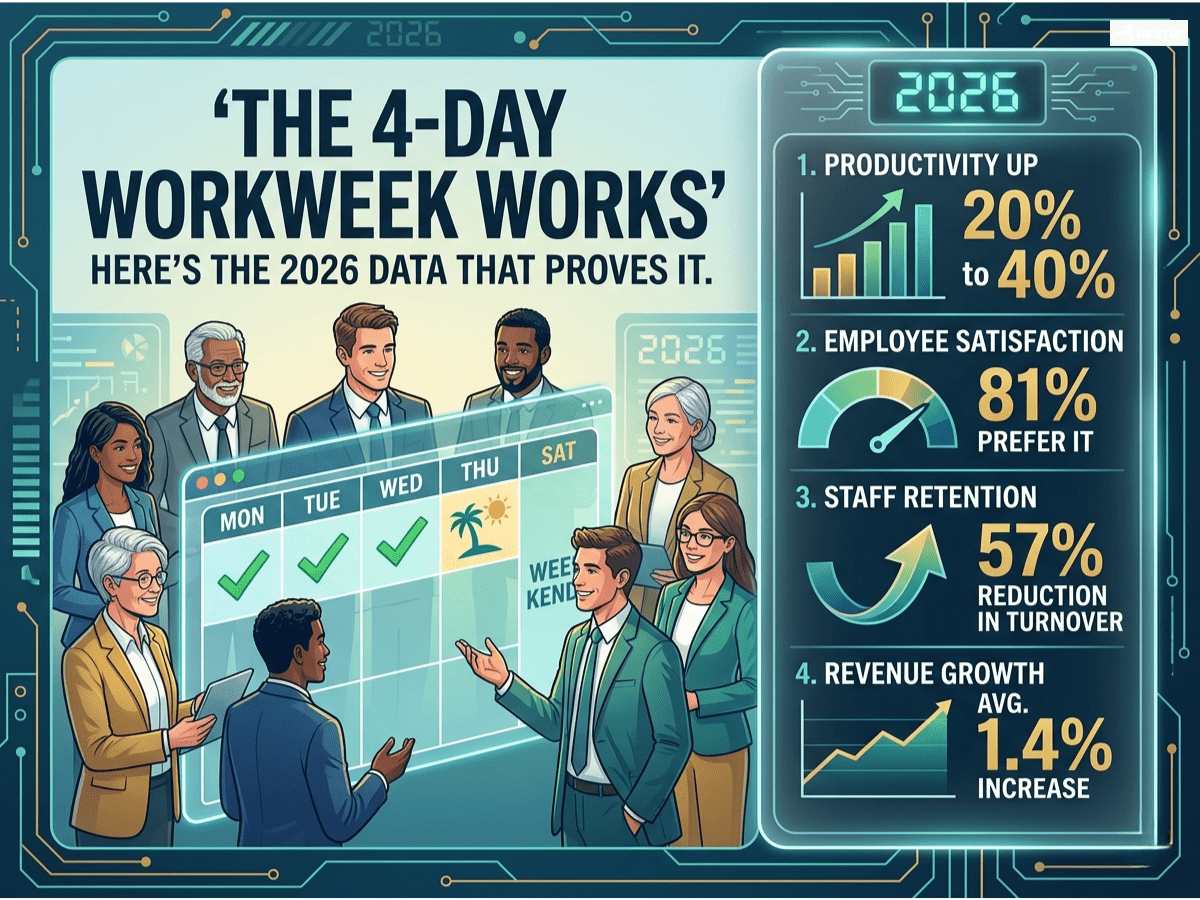
What began as a bold workplace experiment has, by 2026, turned into a data-backed shift in how organizations think about time and productivity. Large-scale trials across multiple countries have consistently shown that reducing the workweek from five days to four does not necessarily reduce output. In many cases, it improves it.
The most widely cited global studies tracked thousands of employees across hundreds of companies and found a consistent pattern: performance remained stable or increased, while employee well-being improved significantly. This has reframed the conversation. The question is no longer whether a four-day workweek can function, but how it can be implemented effectively across different industries.
Rethinking Productivity in Fewer Hours
One of the most surprising outcomes from these studies is how productivity behaves when time is reduced. Conventional wisdom suggests fewer hours should mean less output. In practice, the opposite often occurs.
When companies adopt a four-day workweek, they are forced to rethink how time is used. Meetings become shorter or are eliminated entirely. Communication becomes more direct. Employees focus more on high-impact tasks rather than filling time. The result is a shift from time-based work to outcome-based work.
This change in behavior is the real driver of productivity gains. It’s not that people suddenly work harder—it’s that they work more intentionally. The structure of the shorter week removes inefficiencies that often go unnoticed in a traditional five-day schedule.
The Human Factor: Retention, Burnout, and Well-Being
While productivity is the headline metric, the deeper impact of a four-day workweek is on people. Across multiple studies, employees reported lower stress levels, better sleep, and improved overall well-being.
Burnout, which has become a defining issue of modern work culture, drops significantly under reduced schedules. Employees feel more in control of their time and less mentally drained. This translates into higher engagement and better performance during working hours.
Retention is another major factor. Companies that adopt a four-day workweek often see lower turnover rates. Employees are less likely to leave roles that offer better work-life balance, which reduces hiring costs and preserves institutional knowledge.
Why Companies Are Quietly Adopting It
Despite the strong data, many companies are not loudly advertising their shift to a four-day model. Instead, adoption is happening more quietly through pilots, flexible schedules, and hybrid approaches.
One reason is caution. Organizations want to test the model before fully committing. Another is cultural inertia. The five-day workweek is deeply embedded in business norms, and changing it requires not just operational adjustments but a mindset shift.
Still, the trend is clear. A growing number of companies are experimenting with reduced schedules, and a large percentage choose to continue after initial trials. This suggests that once the model is tested internally, its benefits become difficult to ignore.
Where It Works—and Where It Struggles
The success of a four-day workweek depends heavily on the nature of the work. It tends to perform best in knowledge-based roles where output is not tied to physical presence. In industries like technology, marketing, and consulting, employees can restructure their workflows without disrupting service delivery.
However, the model is more complex in sectors that require continuous coverage, such as healthcare, retail, and manufacturing. In these environments, reducing hours often requires shift-based systems rather than a simple reduction in working days.
Even within suitable industries, implementation matters. Some companies compress five days of work into four longer days, which can increase stress and undermine the benefits. The most successful models focus on reducing total hours, not just rearranging them.
The Economics Behind the Shift
From a business perspective, the four-day workweek is not just about employee satisfaction—it’s also about efficiency and cost management. Companies often see reductions in absenteeism and sick leave, which improves overall productivity.
Operational costs can also decrease. Offices consume less energy, and fewer workdays can reduce overhead expenses. At the same time, companies become more attractive to potential hires, giving them an edge in competitive labor markets.
Perhaps most importantly, the model aligns incentives more effectively. When employees are evaluated based on output rather than hours, organizations naturally move toward more efficient ways of working.
Why It Actually Works
The underlying mechanism behind the four-day workweek is not complicated. It is rooted in constraints. When time is limited, people are forced to prioritize.
This leads to a natural filtering process. Low-value tasks are eliminated, unnecessary meetings are reduced, and attention shifts to work that truly matters. Over time, this creates a culture of efficiency that sustains itself.
It also reflects a broader shift in how work is defined. The traditional model measures effort in hours, while the emerging model measures results. The four-day workweek accelerates this transition by making time a scarce resource.
How to Make the Case Internally
For individuals interested in bringing this model to their workplace, the approach matters. Framing it as a productivity and efficiency improvement is far more effective than presenting it as a lifestyle benefit.
Organizations respond to data and outcomes. Proposing a structured pilot, with clear metrics for success, reduces perceived risk. Demonstrating how workflows can be streamlined and how performance will be measured helps build credibility.
Starting small—within a team or department—can also make the transition more manageable. Once results are visible, scaling becomes easier.
The Limits of Adoption
Despite the growing evidence, the four-day workweek is not universally accepted. Resistance often comes from leadership concerns about productivity, customer expectations, and operational complexity.
There is also a cultural barrier. Many organizations still equate long hours with commitment and productivity, even when data suggests otherwise. Changing this mindset takes time and leadership buy-in.
Additionally, not all roles can be easily adapted. Some industries will require hybrid models or entirely different approaches to achieve similar benefits.
Final Thoughts: A Shift That’s Hard to Reverse
The four-day workweek is no longer an abstract idea. It is a tested, data-backed model that is gradually reshaping how work is structured. The evidence from 2026 is increasingly consistent: companies can maintain or even improve performance while giving employees more time.
What makes this shift significant is not just the reduction in hours, but the redefinition of productivity itself. Work is becoming less about time spent and more about value created.
As more organizations experiment and share results, the five-day workweek may start to feel less like a standard and more like a legacy system—one that persists not because it is optimal, but because it is familiar.