
Presenting a complex project can feel like walking a tightrope. The pressure is on to appear flawless, to showcase a perfect solution, and to have a ready answer for every question. But what if the path to an exceptional presentation isn't about perfection, but about embracing transparency and rigor in surprising ways?
After analyzing the final evaluation criteria for an advanced Claude capstone course, several principles for success emerged that challenge conventional wisdom. These aren't just tips for AI projects; they are powerful strategies for anyone demonstrating complex technical or creative work.
This article breaks down the four most impactful takeaways that can transform how you prepare for and deliver your next project presentation.

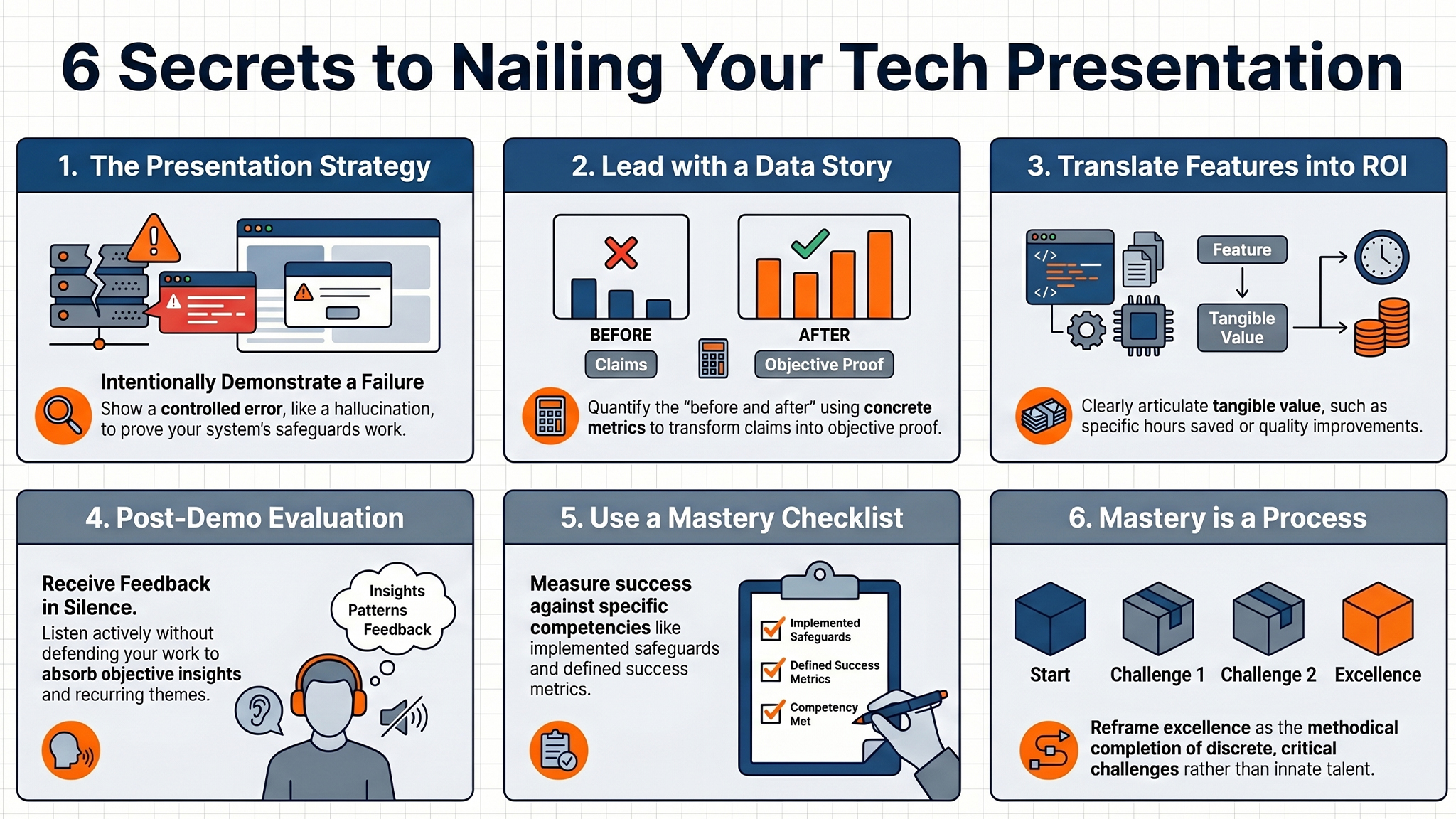
1. The Power Move: Intentionally Demonstrate a Failure
The common instinct during a live demo is to hide every flaw and pray that no edge cases emerge. The opposite is the mark of a true professional: deliberately plan to show a failure. This surprising strategy is a powerful way to build credibility and showcase the true robustness of your work.
Demonstrating a controlled failure proves you've done more than just build a happy-path solution; it shows you have the foresight to anticipate problems and the skill to build in safeguards. Don't just show a generic error. Demonstrate an input designed to elicit a hallucination and show how your confidence scoring or refusal handling mechanism catches it. This provides concrete proof of your system's integrity, building immense trust with your audience by proving you’ve engineered a resilient system.
Be prepared to show a failure case and how your quality checks handle it.
This approach reframes failure from a weakness to be hidden into a powerful demonstration of comprehensive design and thoughtful risk management.
2. Your Story Must Be a Data Story
A successful project presentation doesn't just show that a solution works; it proves that the solution delivers measurable value. This is the fundamental difference between an academic exercise and a business-ready solution. To make your case, you must frame your project's narrative around data, creating a clear "before and after" picture supported by hard numbers.
You must establish a baseline at the very beginning. In your problem statement, quantify the initial pain point with a concrete metric, such as, "This task currently takes 4 hours per week." Then, in your results section, circle back to that initial metric and present the actual outcome. By showing tangible results—like time saved, an improved accuracy rate, or reduced costs—you transform a subjective claim like "it's better now" into an objective proof of value. Metrics are the language of stakeholders, funding, and real-world impact.
3. Learn to Receive Feedback in Silence
When someone critiques work you've poured hours into, the natural reaction is to become defensive and immediately explain your choices. The most effective technique is to do the opposite: receive the initial round of feedback in complete silence.
This means you must listen actively without defending your work immediately. This disciplined, structured silence forces you to absorb what's being said without filtering it through your own justifications. It allows you to take notes, identify recurring themes in the feedback, and truly understand how your work is perceived by others. This technique shifts the focus from defending your ego to absorbing objective insights for growth.
4. Mastery Isn't a Feeling, It's a Checklist
The idea of "mastery" can feel vague and unattainable. The key is to reframe it not as an abstract talent, but as the successful completion of a concrete set of challenges. A "Mastery Checklist" is the ultimate tool for honest self-assessment.
This approach makes excellence tangible and actionable. Instead of guessing if your project is "good enough," you can measure it against specific competencies. Ask yourself these questions to see if you've truly demonstrated mastery:
- Fortify Your Defenses: Have you implemented and tested specific safeguards against common failure modes like hallucinations or biased outputs?
- Prove Your Value with Data: Did you define clear success metrics before you started and can you now present the final, measured outcomes?
- Translate Features into ROI: Can you clearly articulate the tangible value, such as specific hours saved or a quantified improvement in quality?
This checklist approach reveals that mastery is the result of methodically addressing a series of discrete, critical challenges. It is a process of disciplined execution, not an innate gift.
Conclusion
Tying these four principles together reveals a central theme: excellence in building and presenting complex projects relies on transparency, data-driven rigor, and structured reflection. It’s a move away from the performance of perfection and toward a more honest and robust demonstration of skill. The goal isn't just to build something that works, but to prove its value, understand its limitations, and be open to its improvement.
As you approach your next project, which of these unconventional principles will you dare to apply?