
Introduction: AI as the New Strategic Frontier
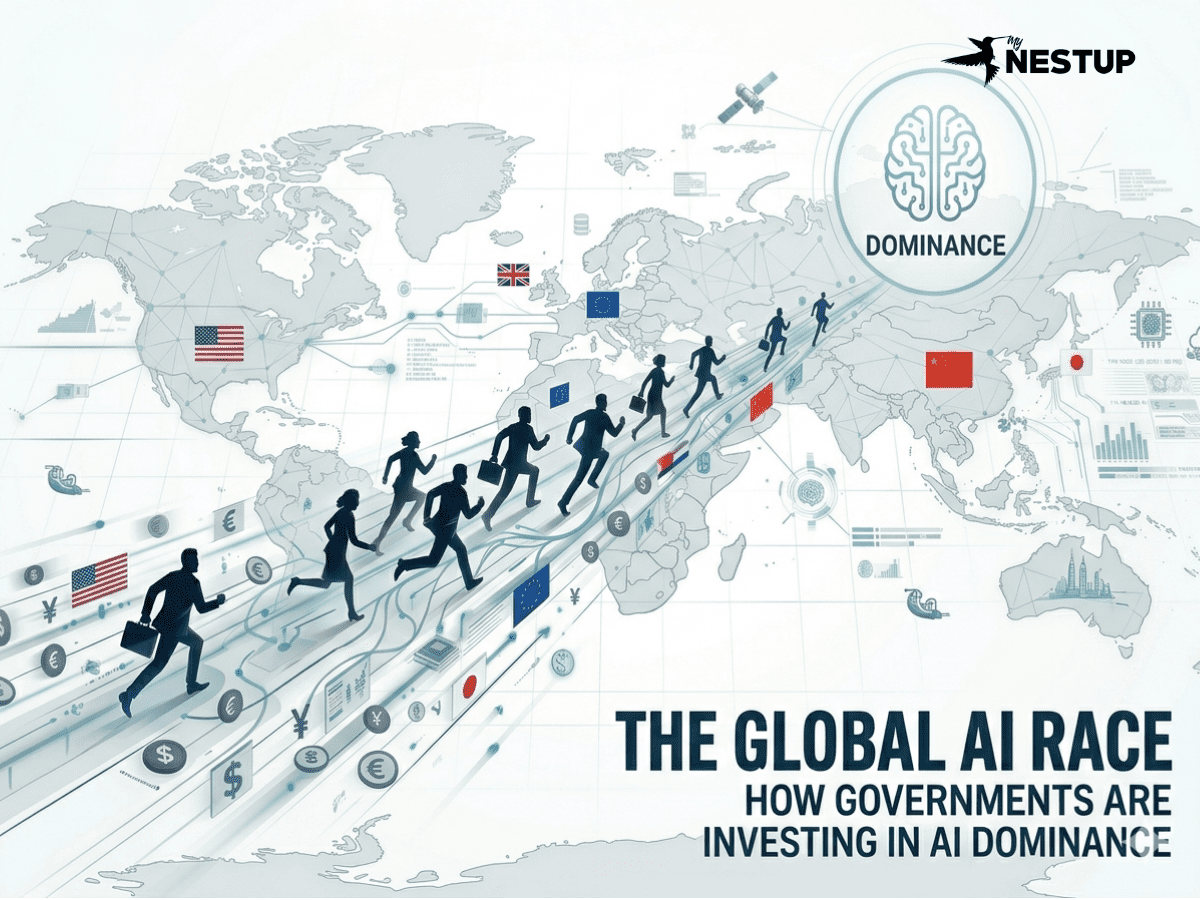
Artificial intelligence has become one of the most strategically important technologies of the 21st century. Governments around the world increasingly view AI not only as a driver of economic growth but also as a critical factor in national security, technological sovereignty, and geopolitical influence. As a result, a global race has emerged—one where countries are investing billions of dollars to secure leadership in AI development, infrastructure, and deployment.
From massive data center projects to national AI strategies and research funding programs, governments are mobilizing resources on a scale comparable to historic technological races such as the space race or the nuclear arms race. The outcome of this competition could reshape global power structures, economic productivity, and the future of technological innovation.
Why AI Dominance Matters
AI is expected to transform nearly every sector of the global economy, including healthcare, finance, manufacturing, transportation, and defense. Nations that lead in AI development gain several strategic advantages.
First, AI can significantly increase economic productivity by automating complex tasks and accelerating scientific discovery. Second, it enhances military capabilities through autonomous systems, advanced intelligence analysis, and cyber defense. Finally, countries that control key AI platforms and standards may shape global digital infrastructure and governance frameworks.
For these reasons, governments increasingly treat AI leadership as a matter of national strategy rather than simply technological progress.
The United States: Innovation Driven by Private Industry
The United States remains one of the most influential players in the global AI ecosystem. Its strength lies primarily in its powerful private sector, world-class universities, and strong venture capital environment. Major companies such as OpenAI, Microsoft, Google, and NVIDIA drive rapid innovation, often supported by government policies and funding programs.
To reinforce leadership, the U.S. government has begun investing heavily in AI infrastructure and research initiatives. One example is the Stargate Project, a massive AI infrastructure initiative expected to mobilize around $500 billion in funding to build large-scale AI data centers and computing infrastructure across the country.
The project aims to expand computational capacity, accelerate AI innovation, and create hundreds of thousands of jobs. By focusing on infrastructure and collaboration between government and private companies, the U.S. hopes to maintain its technological edge in advanced AI systems.
The country also holds a major advantage in talent and research institutions, hosting a large share of the world’s leading AI labs and attracting global researchers.
China: A State-Driven Strategy for AI Leadership
China has adopted a different approach to AI dominance—one characterized by centralized planning, large-scale government investment, and aggressive industrial deployment.
China’s national AI strategy includes more than $100 billion in funding, targeting research, startups, and industrial applications such as smart manufacturing, robotics, and healthcare.
Unlike the U.S. model, which relies heavily on private companies, China’s government coordinates efforts across universities, technology firms, and state institutions. This top-down approach allows rapid development of AI infrastructure, including national data platforms and large computing facilities.
China has also become a global leader in AI research output. By 2025, it produced nearly 36% of the world’s AI research publications, surpassing the United States and Europe in overall volume.
Recent developments suggest that Chinese companies are closing the gap in advanced AI models as well. Analysts warn that Chinese open-source AI models are rapidly gaining global adoption, strengthening the country’s competitive position despite restrictions on advanced chips.
Europe: Building Sovereign and Ethical AI
While the United States and China dominate headlines, Europe is also investing heavily in AI to maintain technological independence.
The European Union has launched major initiatives aimed at mobilizing around €200 billion for AI development. These programs focus on building AI infrastructure, expanding research funding, and developing “AI gigafactories” capable of producing advanced computing chips.
European policymakers emphasize a different priority: trustworthy and regulated AI. The EU seeks to balance technological progress with ethical standards, privacy protections, and regulatory oversight.
Although Europe currently trails the U.S. and China in computing infrastructure and private investment, its regulatory leadership could influence global AI standards and governance.
Emerging AI Powers Around the World
Beyond the three major blocs, several other regions are increasing their investments in artificial intelligence.
Countries such as South Korea, Japan, Singapore, Canada, and Israel are developing specialized AI ecosystems focused on research, semiconductor technology, and advanced applications. Middle Eastern nations, particularly the United Arab Emirates and Saudi Arabia, are also investing heavily in AI startups and computing infrastructure as part of broader economic diversification strategies.
This expanding network of AI investment is turning the competition into a multipolar technological race rather than a simple U.S.–China rivalry.
Infrastructure: The New Battleground
One of the most important aspects of the AI race is computing infrastructure. Training advanced AI models requires enormous amounts of computational power, specialized chips, energy, and data centers.
Countries are now competing to build massive AI clusters and secure access to critical semiconductor technologies. The United States currently leads in global data center capacity, accounting for more than 60% of the world’s data centers, which gives it a major advantage in training large AI models.
At the same time, China is expanding its energy production and industrial capacity to support large-scale AI deployment across industries. This infrastructure race may ultimately determine which countries dominate future AI development.
The Economic and Geopolitical Stakes
The global AI race has implications far beyond technology. It is reshaping international trade, industrial policy, and geopolitical alliances.
Countries that succeed in AI leadership could capture enormous economic value. AI-driven industries are expected to generate trillions of dollars in productivity gains and new market opportunities over the coming decades.
However, this rapid investment also raises concerns about inequality and economic concentration. Some analysts warn that the benefits of AI may primarily flow to countries, companies, and investors with the largest resources and computing infrastructure.
Conclusion: A Defining Competition of the Century
The race for AI dominance is rapidly becoming one of the defining competitions of the modern era. Governments around the world are investing unprecedented amounts of money, infrastructure, and political capital to secure leadership in this transformative technology.
While the United States leads in private-sector innovation, China’s centralized strategy allows rapid deployment at scale. Europe, meanwhile, aims to shape the ethical and regulatory framework of AI development.
The outcome of this global race will influence not only the future of technology but also the balance of economic and geopolitical power in the decades ahead. As nations continue to accelerate their investments, artificial intelligence is poised to become the central arena of global technological competition.