
The Hook: Our Trillion-Ton Legacy
In the climate world, we talk endlessly about reaching "net zero"—essentially, turning off the tap of new emissions. But there is a quieter, more daunting reality we must face: the tub is already overflowing. Even if we stopped every car and shuttered every factory today, trillions of tons of "legacy emissions" would remain in our atmosphere, continuing to trap heat for centuries.
This is the problem of the "overshoot." To solve it, we don't just need to stop emitting; we need to start cleaning up. Enter Direct Air Capture (DAC), a technology designed to serve as Earth’s mechanical cleanup crew by scrubbing carbon dioxide directly from the ambient air.
Takeaway 1: The Giant Atmospheric Sponge
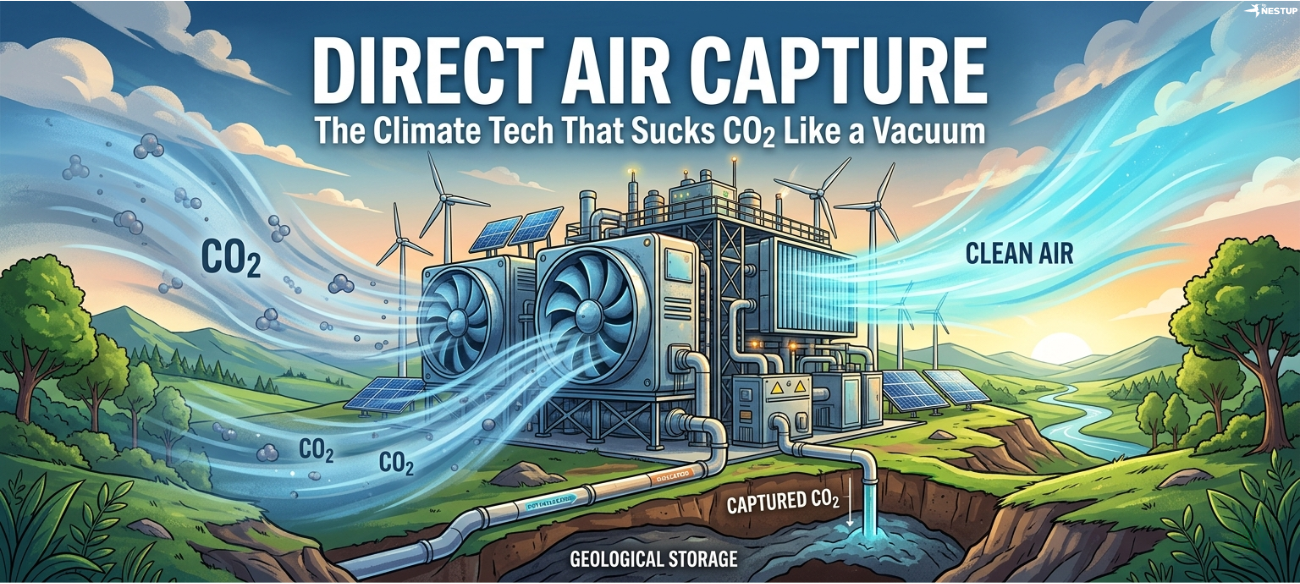
To understand the engineering behind DAC, visualize a giant reusable sponge. The process follows a mechanical loop that mimics how a sponge absorbs and releases liquid:
- The Intake: Massive fans pull ambient air into capture units.
- The Soak: Inside, chemical sorbents (either solid or liquid) act as the sponge, binding specifically with CO2 molecules while letting the rest of the air pass through.
- The Wring: Once the sorbent is saturated, heat or pressure is applied to "wring out" the sponge, releasing the CO2 in a pure, concentrated form.
- The Reset: The sorbent is then ready to begin the loop again, while the captured CO2 is sent for storage or reuse.
The Physics of Scarcity Capturing CO2 from the open air is fundamentally harder than capturing it from a factory smokestack. In a flue, CO2 is densely concentrated. In the atmosphere, however, CO2 makes up only 0.04% of the air. This low concentration is the primary driver of cost and complexity; because the gas is so dilute, the fans must work overtime to process massive volumes of air, requiring significant electricity for the fans and significant heat for the regeneration (the "wringing") of the sorbent.
Takeaway 2: Turning Thin Air into Solid Stone
The most significant real-world test of this technology is the Mammoth plant in Iceland, operated by Climeworks. This facility represents the current "state of the art" for permanent carbon removal.
"What makes Mammoth notable: Designed to capture tens of thousands of tons of CO₂ per year; Powered by geothermal energy (low-carbon input); CO₂ is mineralized underground—turning into stone."
The Geography of DAC As a strategist, the Mammoth plant tells us something vital about the geographic requirements of this technology. DAC cannot be built just anywhere; its scalability is physically tethered to specific "hotspots." Iceland is the perfect pilot location because it offers the two essential pillars of DAC: abundant geothermal energy to power the energy-intensive fans and heat requirements, and a specific basaltic geology that allows CO2 to be injected and mineralized—literally turning into stone for permanent, leak-proof storage.
Takeaway 3: The $1,000-per-Ton Hurdle
The barrier to entry for DAC is purely economic. Today, removing a single ton of CO2 costs between $500 and $1,000. Compare that to existing carbon markets, where prices usually hover below $100 per ton, and the challenge becomes clear.
The Learning Curve vs. The Physics Floor Optimists believe DAC will follow the "Learning Curve" of solar panels and lithium-ion batteries—technologies that saw dramatic cost declines as they scaled. The long-term goal is to reach 100–200 per ton through mass manufacturing and better sorbent materials.
However, we must weigh this against the skeptic’s view: DAC is energy-limited. Unlike software, which can scale with near-zero marginal costs, DAC is governed by the laws of thermodynamics. Because it takes a fixed amount of energy to pull such a dilute gas from the air, there is a physical "floor" to how cheap this technology can ever truly become.
Takeaway 4: Why Silicon Valley is Buying "Air"
Because the current cost is too high for the average business, a coalition of tech leaders including Stripe, Alphabet, and Shopify has formed Frontier. They are utilizing a sophisticated model known as an Advance Market Commitment (AMC).
An AMC is not a donation; it is a market-guarantee mechanism. By pledging billions of dollars to buy carbon removal in advance, Frontier creates a guaranteed "finish line" for startups.
The impact of the Frontier model:
- Securing Capital: Provides startups with the proof of revenue needed to land venture investment.
- Driving Innovation: Forces competition to move down the cost curve faster.
- Market Creation: Establishes a marketplace for high-quality removal that simply didn't exist five years ago.
Takeaway 5: It’s a Cleanup Crew, Not a Get-Out-of-Jail-Free Card
A common critique of DAC is that it might encourage "dangerous thinking"—the idea that we can delay the hard work of decarbonization because we can just "suck it out later." We must be clear: DAC is a backstop, not a replacement for emissions cuts.
"DAC is not a substitute for cutting emissions—it’s a complement."
In a strategic climate portfolio, DAC is the last line of defense. It is intended to neutralize emissions from "hard-to-abate" sectors that we cannot yet fully electrify or decarbonize, specifically:
- Aviation
- Cement Production
- Steel Manufacturing
The Bottom Line: A Necessary Gamble
The scale of the challenge is sobering. While we emit roughly 40 billion tons of CO2 every year, global DAC capacity is currently stuck in the thousands to low millions of tons. We are short by several orders of magnitude.
Yet, DAC remains our most vital "climate insurance." It is one of the few tools capable of reversing atmospheric overshoot and removing the historical carbon that is already baking warming into our system. We are betting on the cleanup crew because, eventually, we won't have a choice.
Ultimately, Direct Air Capture is a necessary—but not sufficient—tool in the climate fight. Does this technology represent a miracle of human engineering, or is it a stark reminder of just how far we have pushed our planet’s boundaries?