
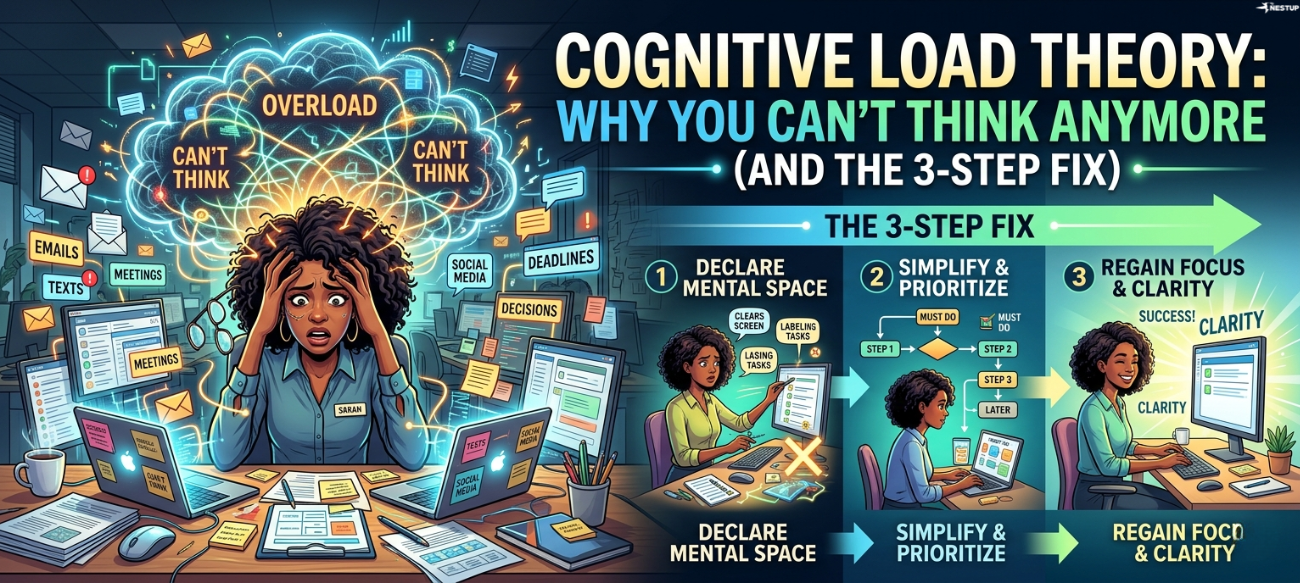
You’ve been at your desk for four hours. You haven't moved a mountain or run a marathon, yet you feel physically and mentally depleted. Your focus has evaporated, and even the simplest email feels like a puzzle you can't solve.
If this sounds familiar, I want you to take a deep breath and give yourself permission to stop fighting your biology. You aren't lazy, and your brain isn't broken. This "fried" sensation is actually an architectural signal—a warning that you have exhausted your Mental Bandwidth. Drawing from the scientific framework of Cognitive Load Theory, we can see that this fatigue is simply a failure in how information is being processed.
To reclaim your focus, you don’t need more willpower; you need to understand the hidden architecture of your mind.
The Hidden Architecture of Your Mind (The Working Memory Tank)
In plain English, your working memory is your brain’s limited processing space. Think of it as a small tank that can only hold a specific, finite amount of information at any given moment. Every task you perform and every notification you receive is liquid being poured into that tank.
When you attempt to force too much into this limited space, the system begins to overflow. As the research indicates:
"When that limit is exceeded, thinking slows down, mistakes increase, and learning breaks down."
By understanding the three types of "load" that fill this tank—extraneous, intrinsic, and germane—we can redesign our habits to clear out the sludge and restore mental clarity.
Lesson #1: You Aren’t Lazy, You’re Distracted (Eliminating Extraneous Load)
The primary reason most professionals feel exhausted is not the difficulty of their work, but Extraneous Load. This is the "sludge" at the bottom of your tank—the unnecessary mental effort caused by how information is presented and the environment in which you work.
Common drains include cluttered digital interfaces, poorly explained instructions, and the constant chime of notifications. Many of us also fall into the trap of multitasking, which is a myth for complex thinking. It is the cognitive equivalent of trying to read while someone is shouting in your ear; it adds zero value to the task but consumes massive amounts of your limited bandwidth.
The 20-Minute Focus Reset To clear this load, you must "Reduce the Noise."
- Turn off all non-essential notifications.
- Close every unnecessary browser tab.
- Work on one clearly defined task for 20 minutes.
You will likely notice that thinking becomes instantly easier—not because the task changed, but because the "noise" disappeared.
Lesson #2: Discipline is a Design Problem (Managing Intrinsic Load)
Every task has an Intrinsic Load, which is the built-in complexity of the subject matter. While you cannot change the inherent difficulty of the task itself, you can manage how you approach it.
Think of intrinsic load like lifting weights. You don’t walk into a gym and start with the heaviest bar; you build up gradually. When we try to "power through" a complex project all at once, we overflow the tank. This is where we must shift from a mindset of grit to one of Cognitive Design.
"You don’t need more discipline. You need better cognitive design."
The most effective design tool for managing complexity is the Chunking Method. Instead of tackling a massive topic, divide it into 3–5 smaller parts. Focus on mastering one "chunk" before moving to the next. By reducing the volume of information entering the tank at any one time, you prevent the system from crashing.
Lesson #3: Not All Stress is Bad (Boosting Germane Load)
It is a common misconception that all mental effort is draining. In reality, Germane Load is the "good" kind of effort. This is the energy your brain uses to build understanding, create patterns, and store information in long-term memory.
While this requires work, it is the work of growth. The key is to shift from passive consumption (like re-reading notes) to active engagement.
"If intrinsic load is the weight, and extraneous load is the noise, germane load is the muscle growth."
The 2-Minute Recall Exercise To increase your germane load and ensure your effort results in real comprehension:
- After learning something or finishing a deep work session, close your notes.
- Spend two minutes writing down everything you can remember.
- Check for gaps and repeat the process if necessary.
This exercise strengthens your mental models and ensures that your mental energy is being spent on progress, not just "busyness."
Summary: The 3-Step Fix
Reclaiming your focus is a systematic process of managing your mental tank. You can restore clarity by following this science-backed system:
- Reduce the Noise (Cut Extraneous Load): Remove distractions and stop multitasking to free up processing space.
- Simplify the Task (Manage Intrinsic Load): Use the chunking method to break complex problems into 3–5 smaller, manageable pieces.
- Learn Actively (Boost Germane Load): Use the 2-Minute Recall to ensure your effort results in real cognitive "muscle growth."
Ultimately, mental clarity is a result of fixing the load, not fixing the person. Your brain is an extraordinary tool, but it must be used according to its architectural limits.
Which specific "extraneous load"—a notification, a cluttered tab, or the myth of multitasking—will you eliminate today to reclaim your focus?