
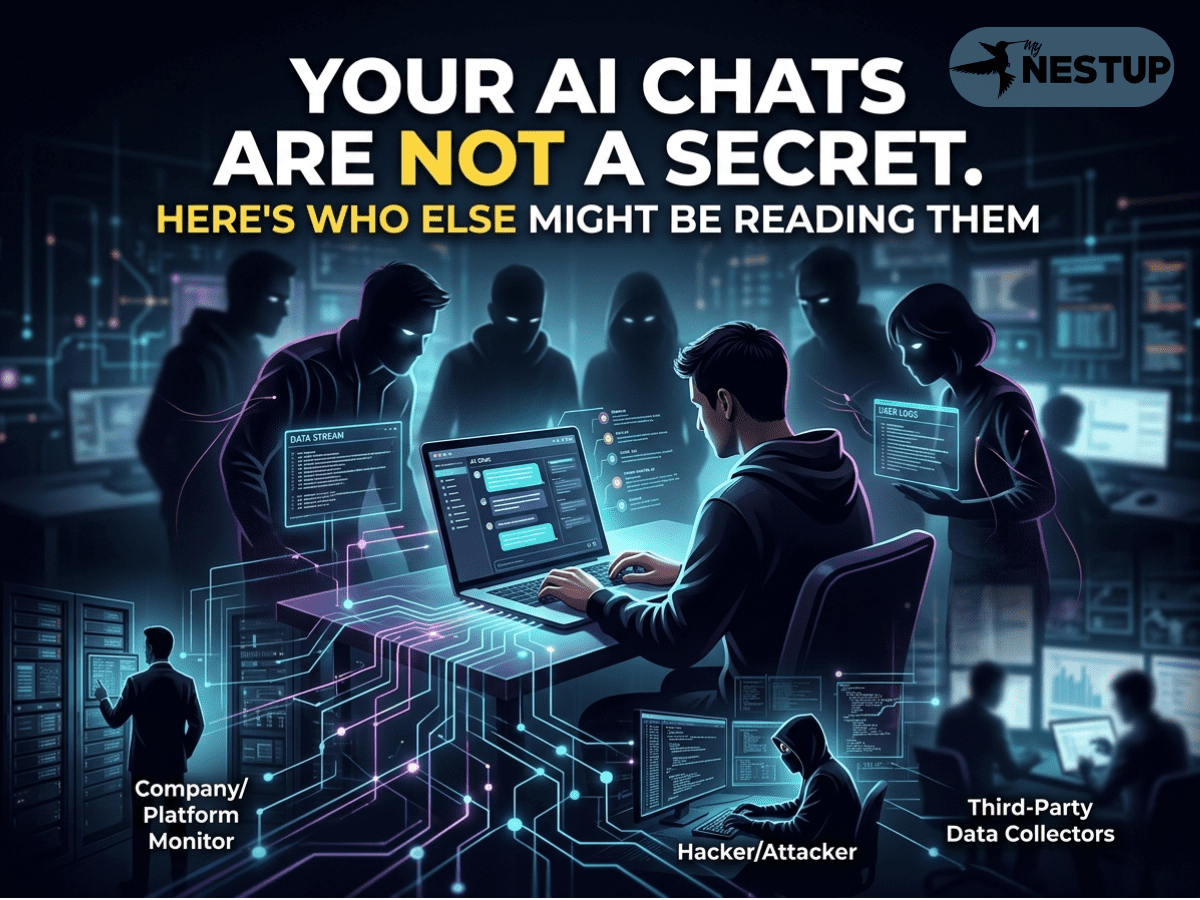
You ask an AI to help draft a sensitive work email, offer advice on a private health concern, or brainstorm a confidential business plan. In seconds, you get a remarkably helpful response. These tools feel like perfect digital confidantes—impartial, intelligent, and, above all, private. But this sense of security is an illusion.
While the convenience is undeniable, it’s built on a foundation of data exchange that most users don't fully see. The assumption that your conversation is a secure, two-way street between you and a machine is a critical flaw in our collective mental model of AI. Your words don’t just vanish into an algorithmic void; they are recorded, processed, and often stored in ways that challenge any reasonable expectation of privacy.
This article pulls back the curtain on the AI illusion, revealing three fundamental truths about your data. Understanding them is the first step toward using these powerful tools without sacrificing your privacy.
1. Your “Private” Conversation Has an Audience
The most jarring reality of using many AI tools is that your chat isn't always private. To improve quality, ensure safety, and refine their systems, AI providers often log your interactions. And those logs can be reviewed by human employees. Imagine explaining a sensitive HR issue or a personal family matter to your AI, only to realize your words could end up in a quality assurance report on a stranger’s desk.
But the audience isn't just potentially human. Even if your data is "anonymized," the substance of your query can be used to train future versions of the model. This means your unique problems, confidential ideas, and sensitive questions can be absorbed into the AI’s vast knowledge base, subtly influencing its future responses for other users. Your data doesn’t just get used; it becomes part of the machine.
2. You Can Be Identified Without Ever Sharing Your Name
You’re careful. You never type your name, email, or address into an AI chat. That should be enough to protect your identity, right? Unfortunately, no. A deeply counter-intuitive risk is "re-identification through inference," where an AI connects seemingly harmless, non-identifying details to pinpoint who you are.
For example, you might mention the city you live in while asking for restaurant recommendations. Later, in a separate chat, you might discuss your niche hobby. Individually, these facts seem anonymous. But when an AI system combines location + hobbies, it can often create a unique profile. These details act like coordinates, allowing the algorithm to triangulate your identity in a sea of anonymized data. You may believe you’re sharing nothing personal, but you’re actually leaving a trail of digital breadcrumbs that can lead directly back to you.
3. The Best Defense is a Simple Change in How You Ask
Protecting your privacy doesn't require abandoning these revolutionary tools. The most effective defense is a simple but powerful change in your habits: anonymize your inputs before you hit send. This technique involves generalizing personal details to get the same high-quality result from the AI without revealing sensitive information.
For instance, instead of feeding it your entire professional bio for career advice, frame your query with a generalized description like, "Give me career advice for a 30-year-old software engineer." You provide the AI with all the context it needs to deliver a relevant answer, but you expose none of your personal data. Beyond careful phrasing, you can further protect yourself by regularly deleting your conversation history and using temporary or anonymous accounts when discussing sensitive topics. This proactive approach puts you back in control.
Conclusion: Becoming a Smarter AI User
The convenience of AI is here to stay, but using it safely demands a new level of digital literacy. Protecting your privacy is not about blindly trusting a platform's policies; it's about developing conscious, proactive habits that assume your data is never truly private.
By understanding that your words can be read by humans, algorithmically re-identified, and even absorbed into the AI itself, you can set clear boundaries on what you are willing to share. This allows you to harness the immense benefits of artificial intelligence without making an unintended trade for your privacy.
After reading this, how will you rephrase your very next question to an AI?