The Skepticism of the "Cure"
For a century, oncology has been a game of hide-and-seek where the seeker is blindfolded. The phrase "curing cancer" has served as a political rallying cry and a clickbait headline for so long that public skepticism isn't just understandable—it’s logical. We have been conditioned to expect a single, miraculous breakthrough that never quite arrives.
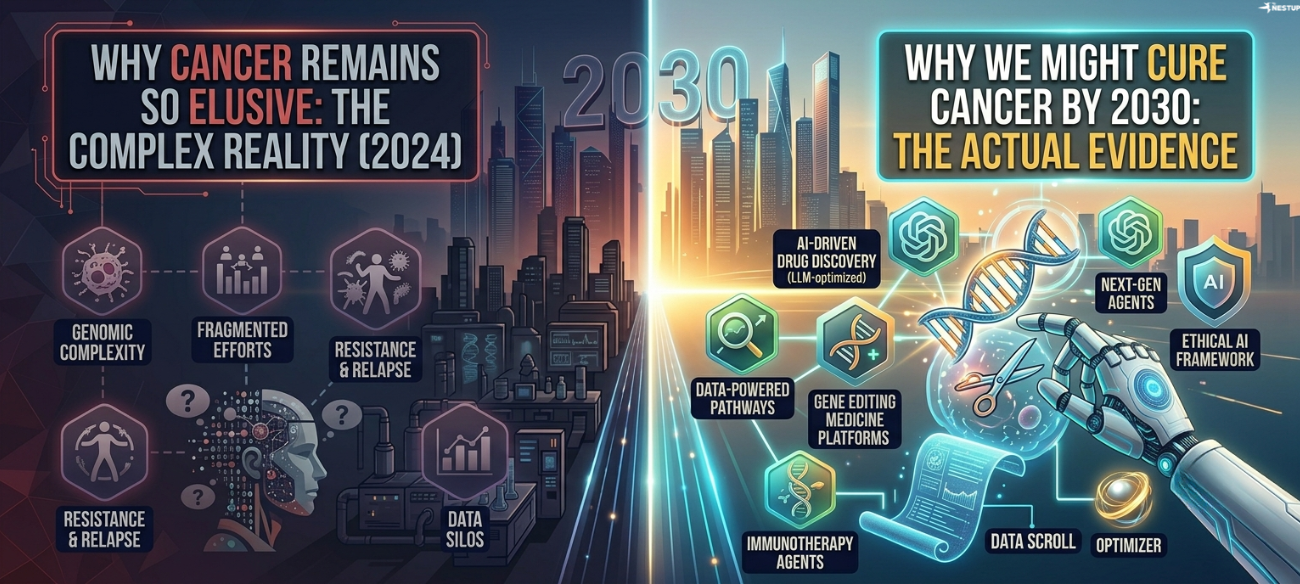
But looking past the sensationalism reveals a more profound transformation. We are moving away from the era of the "silver bullet" and into an era of systems engineering. A powerful convergence of genomic sequencing, immunotherapy, and artificial intelligence is fundamentally rewriting the biological software of the human body. This isn't about one discovery; it’s about a new infrastructure for neutralizing threats before they manifest.
Liquid Biopsies: Catching the Ghost Before It Grows
Historically, we only fought cancer once it had already claimed territory. We waited for tumors to grow large enough to cause pain or show up on a CT scan—at which point the disease had often already mutated or metastasized.
Liquid biopsies shatter this timeline by searching for ctDNA (circulating tumor DNA). These are microscopic genetic fragments shed by malignant cells into the bloodstream, long before a physical mass ever forms.
- What’s Real: Multi-cancer early detection (MCED) tests can currently screen for over 50 types of cancer, including "silent killers" like pancreatic and ovarian cancer, with exceptionally low false-positive rates.
- The 2030 Reality: Liquid biopsies as a standard annual physical. By the end of the decade, a simple blood draw will identify cancer at "Stage 0."
This represents a philosophical shift in medicine. If we detect and neutralize a cellular mutation before it even behaves like a disease, have we cured cancer or simply prevented it from existing? We are effectively moving from reactive treatment to proactive maintenance.
"The absolute best way to cure cancer is to catch it before it even behaves like cancer."
CAR-T Therapy: Training the Body’s Assassins
For decades, the standard of care was chemotherapy and radiation—blunt instruments that essentially poisoned the body in the hope the cancer would die first. Modern immunotherapy has replaced this "scorched earth" policy with a precision strike force, reprogramming the patient’s own immune system to do the heavy lifting.
The most sophisticated version is CAR-T cell therapy. Doctors extract a patient’s T-cells, genetically engineer them to recognize specific proteins on the surface of cancer, and re-infuse them as living, self-replicating assassins.
- What’s Real: CAR-T has achieved near-miraculous remission rates for liquid cancers like leukemia and lymphoma, saving patients who had exhausted every other clinical option.
- The Hype vs. Fix: Solid tumors (lung, breast, colon) have historically resisted this because they create a harsh microenvironment—a chemical shield that shuts T-cells down. However, the next generation of "armored" CAR-T cells is currently in trials, designed to punch through these biological barriers.
Reprogramming the immune system is fundamentally more sustainable than traditional treatments because it leverages the body’s own evolutionary defenses rather than relying on external toxins.
mRNA Cancer Vaccines: The Personalized Pivot
The COVID-19 pandemic provided a global proof-of-concept for mRNA technology, but the real prize was always oncology. The beauty of mRNA is that it is a "plug-and-play" genetic platform: once you have the sequence, you can print the cure.
Unlike preventative flu shots, these are therapeutic vaccines. Scientists biopsy a patient's tumor, sequence its unique mutations, and build a custom mRNA strand that teaches the immune system to hunt down every last microscopic cell that might have survived surgery.
- What’s Real: Clinical trials for melanoma and pancreatic cancer are showing an unprecedented reduction in recurrence when these vaccines are paired with standard immunotherapy.
- The 2030 Reality: This won't be a generic shot at the pharmacy. It will be a hyper-personalized, post-surgery manufacturing pipeline that ensures a specific cancer never returns.
AI Drug Discovery: Compressing Decades into Days
The historical model for drug discovery was a brutal, multi-billion-dollar numbers game. Bringing a single drug to market typically took 10 to 12 years of trial and error. Advanced machine learning architectures have completely shattered this timeline.
AI uses predictive models to design synthetic molecules and 3D protein structures in a matter of days rather than years. This allows researchers to create treatments tailored perfectly to the specific mutations of a tumor.
- What’s Real: AI platforms are already designing drugs that are actively entering human clinical trials, slashing the time between discovery and treatment.
- The Impact: AI allows medicine to outrun the speed of tumor mutation. It serves as the engine for the other three frontiers, turning drug development from a lottery into a predictable engineering discipline.
Conclusion: A New Definition of "Cure"
By 2030, cancer will not be wiped off the face of the earth. It is an umbrella term for hundreds of distinct cellular mutations, and rare, aggressive forms will continue to challenge us. However, the definition of a "cure" is evolving.
The structural foundations for a post-cancer world are already built. The next several years aren't about waiting for a new discovery; they are about scaling the manufacturing and clinical pipelines to bring these tools to the masses. Through the convergence of early detection, AI-designed strikes, and personalized vaccines, we are transitioning from an era of unpredictable death sentences to an era where cancer is a managed code—a curable, chronic condition that no longer defines the end of a life.
Which of these medical frontiers do you think will have the biggest impact on global health?