
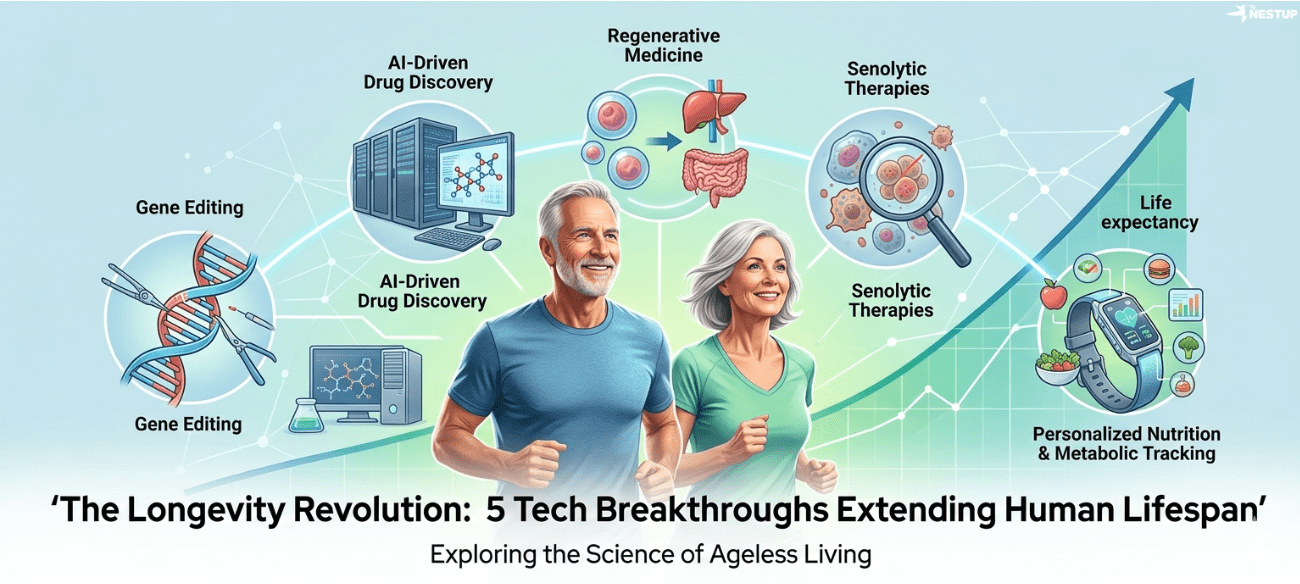
Introduction: The Death of Inevitability
The collision between our ancient biology and the modern laboratory has sparked a radical shift in how we view the passage of time. For generations, the slow decay of the human body was seen as an inescapable fate, but a new field called geroscience is rewriting that narrative by targeting the biological mechanisms of aging itself. Rather than playing "whack-a-mole" with individual diseases like cancer or heart disease, researchers are looking to intervene at the cellular level. This is the transition from science fiction to a clinical reality—one where aging is no longer an unavoidable decline, but a manageable medical condition.
The New Goal: It’s Not About Lifespan, It’s About Healthspan
In the world of longevity science, the most critical distinction isn't how long you live, but how long you live well. While "lifespan" refers to the total number of years an individual survives, "healthspan" focuses on the duration of life spent in good health, free from chronic illness. The scientific community has pivoted its focus toward the latter, acknowledging that adding years to life is meaningless if those years are defined by suffering.
"The real breakthrough isn’t immortality—it’s the growing ability to delay disease, extend vitality, and compress the years of decline at the end of life."
If the primary objective is to maximize those high-vitality years, the first step is clearing out the internal biological debris that accumulates as we age.
Evicting the "Zombie Cells": The Promise of Senolytics
One of the most promising frontiers involves a class of drugs known as senolytics, which target "senescent cells." Often referred to as "zombie cells," these are damaged cells that have stopped dividing but refuse to die. Instead of being cleared by the immune system, they linger in the body, secreting inflammatory signals that poison neighboring healthy tissues and accelerate the aging process.
- What’s Real: There is robust evidence in animal studies showing that removing these cells improves tissue function and delays age-related diseases. Preclinical models have even demonstrated significant improvements in brain and bone health.
- What’s Hype: Despite the success in mice, any claims that current senolytic treatments can achieve "age reversal" in humans remain speculative and premature.
Currently, senolytics have moved into early-to-mid stage human trials, specifically targeting localized conditions such as osteoarthritis and fibrosis. While senolytics focus on clearing out the "trash," other researchers are focused on the master switches that regulate how our cells grow.
Rapamycin: The Most Serious Contender You’ve Never Heard Of
There is a certain irony in the fact that one of the most robust longevity candidates is a drug originally developed as an immunosuppressant. Rapamycin works by inhibiting the mTOR pathway, a central regulator of cellular growth and aging. By dampening this pathway, rapamycin mimics some of the benefits of caloric restriction, effectively reducing cellular damage and improving immune aging.
In the laboratory, rapamycin has a stellar track record, successfully extending the lifespan of yeast, flies, and mice. This potential has led to human research like the PEARL study, which is currently evaluating its effects on aging biomarkers. Researchers are now working to move past its history as a high-dose transplant drug to find safe, low-dose protocols for long-term health.
Bottom line: Rapamycin is promising—but not yet a validated "longevity drug" for humans.
While rapamycin attempts to regulate growth pathways, another major area of research seeks to "recharge" the cell’s internal power supply.
NAD⁺: Recharging the Battery vs. Reality Checks
Nicotinamide adenine dinucleotide (NAD⁺) is a molecule essential for energy metabolism and DNA repair. Our natural levels of NAD⁺ decline precipitously as we age, leading to cellular dysfunction and fatigue. This has created a massive market for precursors like NMN and NR, which are intended to boost NAD⁺ levels and "recharge" our biological batteries.
- What’s Real: The biological role of NAD⁺ is indisputable. In animal models, boosting these levels has been shown to improve muscle function and metabolic health.
- What’s Hype: There is currently no solid evidence that taking these supplements can actually extend the human lifespan.
Most human trials for NAD⁺ boosters are currently focused on narrower healthspan markers—such as metabolic health, fatigue, and age-related decline—rather than total longevity. However, to know if any of these interventions are actually working, we need a way to track our biological progress.
If You Can't Measure It, You Can't Treat It: Epigenetic Clocks
To transform aging into a treatable condition, scientists require a yardstick. This has led to the development of epigenetic clocks, sophisticated tools that analyze DNA methylation patterns—chemical tags on our DNA—to estimate "biological age." Unlike your birthday, your biological age reflects the actual wear and tear on your cells.
These clocks are becoming the standard endpoint in clinical trials, allowing researchers to see if a drug is actually slowing the aging process without waiting decades for a person to die. However, there is a necessary reality check: while these clocks are highly accurate for identifying trends across large populations, their ability to provide precise, actionable predictions for a single individual is still a subject of intense scientific debate.
As these measurements prove that aging is a multi-layered process, it is becoming clear that a single "magic pill" may not be the answer.
The Future is "Stacked": Why Single-Drug Solutions Might Fail
The next decade of longevity medicine is moving away from the search for a silver bullet. Because aging is a complex failure of multiple biological systems, the most effective approach likely involves "stacked interventions" or combination therapies.
By combining treatments—such as using NAD⁺ restoration, rapamycin, and senolytics in specific sequences—researchers hope to address the multifaceted nature of cellular decline more effectively than any single drug could alone. This model of "stacking" represents the future of the field, moving toward a personalized, sequential protocol for maintaining human vitality.
Conclusion: The Road Ahead
We are living through an unprecedented acceleration in geroscience, fueled by billions in investment and a rapidly expanding clinical pipeline. However, as we look toward the future, we must remain grounded in the evidence. There is currently a significant gap between biological plausibility in the lab and proven outcomes in the clinic.
As we evaluate new breakthroughs, it is vital to remember that there is a difference between something that might work and something that has been rigorously tested in people. We are closer than ever to a world where aging is managed as a medical condition, but we are still in the experimental phase of this journey.
How does your perspective on "growing old" change when you stop viewing it as an unavoidable fate and start seeing it as a manageable biological process?