
The Promise Meets Reality
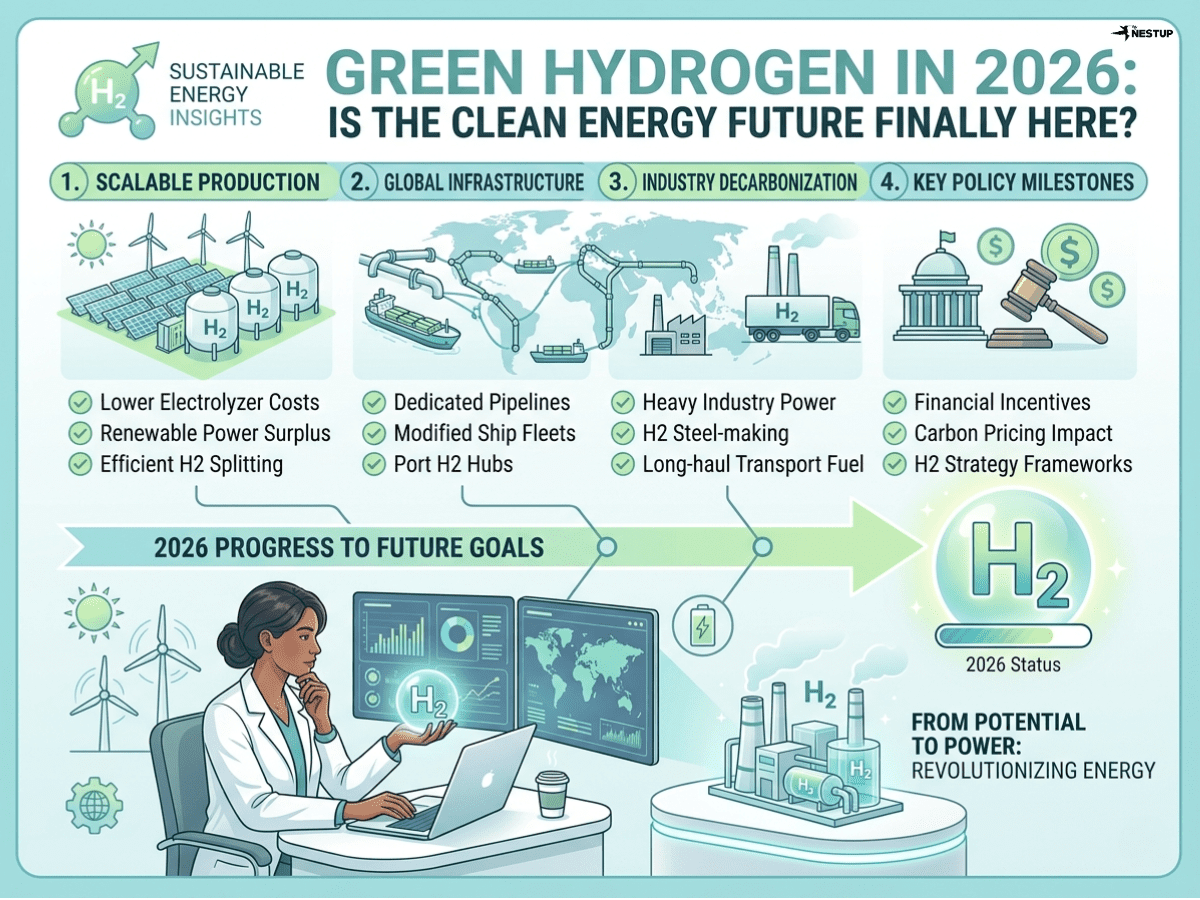
For years, green hydrogen has been framed as a breakthrough solution for decarbonizing the hardest parts of the global economy. In 2026, that promise is closer to being fulfilled, but it remains incomplete. The technology is no longer experimental, and large-scale investments are underway across multiple regions. However, the gap between potential and widespread adoption is still defined by economics. Green hydrogen has moved beyond hype into early deployment, yet it has not fully reached the level of cost competitiveness needed for global scale.
Understanding Green Hydrogen
Green hydrogen is produced by splitting water into hydrogen and oxygen using renewable electricity, typically sourced from solar or wind energy. Unlike conventional hydrogen, which is derived from fossil fuels and emits significant carbon, green hydrogen offers a near-zero-emission alternative. This makes it particularly attractive for sectors where electrification is difficult or inefficient. However, the process itself requires substantial energy input, meaning that the cost of renewable electricity directly determines the viability of green hydrogen production.
The Economics in 2026
In 2026, the cost of producing green hydrogen varies widely depending on geography and energy prices. In regions with abundant and cheap renewable energy, production costs are approaching competitive levels, sometimes falling into the $2.50 to $5.00 per kilogram range. In less favourable conditions, costs remain higher, often exceeding $5.00 per kilogram without subsidies. While this represents a significant improvement compared to earlier years, traditional fossil-based hydrogen is still cheaper, which slows the pace of transition. The industry is clearly progressing, but it has not yet reached full economic parity.
Why the $5/kg Threshold Matters
The $5 per kilogram benchmark has become an important reference point in the hydrogen economy. At this level, green hydrogen begins to make sense for specific industrial applications, particularly in regions where carbon pricing or regulation increases the cost of fossil fuels. It signals the point at which early adoption becomes viable, even if not yet universal. However, true large-scale competitiveness will likely require costs to fall closer to $2 per kilogram. Until that happens, green hydrogen will continue to rely on policy support and targeted use cases rather than broad market adoption.
Mega Projects Driving the Industry Forward
Large-scale projects are playing a crucial role in pushing green hydrogen toward viability. The NEOM Green Hydrogen Project stands out as one of the most ambitious efforts, aiming to produce hydrogen at scale using vast solar and wind resources. Its location provides a natural advantage, enabling lower production costs and positioning it as a potential global export hub. At the same time, Europe is advancing its own strategy through initiatives like the European Hydrogen Bank, which uses subsidies and auctions to bridge the cost gap and accelerate deployment. These projects highlight two different approaches: one driven by natural resource advantages and the other by policy intervention.
Where Adoption Is Happening First
Green hydrogen is not being adopted evenly across all sectors. Instead, it is gaining traction in industries where alternatives are limited. Heavy industries such as steel and chemicals are among the first movers because they already rely on hydrogen in their processes, making the transition more straightforward. The fertilizer sector, particularly ammonia production, is also an early adopter due to both technical feasibility and regulatory pressure. In transportation, hydrogen is finding its role indirectly through synthetic fuels for shipping and aviation, where batteries are not practical. These early use cases share a common characteristic: they require solutions that electricity alone cannot provide.
The Infrastructure Challenge
Beyond production costs, infrastructure remains one of the biggest obstacles to scaling green hydrogen. Transporting and storing hydrogen is complex and expensive, requiring specialized pipelines, high-pressure storage systems, or conversion into other forms such as ammonia. In many cases, the cost of moving hydrogen can rival the cost of producing it, particularly in regions without existing infrastructure. This has led to a growing trend of locating production facilities close to industrial users, reducing the need for long-distance transport but limiting flexibility in global supply chains.
Why Progress Is Slower Than Expected
Despite strong momentum, many announced hydrogen projects have faced delays or cancellations. The primary issue is not technological feasibility but financial uncertainty. High upfront investment costs, unclear long-term demand, and reliance on government incentives create significant risk for developers. Without guaranteed buyers or stable pricing mechanisms, many projects struggle to reach final investment decisions. As a result, the pipeline of planned projects is far larger than the number actually under construction.
What Needs to Change
For green hydrogen to scale meaningfully, several factors must align. The cost of renewable electricity must continue to fall, particularly in regions with strong solar and wind resources. Electrolyzer manufacturing needs to expand to achieve economies of scale and further reduce costs. At the same time, consistent policy support will be essential to bridge the gap between current economics and future competitiveness. These elements are already moving in the right direction, but progress must accelerate to unlock widespread adoption.
Final Verdict: A Transition in Progress
In 2026, green hydrogen is at a critical turning point. It has moved beyond theory and into real-world deployment, supported by major investments and growing industrial demand. Yet it remains a transitional technology rather than a fully established solution. The clean energy future powered by hydrogen is no longer a distant vision, but it is not yet fully realized. The coming years will determine whether falling costs and continued investment can transform green hydrogen from a promising alternative into a central pillar of the global energy system.