
Why One AI Tool Isn’t Enough Anymore
If you’re still trying to use a single AI tool for everything, you’re leaving performance on the table. In 2026, the real productivity leap comes from combining models—each optimized for different strengths. Claude, ChatGPT, and Gemini are not interchangeable. They excel in different areas, and when used together intentionally, they form a workflow that is faster, more accurate, and more reliable than any single tool.
The Core Idea: Route Tasks, Don’t Duplicate Them
The biggest mistake people make is asking all three tools to do the same thing and then comparing outputs. That’s inefficient. Instead, the goal is task routing—sending each task to the model best suited for it. Think of it like a team: you don’t ask your designer to do accounting or your analyst to write marketing copy. The same logic applies here. Once you assign clear roles, the stack starts to feel cohesive rather than redundant.
Claude: The Deep Thinker and Writer
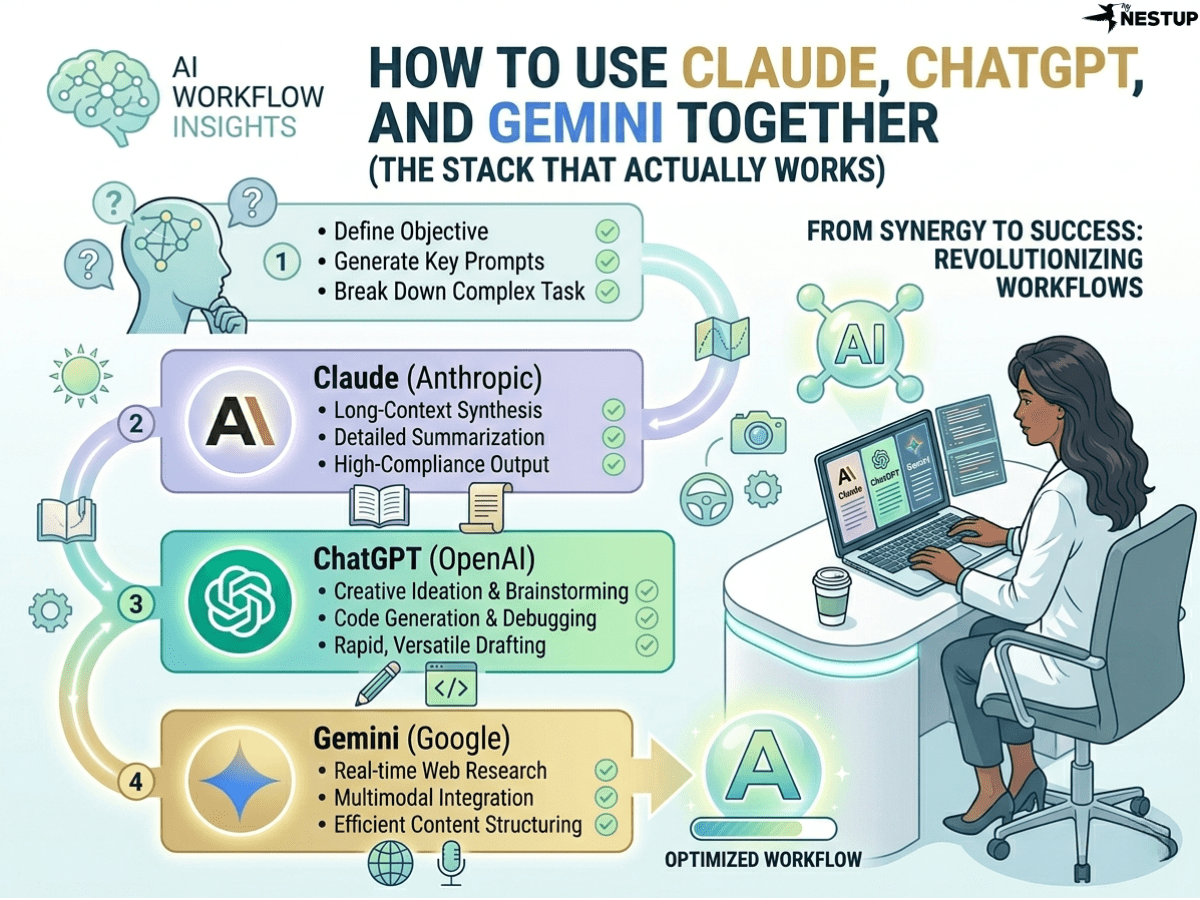
Claude is the strongest of the three when it comes to long-form reasoning, structured analysis, and clean writing. It handles complex prompts with nuance and produces outputs that feel more polished and human. This makes it ideal for tasks like research summaries, strategic thinking, editing articles, and drafting detailed documents. When you need clarity, depth, and well-structured responses, Claude is usually the best starting point.
In practice, Claude works best when you give it context-heavy prompts. It excels at taking messy inputs—notes, transcripts, or rough ideas—and turning them into coherent outputs. For knowledge workers, this makes it the backbone of thinking and writing workflows.
ChatGPT: The Execution Engine
ChatGPT shines in versatility. It’s the most flexible tool for execution tasks, especially when you need speed, integrations, or multimodal capabilities. Whether it’s generating images, running structured workflows, summarizing PDFs, or handling quick iterations, ChatGPT is often the fastest way to get things done.
It’s particularly strong for tasks that require iteration and interaction. You can refine outputs quickly, test variations, and move from idea to execution without friction. If Claude is where you think, ChatGPT is where you build and execute.
Gemini: The Google-Native Connector
Gemini stands out because of its deep integration with Google’s ecosystem. It works seamlessly with tools like Docs, Gmail, Sheets, and Search, making it the best choice for workflows tied to real-time information and cloud-based collaboration.
Gemini is especially useful when your tasks involve pulling in live data, referencing documents, or working داخل Google Workspace. It bridges the gap between AI and your existing files, which is something the other tools handle less naturally.
The Workflow That Actually Works
The most effective setup follows a simple flow: start with thinking, move to execution, and finish with integration. You might begin a task in Claude by outlining an idea or analyzing a problem. Once the direction is clear, you shift to ChatGPT to generate assets, refine outputs, or execute specific steps. Finally, you use Gemini to connect everything to your working environment—saving documents, pulling data, or sharing results within your team.
This flow reduces friction because each tool is used where it performs best. Instead of switching randomly between tools, you move through them with purpose.
Task-to-Model Routing (Real Examples)
In a typical workday, this routing becomes intuitive. If you’re writing an article or report, you start with Claude for structure and clarity, then use ChatGPT to refine sections or generate visuals, and finally use Gemini to format and store the document in Google Docs. If you’re analyzing data, you might use Gemini to pull information from Sheets, Claude to interpret it, and ChatGPT to present it in a clean format.
For email workflows, Gemini can draft replies directly داخل Gmail, Claude can improve tone and clarity, and ChatGPT can help generate quick variations or automate responses. The key is not the tools themselves—it’s the sequence in which you use them.
Monthly Cost Breakdown: What You Actually Pay
Running a multi-model stack does come with a cost, but it’s more manageable than most people expect. A typical setup in 2026 looks like this:
- Claude subscription: around $20/month
- ChatGPT Plus or equivalent: around $20/month
- Gemini Advanced (Google One AI plan): around $20/month
This brings the total to roughly $60/month. For most knowledge workers, the time saved easily outweighs the cost. Even saving one hour per week can justify the investment, depending on your work.
The Hidden Benefits of a Multi-Model Stack
Beyond performance, using multiple models reduces risk. If one tool fails, hallucinates, or produces weak output, you have alternatives. It also improves quality control—you can cross-check results and refine ideas across systems. Over time, this leads to better outputs and more confidence in your work.
Another overlooked benefit is specialization. Each tool improves faster in its domain, so using all three means you’re always leveraging the best available capabilities instead of waiting for one platform to catch up in every area.
What Most People Get Wrong
The biggest misconception is that more tools automatically mean more productivity. Without a clear workflow, switching between models can create confusion and slow you down. The goal isn’t to use all three constantly—it’s to use the right one at the right time.
Another mistake is overcomplicating the setup. You don’t need automation tools or complex integrations to start. A simple mental model of task routing is enough to unlock most of the benefits.
Final Takeaway: Build a System, Not a Tool Habit
The real advantage of using Claude, ChatGPT, and Gemini together is not just efficiency—it’s clarity. You stop asking, “Which tool should I use?” and start following a system that consistently delivers better results.
In 2026, the best AI users aren’t loyal to one model. They build stacks. And the simplest stack—when used correctly—is often the most powerful.