
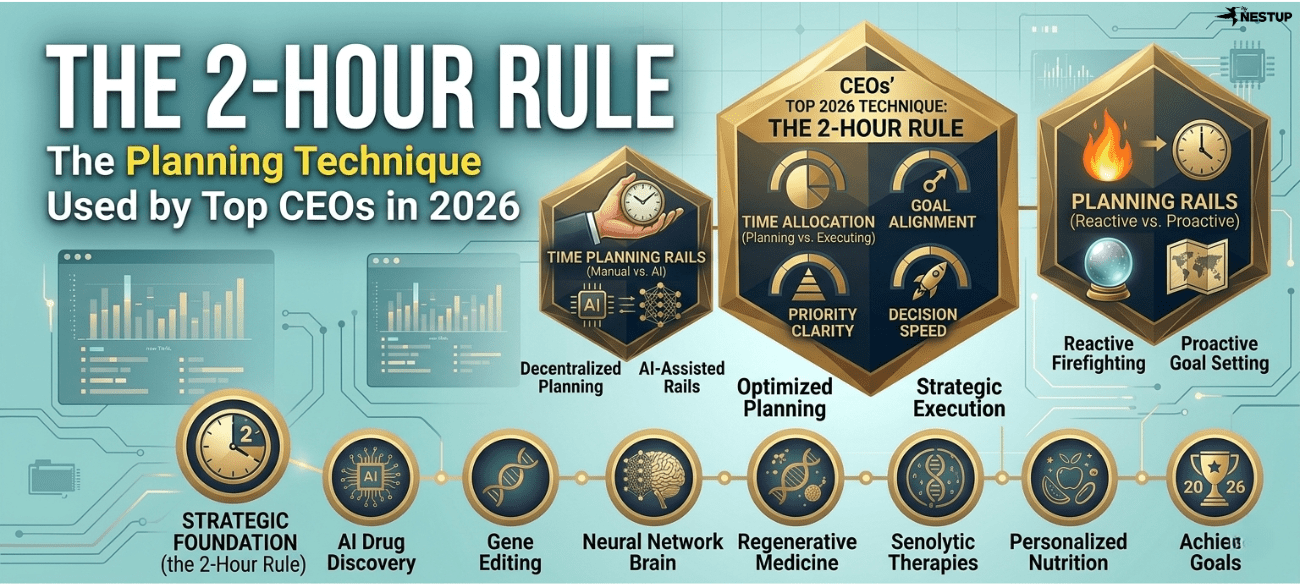
Modern executives are currently enduring a high-speed stagnation: they possess more information than any generation of leaders in history, yet they have never had less clarity. This is the poverty of insight—a direct result of a landscape where fragmented attention and reactive firefighting are the default.
Top CEOs treat the "2-Hour Rule" not as a calendar option, but as a strategic engine. It is a non-negotiable weekly commitment designed to transition a leader from a passenger in their own schedule to the architect of their organization’s trajectory.
Thinking is the Job, Not a Luxury
The 2-Hour Rule is defined as one uninterrupted 120-minute block per week dedicated exclusively to thinking, reviewing, and deciding. For the high-level executive, this is not "time off"—it is the most high-value work on the calendar. To master this, one must ruthlessly distinguish between low-value activity and high-value direction.
Low-value work—catching up on emails, administrative tasks, or passive reading—creates the illusion of progress while sacrificing strategic alignment. High-value thinking is about direction: ensuring the organization is moving toward the right objective rather than simply moving fast in the wrong one. The litmus test for this clarity is the written word.
"If you’re not producing written thoughts, you’re probably not thinking clearly."
As Warren Buffett’s approach suggests, clear thinking and writing are inseparable. If you cannot articulate your strategy on paper during these two hours, you do not have a strategy; you have a wish.
The "One-Way Door" Filter for Decision Making
A primary goal of protected thinking time is to manage organizational velocity. Jeff Bezos famously categorizes decisions into "one-way" and "two-way" doors to prevent the bottleneck of executive overthinking.
- One-Way Doors: Irreversible, high-impact choices. These are the only decisions that earn a place in your 2-hour thinking block.
- Two-Way Doors: Decisions that can be reversed or changed.
The 2-Hour Rule provides the space to identify these filters. By isolating irreversible, high-impact choices for deep reflection, you empower the rest of your organization to move fast on two-way door decisions without your intervention. This increases speed across the board while ensuring your limited cognitive energy is reserved for the choices that are permanent.
The 4-Part Thinking Protocol
Deep thinking requires structure to avoid becoming a session of aimless rumination. To turn abstract ideas into concrete results, the session must follow a disciplined 120-minute flow:
- Phase 1: Review (Minutes 1–30)
- Goal: Build awareness, not judgment.
- Questions: What were the 3 biggest outcomes this week? What surprised me?
- Phase 2: Diagnose (Minutes 31–60)
- Goal: Extract lessons, not blame.
- Questions: What worked—and why? What didn't—and why?
- Phase 3: Decide (Minutes 61–90)
- Goal: Reduce noise and focus effort.
- Questions: What are the top 3 priorities next week? What will I ignore?
- Phase 4: Design (Minutes 91–120)
- Goal: Turn thinking into action.
- Questions: What actions will I take? Who owns what? What goes on the calendar?
The Most Productive List is the "Stop Doing" List
Standard productivity focuses on addition—adding tasks, adding goals, adding meetings. True executive leverage, however, comes from subtraction. The "Stop Doing" list is a mandatory output of a successful thinking session.
During the "Decide" and "Design" phases, you must produce a tangible list of eliminations. Use these specific prompts to identify delegation or elimination opportunities:
- What am I doing that no longer matters?
- What can be delegated or eliminated?
Real productivity gains are found in removing the legacy tasks and low-priority noise that distract from your primary objectives.
Judgment as the Ultimate 2026 Competitive Advantage
As we look toward the landscape of 2026, AI is increasingly automating the "how" of business—execution, data processing, and routine information flow. In this era, the value of execution is commoditized.
What remains uniquely human, and therefore the only remaining competitive moat, is judgment. The 2-Hour Rule is a training regimen for the only skills AI cannot replicate: high-stakes prioritization and strategic clarity. While the machines handle the execution, the leader must own the "why" and the "what." This habit shifts you from reacting to the week to intentionally designing it.
The Environment: Designing for Depth
The environment is the "strategic moat" of your thinking session. The quality of your output is capped by the quality of your focus.
Environmental Non-Negotiables:
- Device Management: No phone or active airplane mode.
- Buffer Zones: No meetings scheduled immediately before or after the session to protect mental transitions.
- Physical Space: A quiet, distraction-free environment.
Optional Upgrades:
- Analog Tools: Use pen and paper to force mental slowing and clarity.
- Movement: A walking session can stimulate thought for leaders who think better in motion.
- Consistency: Schedule the block at the same time every week to build the neural pathways of a habit.
Rule of Thumb: If interruptions are possible, your thinking won’t go deep enough.
Conclusion: From Reaction to Design
The transformation offered by the 2-Hour Rule is a shift from exhaustion to authority. Most leaders spend their careers as passengers, buffeted by the demands of their inbox and the urgency of others.
By applying this rule consistently, you move beyond surviving your schedule. The goal is to stop being a passenger in your own week and start designing it. If you are not dedicating this time to the "why" of your business, you are simply working fast toward a destination you haven't vetted.
Are you truly leading, or are you just the most active person in the room?