
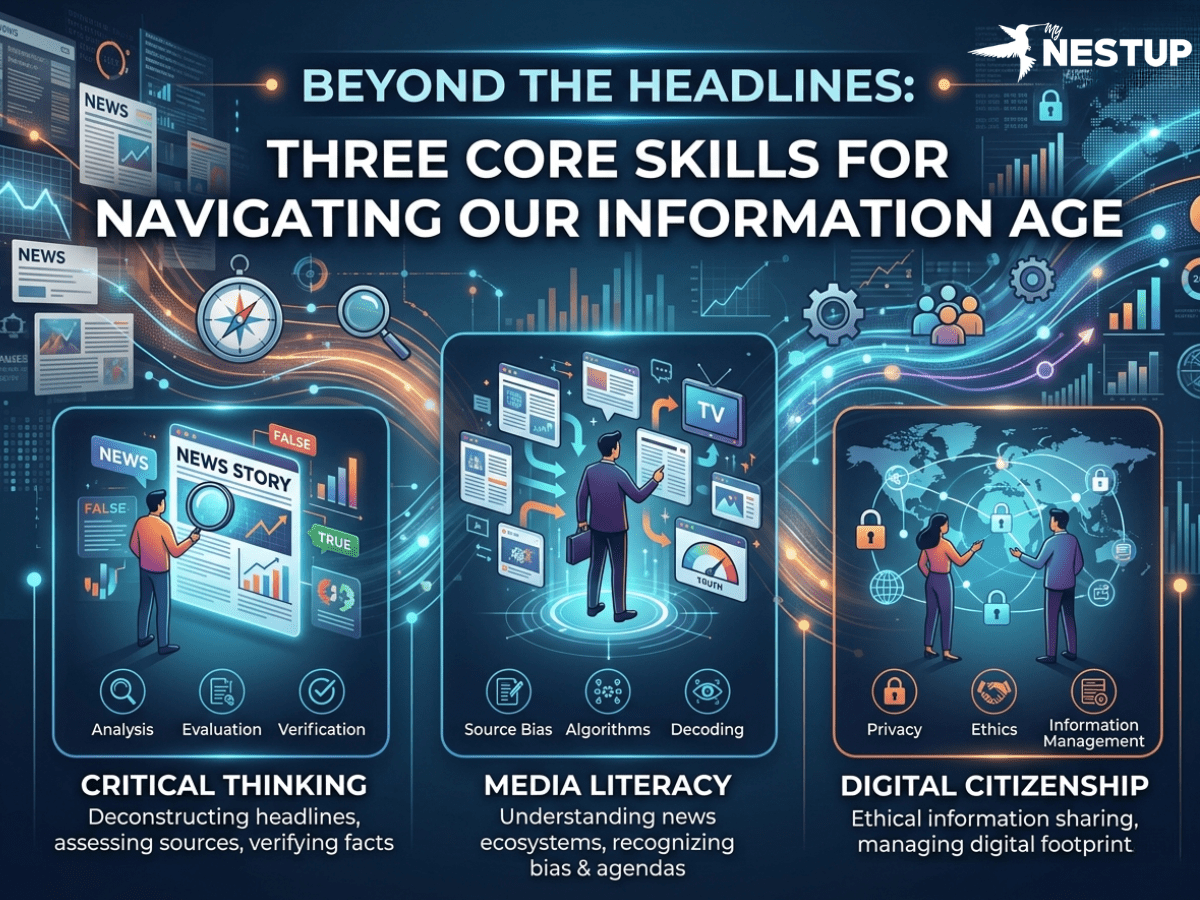
In a world saturated with information, opinions, and endless "content," it’s easy to feel overwhelmed. Distinguishing a credible report from a persuasive opinion or a simple mistake can feel like a full-time job. We are constantly tasked with making sense of complex events, but we are rarely given the tools to do so effectively.
The good news is that a clear framework for this challenge already exists. Journalists, researchers, and expert commentators use a specific set of powerful—and surprisingly simple—skills to bring clarity to chaos. These aren’t secrets, but disciplines. This article will reveal three of these core skills to help you move from being a passive consumer to a discerning reader of information.
1. Reliable Narratives Are Built, Not Just Found
The first, and perhaps most fundamental, insight is that a credible understanding of an event isn't something you stumble upon fully formed. It is the result of a disciplined process called fact synthesis. This involves methodically gathering pieces of information from multiple sources, verifying them, and then carefully combining them into a coherent and accurate narrative.
This idea is powerful because it reframes how we should view reliable information. A trustworthy story isn't just a collection of facts; it's the product of rigorous work. This work involves not only constructing a unified summary but also making critical judgments, especially when sources conflict. It means cross-checking claims and, when faced with contradictions, making the crucial decision to resolve discrepancies by prioritizing stronger evidence.
Fact synthesis is the process of gathering information from multiple sources, evaluating credibility, identifying patterns or contradictions, and combining verified facts into a coherent, accurate narrative.
2. Credibility Is a Discipline, Not a Feeling
One of the most critical skills for any credible communicator is the ability to draw a sharp line between verifiable evidence (facts) and subjective interpretations (opinions). A fact is a statement that can be proven true, while an opinion is a judgment or belief. Blurring this line, whether intentionally or not, is a primary driver of misinformation.
Maintaining this separation is a deliberate practice, not an accident. Professionals use several clear techniques to maintain credibility, including explicitly labeling their opinions with phrases like "In my view..." or "Analysts argue...", presenting the evidence before drawing a conclusion from it, and avoiding emotionally loaded language when reporting facts. This is an empowering takeaway for the reader, as it provides clear, actionable signals to look for when evaluating whether a source is providing objective information or trying to push a particular viewpoint.
3. Every Story Has an Angle—And That’s How It Becomes Meaningful
It’s tempting to believe that the best information is delivered without any perspective at all. However, a "story angle" is the specific hook that makes a set of facts engaging, relevant, and newsworthy. An angle isn’t necessarily a form of bias; it's a necessary tool of effective communication that answers the reader’s unspoken question: "Why does this matter?"
Angles are developed by focusing on specific elements of a story, such as its human impact, conflict, timeliness, proximity, or novelty. By choosing a specific lens, a writer can make a complex topic understandable and relevant to a particular audience. This demystifies the news. Instead of just accepting a story as it's presented, you can see the deliberate choice behind it. The most powerful way to use this insight is to actively brainstorm multiple perspectives on the same facts. Ask yourself: What other angles could have been chosen for this story? Whose voice is missing? This single habit transforms you from a passive consumer into a critical analyst.
A story angle is the specific perspective or "hook" that makes a topic newsworthy and engaging. Developing strong angles involves finding uniqueness in familiar events.
From Passive Consumer to Active Architect
These three skills work together to form a powerful framework for understanding the world. They reveal that reliable information is synthesized from many parts, that credibility is a discipline that separates fact from opinion, and that stories are consciously angled to make them impactful and meaningful. These skills build on one another: Accurate synthesis provides the raw material, disciplined separation of fact from opinion ensures its integrity, and a well-chosen angle gives it meaning.
Armed with this knowledge, you are no longer just a passive recipient of information. You can begin to see the structure behind the story, the evidence behind the claim, and the perspective that gives it shape. Now that you can see the architecture behind the information you consume, what will you look for differently?