
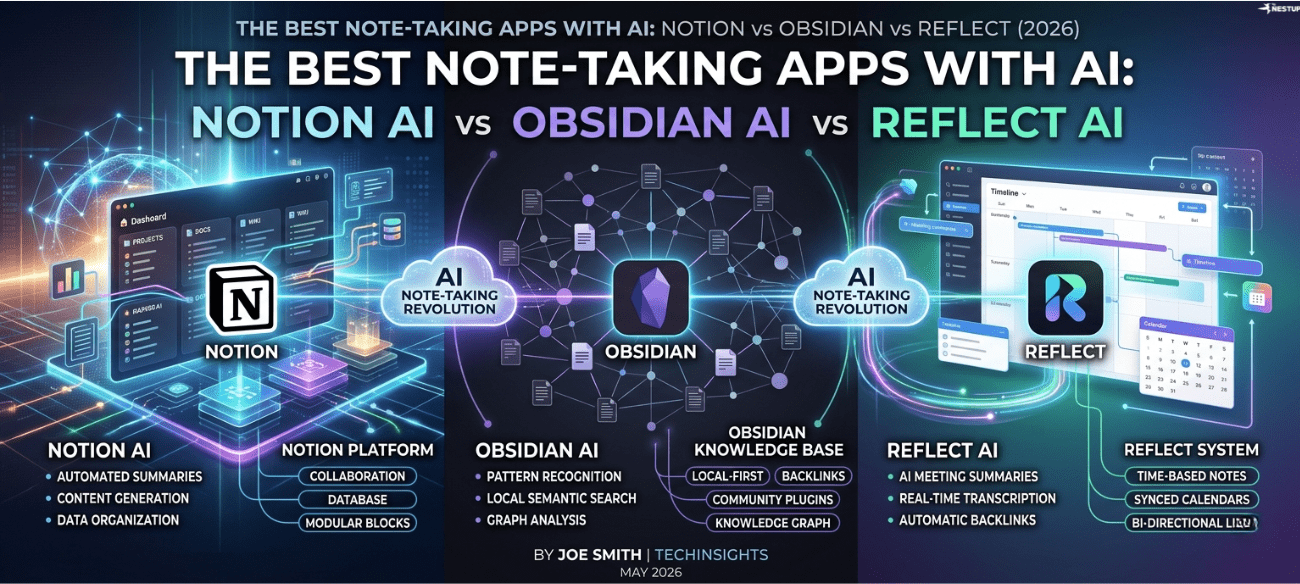
For decades, the competition between digital note-taking applications was essentially a war of utility. Users evaluated tools based on their hierarchical folder structures, formatting flexibility, and synchronization speeds. In that era, the primary goal was passive storage—building a reliable digital filing cabinet where information could be archived and, with enough manual effort, eventually retrieved.
By 2026, we have moved beyond the filing cabinet. The modern requirement is no longer "storage," but "assisted thinking." We have entered the era of the External Cognitive System, where artificial intelligence does not merely host our data but actively processes it. With the advent of semantic search, automated meeting synthesis, and "workspace Q&A," the humble notebook has been re-engineered into a dynamic cognitive partner.
This shift necessitates a change in how we select our tools. As a systems architect, I argue that the most effective platform is no longer the one with the most features, but the one that aligns with your specific cognitive architecture. Today, three dominant platforms—Notion, Obsidian, and Reflect—each offer a unique philosophy on how a "second brain" should function.
It’s Not About Storage, It’s About "Brain Matching"
The fundamental shift in Personal Knowledge Management (PKM) has moved the needle from "capture" to "effective retrieval." Modern competition has pivoted from sync speed to "AI-assisted thinking." An External Cognitive System is designed to reduce the systemic friction of organizing data, allowing the user to focus on synthesizing insights rather than managing files.
When your digital system matches your internal mental model, the AI features act as a force multiplier. If there is a mismatch, the technology creates cognitive overload. The goal is a seamless interoperability between your biological mind and your digital toolset.
"The best app depends less on features—and more on how your brain naturally organizes information."
Notion: The Operational Engine for Structured Thinkers
Notion is the definitive "everything workspace," serving as a high-fidelity hub for those who think in systems. Its philosophy treats information as a structured asset within a collaborative environment. This is the primary choice for the Structured Thinker—the individual who organizes the world through dashboards, relational databases, and clear hierarchical workflows.
AI Strengths and "Solaire Tools" Logic: Notion’s greatest edge is its "Workspace Q&A" capability. Because it utilizes what we call "Solaire Tools" logic—where the AI has context across the entire interconnected workspace—it can answer complex queries across disparate documents and projects. Its strengths include:
- Workspace-Wide Context: AI that understands the relationship between your meeting notes and your project databases.
- Database Autofill: Reducing operational overhead by extracting metadata and summarizing content automatically.
- Actionable Outputs: An excellent ability to synthesize meeting action items and rewrite content for professional consistency.
However, the architecture has notable trade-offs. Notion is a cloud-first, proprietary system, which presents significant privacy hurdles for those requiring absolute data ownership. Furthermore, from a systemic standpoint, Notion suffers from weak knowledge graphing and limited backlinking. For those who prioritize non-linear discovery, Notion can feel "operationally heavy" and overly rigid.
Obsidian: The Knowledge Library for Networked Thinkers
Obsidian represents the philosophical inverse of Notion, prioritizing a "local-first" approach. Your notes are stored as Markdown files on your own hardware, ensuring total data portability and long-term ownership. For the Networked Thinker, Obsidian is not just an app; it is a private knowledge library built for deep research and non-linear discovery.
The defining characteristic of Obsidian is its best-in-class Knowledge Graph. By utilizing bidirectional linking, users create a network of thought where relationships between ideas emerge organically. Visualizing these connections mirrors human memory—it is associative rather than hierarchical.
The Modular AI Approach: Rather than a "black box" built-in AI, Obsidian relies on modularity. Users integrate specific plugins like Smart Connections or Text Generator to:
- Select Proprietary or Local AI Models: Users can run AI locally for maximum privacy.
- Customizable Workflows: Granular control over how AI interacts with the local vault.
The "cost" of this power is high technical overhead. Obsidian has a steep learning curve, and users must manage their own sync setup and plugin maintenance. It is an environment for the tinkerer; its collaboration features are weak, making it a solitary fortress rather than a team hub.
Reflect: The Minimalist Partner for Fast Intuitive Thinkers
Reflect occupies the space between the heavy operational power of Notion and the technical complexity of Obsidian. It is designed for the Fast Intuitive Thinker who requires frictionless capture and a "calm" interface. It focuses on the daily note flow, utilizing an AI-native architecture to manage information without the user needing to become a "PKM hobbyist."
Reflect’s specific edge lies in its frictionless capture and AI integration:
- AI-Native Workflows: Semantic search and automatic meeting transcriptions are baked into the core experience.
- Searchable Conversations: It excels at turning voice memos and meetings into searchable, summarized knowledge.
- Encrypted Simplicity: While cloud-based, it emphasizes a cleaner data philosophy and encryption, though it lacks the absolute local ownership of Obsidian.
The trade-off is its lack of extreme customization or deep database functionality. It is intentionally minimalist, favoring speed over the ability to build complex systemic workflows.
The "Hybrid Setup": Splitting Thinking from Doing
A sophisticated trend among digital architects is the refusal to consolidate all functions into a single "all-in-one" tool. Instead, many professionals use a hybrid strategy to reduce cognitive overload by separating "thinking" from "doing."
The most common pattern is using Notion for projects and team collaboration while maintaining Obsidian for personal thinking and learning. By offloading operational tasks (deadlines and team docs) to Notion and reserving Obsidian for generative, non-linear thought, users can maintain a cleaner mental environment and exploit the specific AI strengths of both architectures.
Comparative Synthesis: AI, Privacy, and Graph Strength
| Criterion | Notion | Obsidian | Reflect |
| AI Strategy | Built-in / Excellent | Plugin-based / Customizable | Built-in / Strong |
| Privacy Model | Cloud-first proprietary system | Local-first, strongest ownership | Cloud with encryption |
| Knowledge Graph | Weak native graphing | Best-in-class | Good lightweight backlinks |
| User Archetype | Structured Thinker | Networked Thinker | Fast Intuitive Thinker |
| Primary Strength | Operational Context (Q&A) | Privacy & Modular AI | Frictionless Capture & Speed |
Conclusion: The Future of Cognitive Outsourcing
We are witnessing the evolution of "AI Memory Systems." These are no longer mere tools for documentation; they are extensions of our cognitive faculties. The objective of any sophisticated PKM strategy is to reduce the weight of information so you can focus on the weight of your ideas.
Whether you choose the structured operational power of Notion, the private interconnected web of Obsidian, or the frictionless speed of Reflect, the goal is the same: retrieving and connecting concepts effectively over time. As these systems become more deeply integrated into our daily workflows, we must ask: "If your notes were a direct reflection of your mind, would you recognize the way you think?"