
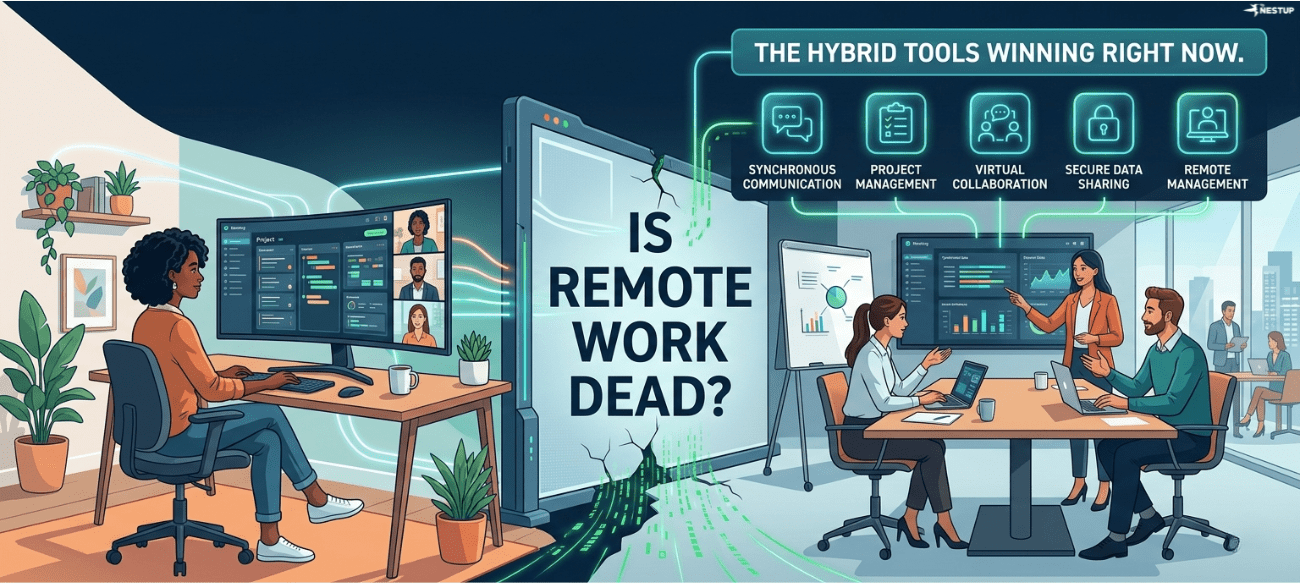
In 2023, the headlines were as definitive as they were loud: "Remote Work is Dead." Return-to-office mandates were touted as the ultimate corporate weapon, and executives argued that culture was eroding in the absence of cubicles. Fast-forward to 2026, and those predictions weren't just wrong; they fundamentally misunderstood the tectonic shift already in motion.
The narrative of remote work’s "demise" was actually a productive lie. By claiming the experiment had failed, the corporate world stopped trying to haphazardly replicate the 2019 office experience over Zoom. Instead, it was forced to build something entirely new: a hybrid-first infrastructure. Today, we don’t debate where work happens; we optimize for how it is coordinated.
Hybrid Isn’t a Compromise—It’s the Operating System
By 2026, the landscape of knowledge work has shifted from the "remote-first" idealism of the pandemic to a sophisticated "hybrid-optimized" reality. This is no longer a temporary fix for a global crisis; it is the default state of the modern enterprise.
The most successful companies now operate with a structured cadence—typically 2–3 office days per week—balancing physical presence with the reality of distributed global teams. This evolution required moving beyond the simple assumption that "everyone is remote" to solving the much harder problem of managing a workforce split across time zones and physical locations. As the industry has matured, one thing has become clear:
"Hybrid isn’t a temporary compromise anymore—it’s the operating norm."
The Erasure of the Hour-Long Calendar Block
One of the most significant psychological shifts in the workplace has been the decline of the formal, scheduled video call. Tools like Slack Huddles and Around have redefined digital interaction by prioritizing "informal proximity."
The success of these tools stems from a critical realization: people didn't actually hate video technology; they hated the fatigue and constant self-monitoring required by traditional conferencing. By utilizing minimal UIs and features like "floating avatars," these platforms reduce the cognitive load of "being on camera." They allow for instant, lightweight audio and video layers that mimic spontaneous office interactions, effectively reducing communication friction and the dreaded calendar overload.
Documentation as the Ultimate Scaling Strategy
As hybrid teams matured, they discovered a fundamental truth: meetings do not scale. This realization fueled the rise of tools like Loom and Linear, which prioritize "async clarity" over real-time dependency.
In 2026, a company’s ability to document is its ability to grow. Linear has gained dominance by optimizing for speed and simplicity in engineering workflows, proving that hybrid work punishes unclear project management. In this environment, operational clarity is no longer a luxury—it is the cultural infrastructure that allows a team to function without being in the same room.
What asynchronous communication now replaces:
- The friction of repetitive onboarding walkthroughs.
- Daily status meetings that drain creative momentum.
- Overwhelmingly long, multi-person documentation threads.
- The dependency on real-time presence across global time zones.
The High Cost of the "Spectator" Problem
Despite the efficiency of hybrid models, the "Proximity Bias" problem remains the primary cultural challenge of the decade. Employees in the physical office often gain more visibility and faster networking opportunities, while remote staff risk isolation and slower promotion tracks.
The most dangerous practice in 2026 is the "office-first" meeting, where remote employees are treated as mere spectators to a conversation happening in a room. Winning teams solve this through intentional systems rather than hallway assumptions. This requires a "default-to-digital" documentation practice, ensuring that every decision made casually over coffee is immediately recorded and accessible to the entire distributed team.
The Rise of the Meeting Operating System
The technology we use for collaboration has evolved from simple communication apps into comprehensive AI suites. Zoom Workplace serves as the prime example, shifting from a video conferencing tool to an AI-powered meeting operating system.
By automating "communication management"—handling everything from AI meeting summaries and automated action items to searchable knowledge retrieval—AI has fundamentally reshaped human labor. We now spend significantly less time managing the process of communication and more time on the actual execution of work. AI ensures that the context of a meeting is never lost, even for those who weren't in the room.
The Future is Distributed and Asynchronous
The organizations thriving in 2026 are those that have stopped the "office vs. remote" debate and started focusing on clarity and flexibility. They have traded the ghost of the 2019 floor plan for intentional systems that empower a distributed workforce.
As you look at your own organization, ask yourself: Are you designing a system for the way we work now, or are you still attempting to manage by hallway assumptions?
The final takeaway of this decade is clear: The future of work isn’t fully remote or fully in-office. It’s distributed, flexible, and increasingly asynchronous.