
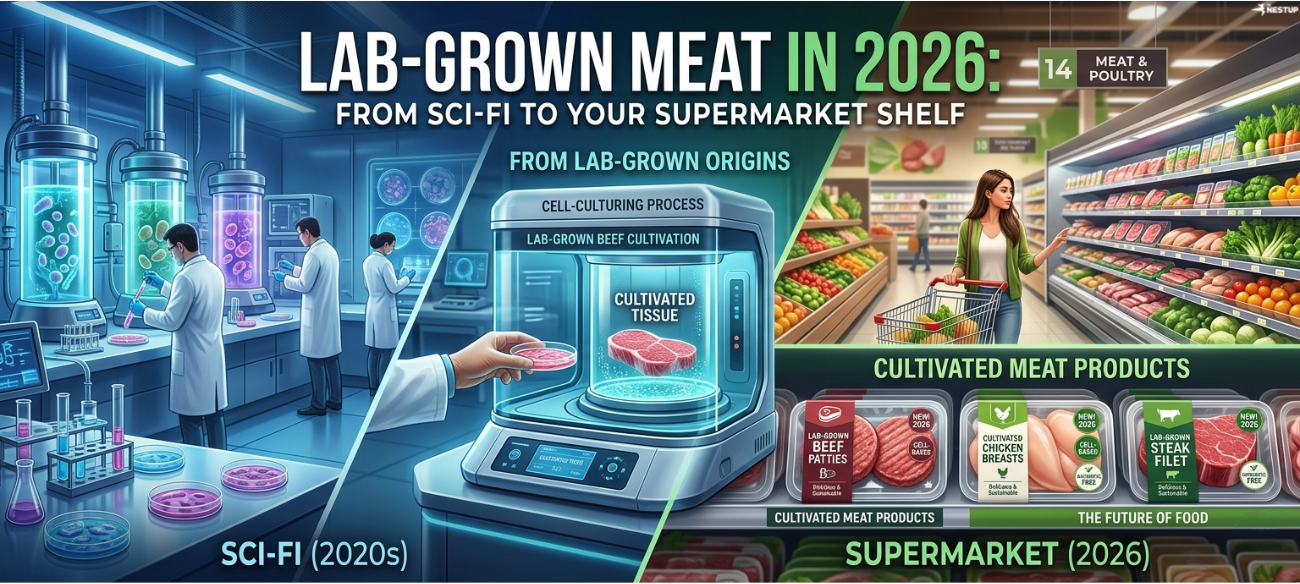
Introduction: The Dinner Plate of the Future has Arrived
Walk down the refrigerated aisle of a high-end grocer in late 2026, and you’ll notice a subtle but profound shift in the landscape of protein. Nestled between the organic poultry and the grass-fed beef is a new category altogether: "Cultivated." For decades, the concept of "lab-grown meat" was a convenient trope for science fiction writers—a sterile solution for a crowded planet. Today, it is a commercial reality.
It is vital to clear up a common misconception: this is not a veggie burger. While plant-based alternatives have paved the way for meat reduction, cultivated meat is biologically actual meat. It is grown from animal cells, possessing the same flavor profiles, fats, and muscle fibers as the steaks and chicken breasts we’ve eaten for millennia. As we navigate this industrial revolution, we are discovering that while the biology has been mastered, the transition from a laboratory curiosity to a global food staple is fraught with engineering and psychological hurdles.
Takeaway 1: It’s Not a Veggie Burger—It’s Molecularly Identical
The most startling realization for the average consumer is that cultivated meat is not a "substitute." It is the real thing, produced through a sophisticated four-step biological journey:
- Cell Collection: A small, painless sample of cells is harvested from a living animal.
- Bioreactor Growth: These "starter" cells are placed in nutrient-rich tanks called bioreactors.
- Tissue Multiplication: Immersed in a controlled environment, the cells multiply, forming actual muscle and fat tissue.
- Harvesting: The resulting tissue is harvested and prepared as edible meat.
This distinction is the cornerstone of the industry’s bid for consumer adoption. However, a clear generational divide is emerging. While younger, climate-conscious consumers have embraced cultivated protein as an ethical evolution, older demographics remain more skeptical, often questioning the "naturalness" of the process. For the livestock industry, this technology represents a looming disruption that has shifted their stance from dismissal to cautious investment and intense lobbying over labeling.
Takeaway 2: The "Scientific" Problem is Solved, but the "Industrial" Problem is Just Beginning
Thirteen years ago, Mosa Meat debuted the world’s first cultivated burger prototype—a single patty that cost hundreds of thousands of dollars to produce. Since then, costs have plummeted, but the industry has hit a new wall.
"The challenge isn’t scientific anymore—it’s industrial."
The shift from the research phase to commercialization has revealed three massive bottlenecks. First is the growth media: cells require nutrient-rich solutions to survive. The industry is currently in a high-stakes transition, moving away from expensive pharmaceutical-grade ingredients toward cheaper, food-grade alternatives. This transition is the literal linchpin for reaching price parity by 2030.
Second is the infrastructure. Scaling production requires massive stainless-steel bioreactors and precise environmental controls—a capital-heavy undertaking that requires significant engineering. Finally, the supply chain for these specialized components simply does not yet exist at the scale required to feed a nation.
Takeaway 3: Singapore Beat the World to the Table
While the rest of the world’s regulators were still defining what "cultivated" meant, Singapore established itself as the global leader. The island nation moved first for three strategic reasons: an urgent need for food security, an innovation-friendly regulatory climate, and a national interest in diversifying protein sources.
The United States followed, with the FDA and USDA providing oversight for pioneers like Upside Foods and GOOD Meat. These approvals served as a major legitimacy breakthrough, signaling to global markets that the tech was ready for prime time. Meanwhile, Europe remains the slowest mover. Hampered by stricter food approval frameworks and a political landscape deeply protective of traditional agricultural heritage, the Continent’s commercialization timeline remains significantly longer.
Takeaway 4: The Environmental Impact Hinges on a "Clean" Grid
The environmental promise of cultivated meat is its most potent marketing tool. On paper, the benefits are staggering: a massive reduction in land use, lower water consumption, and the total elimination of methane emissions from cattle.
However, the reality is more nuanced. Cultivated meat production is incredibly energy-intensive. If these massive bioreactor facilities are powered by a fossil-fuel-heavy grid, the carbon gains over traditional livestock shrink substantially. In a very real sense, the "clean meat" brand identity is a hostage to the energy sector. For the climate case to hold its integrity, renewable energy is critical to the manufacturing process. Without a green grid, the sustainability argument loses its teeth.
Takeaway 5: We Can Make a Nugget, but We Can’t (Yet) Make a Ribeye
As of 2026, the industry has mastered the "processed" format. Cultivated chicken nuggets and minced meat products from companies like GOOD Meat and Upside Foods have reached a point where the taste and texture are virtually indistinguishable from conventional versions.
The final frontier of culinary legitimacy remains the "thick steak." Replicating the structural complexity of a ribeye—with its intricate marbling, fat distribution, and tough muscle fibers—requires advanced tissue engineering that the industry has yet to scale. Replicating a premium steak is orders of magnitude harder than producing a chicken nugget, and until a bioreactor can grow a perfect filet mignon, cultivated meat will likely remain centered around ground and processed formats.
The 2030 Roadmap: A Protein Category of Its Own
As we look toward the next decade, the roadmap is becoming clear. Between 2026 and 2030, cultivated meat will continue to expand as a premium niche, primarily appearing in high-end restaurants and through limited pilot launches. However, the window between 2030 and 2035 is where the real shift occurs. As manufacturing scale increases and cost-efficiency improves, a wider supermarket presence becomes a realistic possibility.
The bottom line is that this technology won’t replace traditional meat overnight. Instead, it is creating an entirely new category of protein that will exist alongside conventional and plant-based options. As we move toward 2035, the ultimate hurdle won’t be the price or the technology—it will be the psychology of the consumer. As the cost curve drops and the product becomes a normal sight on the shelf, will our perceptions of "naturalness" and safety evolve? Only time, and the price tag, will tell.