
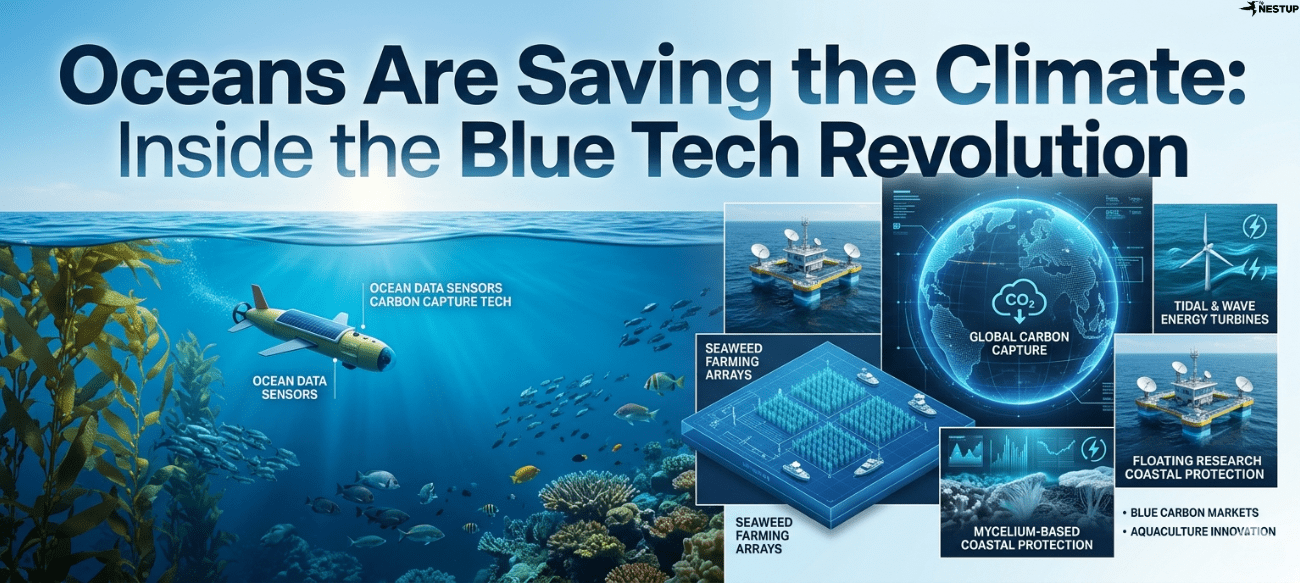
1. Introduction: The Great Shift Seaward
For the better part of two decades, the "Green Tech" narrative has been fundamentally landlocked. We have obsessed over solar arrays in the Mojave, lithium mines in the Andes, and the steady march of electric vehicles down our suburban streets. But while we focused on the terra firma, a quieter, more profound revolution was gathering momentum offshore.
We are entering the era of the "Blue Tech Revolution." The ocean is no longer being viewed through the narrow lens of conservation or a niche environmental sector; it is being reimagined as a critical, high-tech pillar of global decarbonization. The core premise is a pivot toward the inescapable: the ocean is the planet's primary climate regulator, and to meet our climate goals, we must move from merely protecting it to actively engineering with it.
2. Takeaway 1: The Planet’s Greatest Climate Buffer is Already Underwater
The ocean has been performing the heavy lifting of climate regulation for centuries, largely out of sight and off the balance sheet. It is a massive, natural heat sink and carbon repository that dwarfs any man-made system currently in operation.
"The oceans absorb roughly 25–30% of human-generated CO₂ emissions and more than 90% of excess planetary heat. That makes them the planet’s largest climate buffer." — The Guardian
Despite this, the tech sector has historically overlooked the sea. The reason is simple: the marine environment is brutally indifferent to hardware. Saltwater corrodes, storms destroy, and the sheer vastness makes monitoring nearly impossible. However, venture capital is finally reckoning with the fact that "ocean-scale" is the only scale that matters. If we are to achieve gigaton-level carbon removal, the ocean is not just an option—it is the only frontier with the inherent capacity to handle the load.
3. Takeaway 2: Kelp is the New Industrial Infrastructure
Seaweed has undergone a radical rebranding, moving from a health-food niche to a cornerstone of industrial infrastructure. The catalyst is kelp’s staggering growth speed—certain species can grow over a foot per day—allowing it to sequester carbon, nitrogen, and excess nutrients with a biological efficiency that land plants cannot match.
Startups like Running Tide, Ocean Rainforest, and Coast4C, alongside industrial-scale players like Rongbient and Birufinery, are now positioning kelp as a regenerative replacement for high-emission materials:
- Plastics: Developing biodegradable bioplastics that decompose without a trace.
- Fertilizers: Creating organic alternatives to synthetic, high-emission agricultural inputs.
- Livestock Feed: Utilizing additives that significantly reduce methane emissions from cattle.
- Textiles and Packaging: Engineering sustainable raw materials for the fashion and shipping industries.
- Biofuels: Providing a renewable, ocean-based energy source.
Beyond the products themselves, this shift is revitalizing coastal economies. By integrating seaweed farming into regenerative aquaculture, these companies are reducing the economic pressure on wild fisheries and creating new, climate-positive income streams for coastal communities. For investors, kelp offers a rare "multi-exit" potential: it is a climate-positive asset that is simultaneously a high-demand commercial commodity.
4. Takeaway 3: The High-Stakes Gamble of Ocean Alkalinity Enhancement (OAE)
Ocean Alkalinity Enhancement (OAE) represents the most ambitious, and perhaps most controversial, technical play in the Blue Tech portfolio. The process involves adding alkaline minerals or utilizing electrochemical treatments to seawater to increase its pH, thereby boosting its natural ability to absorb CO₂ and mitigating the devastating effects of ocean acidification.
The sector is no longer just theoretical; it is attracting serious capital. Startups like Ebb Carbon, Planetary Technologies, and Equatic are leading pilot programs, while Gigablue recently secured a $20 million raise to scale its systems. This momentum is further validated by corporate giants like Microsoft and Boeing, which have begun purchasing ocean carbon-removal credits to hedge their long-term sustainability goals.
The tension, however, is palpable. We are weighing the potential for gigaton-scale climate stabilization against the risk of unforeseen chemical imbalances. While proponents argue that OAE simply accelerates a natural geochemical cycle, critics remain wary of "unintended ecological effects" on marine life. This is the ultimate futurist’s gamble: can we safely manipulate the chemistry of our largest ecosystem to save it?
5. Takeaway 4: Wind Energy is Moving into the Deep
Offshore wind is undergoing a fundamental engineering shift, moving from fixed-bottom turbines in shallow waters to floating platforms in the deep. This transition unlocks the massive power of deep-ocean winds, which are far more consistent and powerful than those near the shore.
Pioneered by nations like Norway, Japan, and the UK, this shift requires overcoming "brutally difficult" engineering hurdles:
- Structural Integrity: Designing platforms to withstand extreme wave stress and constant salt-spray corrosion.
- Resilience: Engineering for hurricane-grade weather and deep-water mooring.
- Advanced Logistics: Managing maintenance and energy transmission in remote, hostile environments.
The most visionary applications for this energy aren't just for the grid. Startups like Panthalassa are exploring a new industrial paradigm: offshore AI data centers. These deep-sea hubs would be powered by a combination of floating wind and wave energy, utilizing ocean cooling systems to manage the massive heat generated by AI processors. It is a circular, offshore economy where clean power and natural cooling converge.
6. Takeaway 5: Turning Ecosystems into Investable "Blue Carbon" Assets
"Blue Carbon" refers to the sequestration potential of coastal ecosystems—mangroves, seagrasses, and salt marshes. Per acre, these environments can store significantly more carbon than tropical rainforests, yet they remain under-protected.
The move to "financialize" these ecosystems through carbon credits is accelerating. However, as land-based carbon markets face a crisis of credibility and "greenwashing" accusations, the Blue Tech sector is taking a more technical approach. To ensure these assets are truly permanent and verifiable, the industry is building out autonomous ocean monitoring networks. These sensors and robotics provide the rigorous, real-time data needed to prove that a restored mangrove forest is actually doing its job. By treating coastal restoration as "revenue-generating carbon infrastructure," we are finally putting a market price on the biological services that keep our planet habitable.
7. The $2 Billion Tipping Point: Why Investors are Diving In
Ocean-climate investment has officially passed the experimental phase. In 2025, the sector attracted more than $2 billion in funding, bolstered by specialized accelerators such as Katapult Ocean, the Ocean Startup Project, and the VentureWell Ocean Enterprise Accelerator.
The appeal for venture capital lies in the sector’s diversified revenue model. Unlike early-stage land tech that often relies on government subsidies, Blue Tech companies are building multi-layered value propositions:
| Climate Problem | Ocean-Based Solution |
| Carbon removal | OAE, Kelp, Blue Carbon |
| Clean energy | Floating Wind, Wave Power |
| Industrial replacement | Seaweed Biomaterials |
| Coastal Resilience | Mangrove Restoration |
| Food Security | Regenerative Aquaculture |
By combining carbon credit revenue with energy sales, industrial products, and food production, these startups are creating a resilient investment case that is decoupled from any single regulatory or subsidy framework.
8. Conclusion: A New Technological Battleground
The seaward shift is as inevitable as it is daunting. Marine engineering is inherently high-stakes; the relentless pressure of corrosion and the unpredictable violence of storms mean that failure is the default state for the unprepared.
As we deploy gigatons of infrastructure into the deep, we are forced to confront a critical reality: the speed of capital is currently moving faster than our scientific baseline. We are effectively building a new global economy in an environment we are only beginning to understand.
Closing Thought: As the Blue Tech Revolution accelerates, we must ask: Can our scientific safeguards and regulatory frameworks keep pace with the massive influx of capital currently diving into the deep, or are we risking the very ecosystem we are trying to save?