
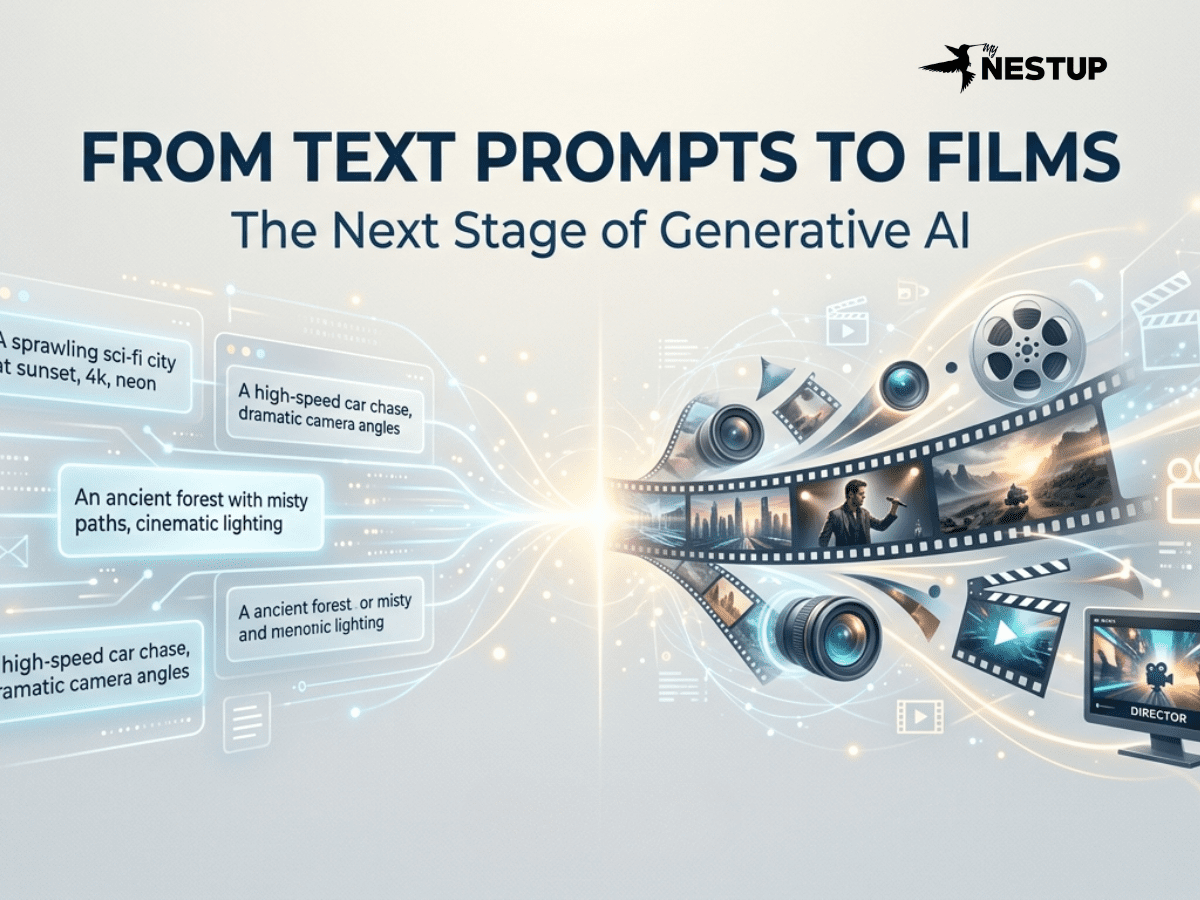
Generative AI has evolved at breakneck speed, transforming from simple text generators into sophisticated systems capable of creating images, music, and now video. The frontier that once seemed like science fiction—turning a plain text prompt into moving pictures—is here, and it's accelerating toward something even more profound: the ability to generate full films.
The Journey from Static to Dynamic: Early Text-to-Video Milestones
Just a few years ago, AI video generation produced short, often glitchy clips with inconsistent motion and poor physics. Models struggled with basic elements like human movement, object persistence, or coherent storytelling. Early tools generated a few seconds of footage at best, frequently marred by artifacts such as morphing faces or flickering backgrounds.
By 2025–2026, the landscape shifted dramatically. Leading models now deliver higher-resolution outputs (up to 4K in some cases), longer clips (10–60+ seconds), improved physics simulation, and even native audio synchronization—including dialogue, ambient sounds, and music.
Key players include:
- OpenAI's Sora 2: Excels at photorealistic motion, world simulation, and controllability. It supports extensions for continuing stories and can generate videos with sound in an accompanying app.
- Google's Veo 3.1: Stands out for native audio generation alongside visuals, making it ideal for immersive, synchronized clips.
- Runway (Gen-4.5): Prized by professionals for precise camera control, motion brushes, and cinematic fidelity.
- Kling AI (from ByteDance): Strong in realistic human motion, character consistency, and photorealism.
- Others like Luma Dream Machine and emerging tools from various labs push boundaries in speed, stylization, or specialized animation.
These advancements stem from improvements in diffusion models, transformers, and multimodal training—allowing AI to better understand prompts involving complex scenes, lighting, emotions, and narrative flow.
Current Capabilities: From Prompts to Professional-Grade Clips
Today, a well-crafted text prompt can yield stunning results. Describe a "cyberpunk detective chasing a holographic suspect through neon-drenched streets at night, cinematic lighting, rain-slicked pavement," and tools like Sora or Veo can produce coherent, emotionally charged footage with believable physics and atmosphere.
Multimodal inputs enhance this further: upload reference images for character consistency, combine text with audio cues, or use "image-to-video" to animate stills. Features like style presets (vintage, comic, musical), character anchoring, and video editing tools within platforms allow creators to iterate rapidly.
In practice, this powers real-world applications:
- Marketing teams generate personalized ads in minutes.
- Filmmakers use AI for pre-visualization, storyboarding, or VFX placeholders.
- Independent creators produce short films, music videos, or social content without massive budgets or crews.
Netflix has already incorporated generative AI into productions like the series El Eternauta, slashing time and costs for certain scenes. Short AI-generated films—sci-fi dystopias, animated adventures, or surreal experiments—proliferate on platforms like YouTube, often blending tools like Midjourney for stills with video models for animation.
The Leap to Full Films: Storytelling, Consistency, and Length
The "next stage" is stitching these clips into cohesive, feature-length narratives. Challenges remain significant:
- Consistency: Characters must retain appearance, clothing, and personality across scenes. Backgrounds and lighting need continuity. Current models still falter on long sequences, leading to "drift" where faces morph or objects disappear.
- Narrative Coherence: AI excels at visuals but struggles with deep emotional arcs, logical plot progression, or subtle character development without human guidance.
- Length and Structure: Most outputs top out at under a minute per generation. Extending to 90–120 minutes requires advanced pipelines—autoregressive continuation, multi-shot planning, or hybrid workflows combining AI with traditional editing.
- Audio and Integration: While native sound is improving, syncing complex dialogue, scores, and effects across a full story is nascent.
Despite this, 2026 marks a turning point. Experts predict AI will handle cinema-grade elements: hyper-personalized stories, real-time interactive video, and full-stack production (script → visuals → edit → sound). Multimodal models that process text, image, audio, and video simultaneously will enable end-to-end generation. Tools are already emerging for multi-scene storytelling with better character stability.
Imagine prompting: "Create a 90-minute sci-fi thriller about a lone astronaut discovering alien ruins on Mars, in the style of Ridley Scott, with tense orchestral score." Future systems could output a complete film—scenes, transitions, dialogue—ready for refinement.
Transformative Impacts on Creativity and Industry
This evolution democratizes filmmaking. Aspiring directors in Lahore, Lagos, or Los Angeles can bypass expensive equipment, unions, and studios. A single person (or small team) could produce polished shorts or even features, fostering a renaissance of diverse voices and experimental stories.
Industries beyond entertainment benefit too:
- Education: Custom animated tutorials or historical recreations.
- Advertising: Hyper-targeted, real-time videos.
- Gaming and VR: Dynamic, on-the-fly environments.
Yet, disruptions loom. Hollywood faces questions around jobs for actors, cinematographers, and editors. Copyright battles intensify as models train on vast datasets—leading to legal pushback from studios. Environmental costs are notable: generating videos consumes significant energy and water.
Authenticity and ethics matter deeply. AI-generated content risks homogenization—repetitive tropes or "uncanny valley" eeriness—unless guided by human taste. Deepfakes and misinformation add urgency for watermarking, detection tools, and transparent labeling.
The Human Element Endures
AI won't replace storytellers; it amplifies them. Directors like Jason Zada describe it as granting "superpowers"—rapid world-building from ideas to visuals in days, not months. The best results emerge from human-AI collaboration: crafting nuanced prompts, refining outputs, injecting emotional depth, and making editorial choices.
Future workflows might involve AI agents handling technical generation while humans focus on vision, themes, and audience connection. Full AI films may start as novelties or indie experiments before scaling to mainstream—perhaps personalized versions tailored to individual viewers.
Looking Ahead: The Cinematic Horizon
From basic text prompts to immersive, audio-rich clips, generative AI has already rewritten the rules of visual creation. The next stage—coherent, feature-length films generated on demand—feels inevitable, driven by faster compute, smarter architectures, and creative demand.
This isn't the end of cinema; it's its expansion. A new golden age awaits, where barriers to entry crumble, imagination runs freer, and the line between prompt and picture dissolves. The question isn't whether AI will make films, but how humans will use this power to tell stories that move us.
The prompt is simple. The possibilities? Limitless.