
The Defining Blockchain Battle of 2026
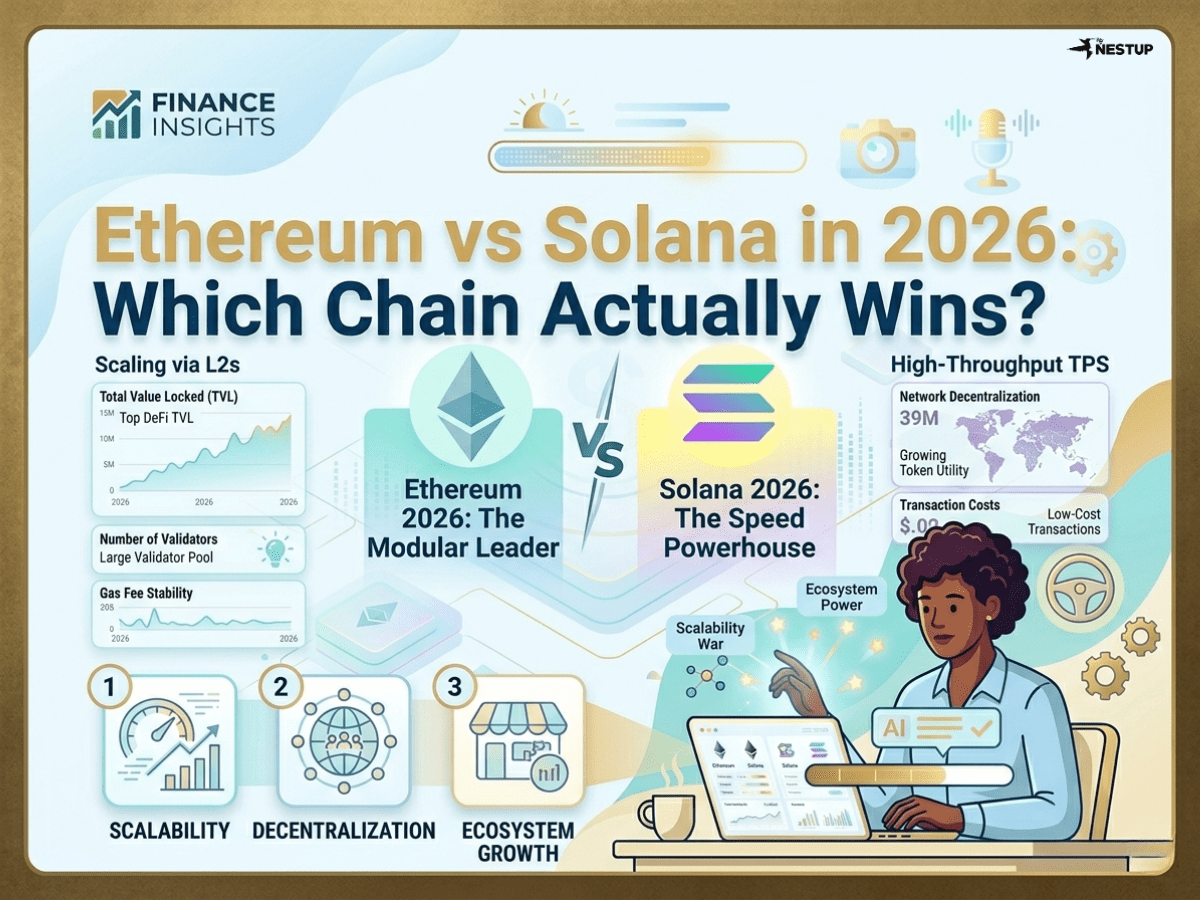
The rivalry between Ethereum and Solana has evolved into one of the most important contests in modern crypto. This is no longer just about speed or fees—it’s about which ecosystem becomes the foundation of the next internet of value. By 2026, both chains dominate the landscape, but they are winning in very different ways, appealing to different users, developers, and institutions.
Price Trends and Market Momentum
The price chart above highlights how Ethereum continues to act as a macro asset tied to institutional flows and long-term capital, while Solana (not shown here but widely tracked alongside ETH) tends to move more aggressively with retail activity and ecosystem growth. Ethereum’s price stability is often linked to its role in DeFi and tokenized assets, while Solana’s volatility reflects its rapid user growth and speculative activity cycles. This divergence mirrors their broader positioning in the market.
Transaction Throughput: Speed vs Structure
One of the clearest differences between the two chains is performance. Solana is built for speed, processing thousands of transactions per second in real-world conditions, with theoretical capacity reaching tens of thousands. Ethereum, by contrast, processes around 15–30 transactions per second on its base layer, relying heavily on Layer 2 scaling solutions to increase throughput. (CoinCreate Web3 Resources)
This creates a fundamental distinction. Solana offers a seamless, high-speed experience on a single chain, while Ethereum distributes activity across multiple layers. The result is that Solana feels faster and more responsive, but Ethereum maintains a more modular and arguably more resilient architecture.
Fees: The Cost of Using Each Chain
Fees are where Solana has a decisive advantage. Transactions on Solana typically cost fractions of a cent, often under $0.01. Ethereum, even after improvements, still ranges from cents on Layer 2 to several dollars on its main network depending on congestion. (CoinCreate Web3 Resources)
Ethereum’s Layer 2 ecosystem has significantly reduced costs—sometimes by over 90%—but it introduces complexity, such as bridging assets between networks. (paylinedata.com) Solana avoids this entirely with a single-layer design, making it more user-friendly for everyday transactions and high-frequency applications.
Developer Activity: The Network Effect Advantage
Ethereum still dominates in developer activity, with roughly 8,000+ active developers compared to around 2,000–2,500 on Solana. (Whale Factor) This gap reflects Ethereum’s long-standing ecosystem, mature tooling, and first-mover advantage.
However, the trend tells a more nuanced story. Ethereum’s growth has plateaued somewhat, while Solana’s developer base is expanding rapidly. This suggests that while Ethereum leads today, Solana is gaining momentum—especially among developers building consumer-facing applications.
Total Value Locked (TVL): Where the Money Lives
Total Value Locked (TVL) is one of the most important indicators of blockchain dominance, and here Ethereum remains far ahead. Its ecosystem holds tens of billions in locked assets, often exceeding $80–$120 billion when including Layer 2 networks. Solana, by comparison, typically ranges between $10–$20 billion. (AInvest)
This gap highlights Ethereum’s role as the financial backbone of crypto, hosting major DeFi protocols, institutional products, and stablecoin infrastructure. Solana’s TVL is smaller but more dynamic, driven by high trading activity, NFTs, and consumer apps.
Institutional Adoption vs Retail Dominance
Ethereum clearly leads in institutional adoption. Major banks, asset managers, and tokenization projects overwhelmingly build on Ethereum due to its security, decentralization, and regulatory familiarity. (Whale Factor)
Solana, on the other hand, dominates in retail-driven activity. Its low fees and fast execution make it ideal for trading, gaming, and social applications. In 2025 and 2026 data, Solana consistently led in user activity, transaction volume, and app engagement, even as Ethereum retained deeper financial integration. (CCN.com)
Ecosystem Strength: Depth vs Velocity
Ethereum’s ecosystem is deeper and more mature. It hosts the majority of high-value DeFi protocols, has the largest liquidity pools, and benefits from strong standards like ERC tokens. This makes it the preferred platform for complex, high-stakes applications.
Solana’s ecosystem, while smaller, is faster-moving and more experimental. It excels in areas like NFTs, decentralized exchanges, and consumer apps where speed and cost are critical. The difference can be summed up simply: Ethereum is where value is stored, while Solana is where activity happens.
Architecture: Layered vs Monolithic Design
Ethereum’s modular approach separates execution (Layer 2) from settlement (Layer 1), improving scalability while maintaining security. However, this adds complexity for users and developers. (paylinedata.com)
Solana uses a monolithic architecture, handling everything on a single chain. This simplifies the user experience but places greater demand on the network’s performance and stability. Each approach has trade-offs, and neither is clearly superior—it depends on the use case.
Forward-Looking Analysis: 2026 and Beyond
Looking ahead, the idea of a single winner is increasingly unrealistic. Instead, the market is converging toward a multi-chain future where both Ethereum and Solana play critical roles.
Ethereum is likely to remain the settlement layer for high-value assets, institutional finance, and long-term infrastructure. Its security, liquidity, and credibility make it difficult to replace.
Solana is positioned to dominate high-speed, consumer-facing applications, including gaming, payments, and real-time trading. Its performance advantage makes it ideal for mass adoption scenarios.
In fact, many projects are already adopting a hybrid approach—using Ethereum for security and settlement, while leveraging Solana for execution and user interaction.
Final Verdict: Who Actually Wins?
The honest answer is that neither chain fully “wins” in 2026—they win in different categories.
- Ethereum wins in trust, liquidity, and institutional adoption
- Solana wins in speed, cost, and user experience
The real outcome is not a winner-takes-all scenario, but a split ecosystem. Ethereum is becoming the financial backbone of crypto, while Solana is emerging as the high-performance engine for user activity.
If 2026 proves anything, it’s this: the future of blockchain isn’t one chain dominating—it’s multiple chains specializing and coexisting.