
Why Mental Models Matter More Than Raw Intelligence
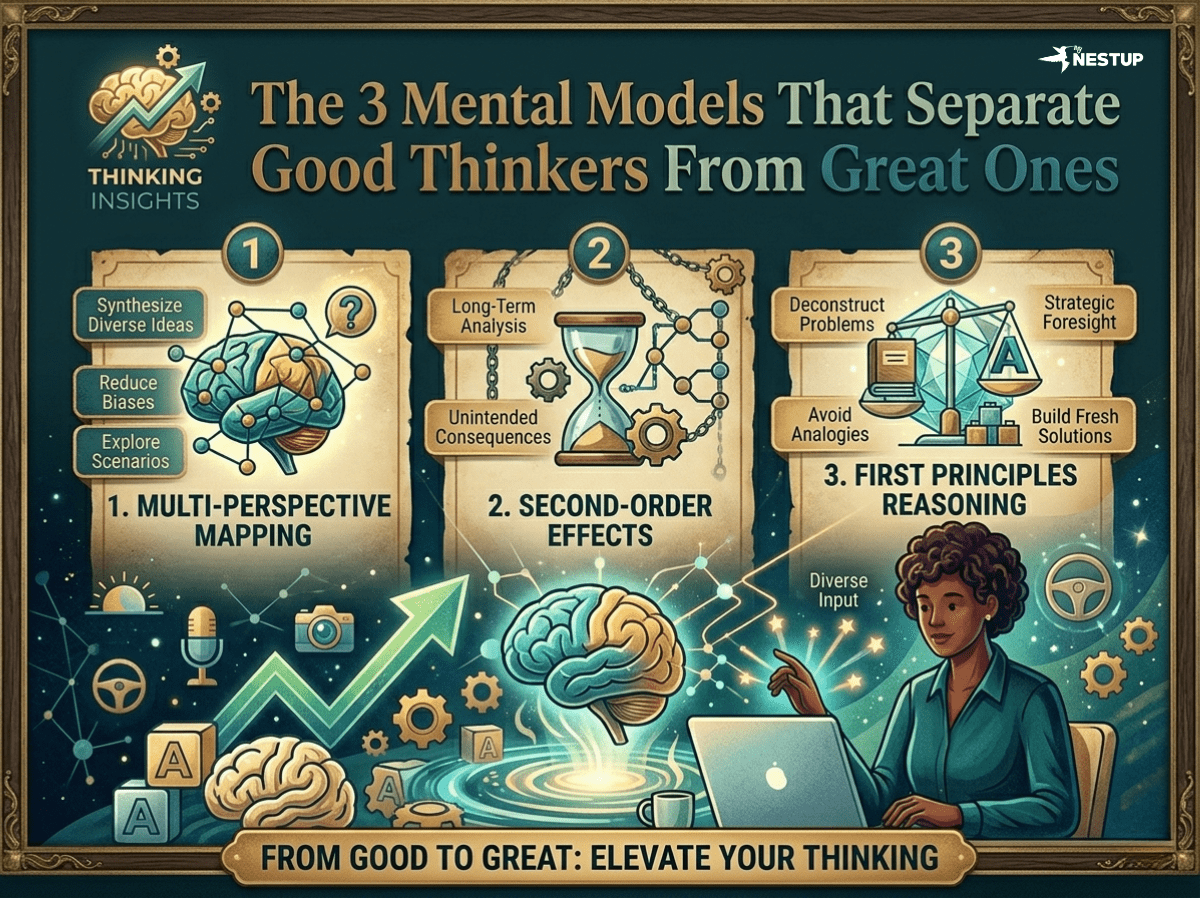
Most knowledge workers don’t struggle because they lack information—they struggle because they don’t process it effectively. In a world overloaded with data, the real advantage comes from how you think, not how much you know. Mental models are the frameworks that shape your decisions, filter noise, and help you see patterns others miss. The difference between a good thinker and a great one often comes down to a small set of powerful models used consistently. Among them, three stand out for their practical impact: inversion, second-order thinking, and probabilistic reasoning.
Inversion: Start by Thinking Backward
Inversion flips the usual approach to problem-solving. Instead of asking, “How do I succeed?” it asks, “How do I fail?” This shift sounds simple, but it exposes blind spots that forward thinking often misses. By identifying what could go wrong, you can systematically avoid those pitfalls.
In a work context, imagine launching a new project. A forward-thinking approach might focus on strategy and execution. Inversion forces you to ask uncomfortable questions: What would cause this to fail? Poor communication? Unrealistic timelines? Lack of stakeholder buy-in? By addressing these risks early, you dramatically increase your chances of success.
This model is especially powerful because it cuts through optimism bias. Humans naturally underestimate risks, but inversion forces realism into the process.
Practicing Inversion in Daily Decisions
To apply inversion, start with a simple exercise. Take a goal—finishing a project, improving productivity, or even maintaining good health—and list everything that would guarantee failure. Be specific. For example, if your goal is deep work, failure might include constant notifications, unclear priorities, or multitasking.
Once you have the list, reverse it into action steps. Turn “constant interruptions” into “scheduled focus blocks.” Turn “unclear priorities” into “define top three tasks each morning.” This transforms abstract thinking into practical execution.
Over time, inversion becomes automatic. You begin to spot risks before they materialize, which is one of the defining traits of great thinkers.
Second-Order Thinking: Looking Beyond the First Outcome
Most people stop at the first consequence of a decision. Great thinkers go further. Second-order thinking asks: “And then what?” It considers the ripple effects that unfold over time.
For example, adopting a new productivity tool might seem like a clear win. The first-order effect is improved organization. But the second-order effects might include increased complexity, time spent managing the tool, or dependency on a system that could fail. By thinking beyond the immediate benefit, you make more balanced decisions.
This model is crucial in environments where actions have delayed or compounding consequences, such as business strategy, investing, or career planning.
Training Yourself to Think in Second-Order Effects
A practical way to build this skill is to pause after making a decision and map out at least two future steps. Ask yourself: What happens next? And what happens after that? Write it down if needed.
For instance, consider taking on extra work to impress your manager. The first-order effect is recognition. The second-order effect might be burnout or setting unsustainable expectations. The third-order effect could be long-term dissatisfaction or reduced performance.
This exercise doesn’t mean avoiding action—it means acting with awareness. Over time, you’ll start seeing consequences more clearly and avoiding decisions that look good in the short term but fail in the long run.
Probabilistic Reasoning: Thinking in Odds, Not Certainties
The world is uncertain, yet most people think in absolutes—something will either happen or it won’t. Probabilistic reasoning replaces this with a more accurate lens: everything has a likelihood.
Instead of saying, “This project will succeed,” a probabilistic thinker might say, “There’s a 70% chance of success given current conditions.” This subtle shift improves decision-making because it accounts for uncertainty and encourages better risk management.
In knowledge work, this is especially valuable. Whether you’re forecasting outcomes, making strategic bets, or prioritizing tasks, thinking in probabilities helps you allocate time and resources more effectively.
How to Practice Probabilistic Thinking
Start by attaching rough probabilities to your decisions. They don’t need to be perfect—the goal is to move away from binary thinking. For example, estimate the likelihood of meeting a deadline or achieving a target.
Then, update your estimates as new information comes in. If progress is slower than expected, adjust your probability downward. If new resources become available, adjust it upward. This process, known as updating beliefs, keeps your thinking flexible and grounded in reality.
Another useful exercise is reviewing past decisions. Compare your predicted probabilities with actual outcomes. Over time, this builds calibration—the ability to make more accurate judgments.
Integrating These Models Into Daily Work
Individually, each model is powerful. Together, they form a system for better thinking.
Inversion helps you avoid failure before it happens. Second-order thinking ensures you understand the broader consequences of your actions. Probabilistic reasoning keeps you grounded in uncertainty and improves your judgment over time.
A simple daily workflow might look like this: start your morning by identifying your top priorities, use inversion to eliminate obvious risks, apply second-order thinking to evaluate potential consequences, and assign rough probabilities to your expected outcomes. This doesn’t add much time—but it significantly improves the quality of your decisions.
The Compounding Advantage of Better Thinking
The real benefit of these mental models isn’t immediate—it compounds. Each better decision builds on the last. Over weeks and months, this leads to clearer priorities, fewer mistakes, and more consistent results.
Great thinkers aren’t necessarily smarter. They simply use better frameworks, more consistently, across more situations. By adopting inversion, second-order thinking, and probabilistic reasoning, you’re not just improving individual decisions—you’re upgrading the system that produces them.
Final Takeaway
In a world where information is abundant, thinking clearly is a rare and valuable skill. These three mental models offer a practical way to cut through complexity and make better decisions every day.
Start small. Apply one model to one decision today. Then repeat. Over time, the gap between reacting and thinking deliberately becomes the gap between good and great.