Introduction: The Silicon Valley Blind Spot
The dominant narrative in artificial intelligence remains stubbornly centered on a few square miles in Northern California. Names like OpenAI, Google, and Anthropic capture the headlines, the venture capital, and the public imagination. However, for a global technology strategist, this focus creates a dangerous blind spot. While the West is fixated on the next frontier breakthrough, China’s AI ecosystem—led by DeepSeek, Moonshot AI, Alibaba, and Baidu—is executing a “quiet” pivot that is fundamentally shifting the global center of gravity.
The AI race has entered a new phase. It is no longer a simple sprint toward the most parameters; it is an asymmetric war of strategy. As the West doubles down on massive Capital Expenditure (CapEx) to fuel raw compute power, China is optimizing for the unit economics of inference. The winner of this decade won’t just be the one with the biggest model, but the one with the most sustainable and scalable deployment strategy.
Efficiency Over Scale: The DeepSeek Disruption
DeepSeek has emerged as the primary disruptor of the “bigger is better” philosophy. While Silicon Valley remains locked in a high-cost arms race, DeepSeek is prioritizing inference efficiency and cost-performance ratios. This represents a shift from compute-heavy frontier research to compute-constrained innovation.
By slashing the training and operational costs of competitive models, DeepSeek is turning AI into a high-utility, low-friction tool. This strategic emphasis on OpEx (Operating Expenditure) optimization makes their technology far easier to export to emerging markets where budget constraints dictate adoption.
“Cost-performance ratio may be the real battleground.”
In the strategist’s view, DeepSeek is effectively commoditizing the intelligence layer, challenging the assumption that the most expensive model is the only one that matters.
Beyond Generalization: The Power of Specialization and Alignment
Chinese firms are moving past the “copycat” era and are now specializing to solve high-value problems where Western models often lose consistency.
- Moonshot AI and Long-Context Utility: Moonshot AI has carved out a niche in long-context models, designed to ingest entire codebases or massive datasets in a single prompt. While Western frontier models are still refining consistency across massive token windows, Moonshot is positioning this as a core enterprise workflow requirement, not just a technical feature.
- Baidu’s ERNIE: The National Champion: Baidu has positioned its ERNIE platform as a “national champion,” leveraging deep localization and regulatory alignment. In a tightly controlled digital ecosystem, ERNIE provides a level of infrastructure sovereignty and domestic compliance that foreign competitors simply cannot replicate.
This specialization indicates that the “efficiency war” is also a war of relevance. By solving specific enterprise pain points, these firms are securing high-value niches in the global stack.
Open Source and the Cloud Feedback Loop
One of the most effective geopolitical power moves is the aggressive shift toward open-source and open-weight models, most notably by Alibaba and its Qwen series. While the West moves toward “closed” proprietary systems, the East is building a global developer ecosystem.
Alibaba’s advantage is reinforced by its cloud ecosystem feedback loop. By integrating Qwen into a cloud platform that serves millions of businesses, Alibaba creates a virtuous cycle: massive enterprise data informs model improvement, which in turn attracts more users. This strategy has two-fold effects:
- Accelerated Global Adoption: Independent developers can modify and deploy these models without the “tax” of Western APIs or restrictive licensing.
- Shifting Developer Mindshare: As the global developer community standardizes on Chinese-origin open-weight models, the technical center of gravity moves East, granting China immense standard-setting power.
Economic Asymmetry: AI as a Commodity, Not a Luxury
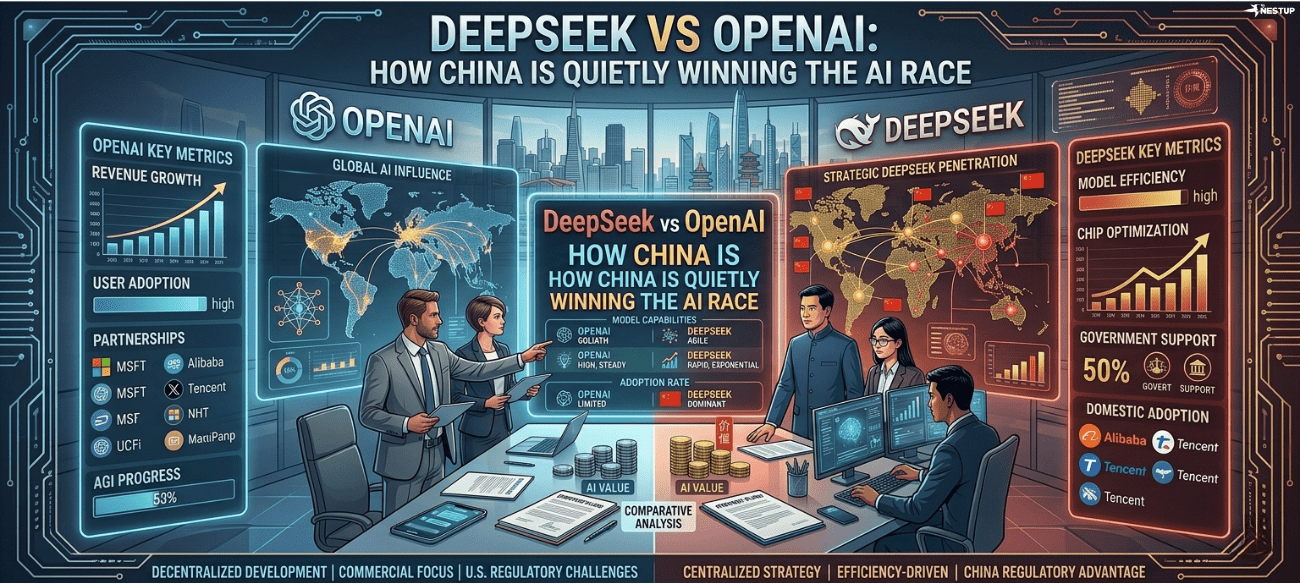
China’s structural advantages—vertically integrated supply chains and lower infrastructure costs—allow it to use cost as a strategic weapon. We are seeing a profound divergence in the global market: the “high-end, high-cost” Western AI vs. the “accessible, low-cost” Chinese AI.
In price-sensitive markets (Southeast Asia, Latin America, and Africa), the “good enough” model that runs at a fraction of the cost will always win over the frontier model that is gated behind a premium subscription. By focusing on accessible AI, China is positioning its technology as the foundational utility for the developing world.
The Bifurcated Future: A New Digital Geography
AI has transcended the realm of software to become critical infrastructure. This is creating a new digital geography where nations must choose between U.S.-aligned and China-aligned stacks.
This isn’t just about which model is “smarter.” It is about infrastructure sovereignty. Countries may choose the Chinese stack not just for the lower price point, but for the openness that allows them to maintain control over their own data and deployment. The winner of the AI race won’t be determined by a single breakthrough, but by the scale of global distribution and the depth of integration into the world’s digital architecture.
Conclusion: The Long Marathon
The AI race is not a sprint for raw power; it is a marathon of strategy and economics. We are witnessing a clash between two distinct innovation models:
- The Silicon Valley Model: Centralized, high-cost, frontier research focused on pushing the absolute limits of machine intelligence.
- The China Model: Distributed, cost-efficient, rapidly deployed systems focused on utility, scale, and openness.
Both models are scaling, but the rules of the competition are shifting. If the next decade of AI is defined by adoption and unit economics rather than sheer parameter count, the “quiet” strategy of the East may prove to be the more resilient one.
Final Thought: As the world moves toward a bifurcated AI ecosystem, how will the choice between a high-cost, closed system and a low-cost, open stack change the way your organization navigates the next decade of technological disruption?