
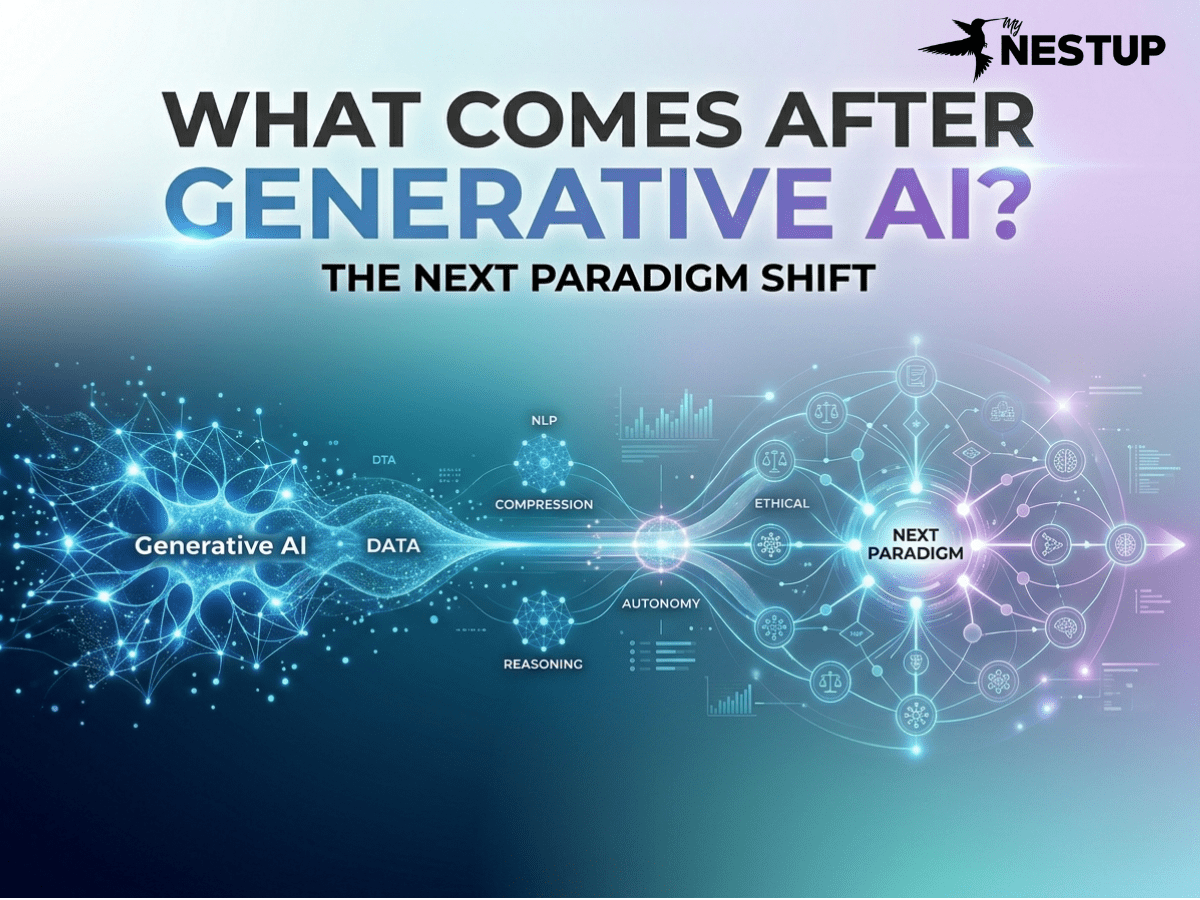
Introduction: The End of the Beginning
Over the past few years, Generative AI has transformed the technology landscape. Systems capable of producing text, images, music, code, and video from simple prompts have reshaped industries ranging from marketing and education to software development and filmmaking. The rapid rise of models like ChatGPT, DALL·E, and Midjourney demonstrated how machines could create content once thought to require uniquely human creativity.
But technological revolutions rarely stop at one stage. Generative AI may feel groundbreaking today, yet many researchers believe it represents only an early phase in a much larger transformation. The next paradigm shift is already forming—one where AI systems move beyond generation toward autonomy, reasoning, and real-world action.
The question is no longer what AI can create, but what it can decide and do.
From Content Generation to Autonomous Systems
Generative AI systems excel at producing outputs based on patterns learned from massive datasets. However, they typically rely on human prompts and supervision. The next wave of AI development aims to reduce that dependence by enabling systems to act autonomously toward goals.
This shift is often described as the rise of agent-based AI systems—software that can plan tasks, execute them, and adapt based on results. Instead of writing a paragraph when prompted, such systems might:
- Conduct research across multiple sources
- Analyze data and form conclusions
- Execute multi-step workflows
- Interact with software tools or digital environments
In this model, AI becomes less like a creative tool and more like a digital collaborator capable of independent action.
The Emergence of Agentic AI
One of the most discussed developments beyond generative AI is agentic AI, a concept where machines operate with a degree of goal-directed autonomy. These systems combine reasoning, memory, planning, and tool usage.
Unlike traditional chatbots, agentic systems can break down complex objectives into smaller steps and continuously refine their strategy. For example, instead of merely generating marketing copy, an AI agent might:
- Analyze market trends
- Identify target audiences
- Generate campaign concepts
- Run simulations or tests
- Optimize strategies based on performance data
Researchers and technology companies—including OpenAI, Google, and Anthropic—are actively exploring this direction, viewing it as a critical step toward more capable artificial intelligence systems.
AI With Memory and Context
Another limitation of many current generative systems is short-term context. They often treat each conversation or task as largely independent.
The next paradigm shift involves AI systems with persistent memory—models capable of remembering information over long periods and learning continuously from interactions. This development would allow AI to:
- Maintain long-term relationships with users
- Accumulate knowledge across tasks
- Adapt to individual preferences
- Improve decision-making through experience
In essence, AI would begin to behave less like a stateless tool and more like a learning partner that evolves over time.
AI That Understands the Physical World
Generative AI primarily operates in the digital realm. The next phase may bridge the gap between digital intelligence and the physical environment.
Advances in robotics, sensors, and multimodal AI are enabling systems that can interpret and interact with the real world. Companies such as Tesla, Boston Dynamics, and NVIDIA are exploring AI models capable of controlling robots, navigating environments, and performing complex tasks.
If successful, this convergence could lead to machines that not only generate ideas or content but execute actions in physical space, from manufacturing to healthcare.
The Rise of Reasoning AI
Generative models often rely on statistical patterns rather than true reasoning. Researchers are now focusing on creating systems that can think through problems step by step, understand cause-and-effect relationships, and apply logic more reliably.
This new generation of AI aims to combine large-scale neural networks with reasoning techniques, enabling machines to:
- Solve complex scientific problems
- Conduct sophisticated analysis
- Plan long-term strategies
- Provide more reliable and explainable answers
If achieved, such capabilities could dramatically expand AI’s role in research, engineering, and decision-making.
Toward Artificial General Intelligence
Many experts see these developments—autonomy, memory, reasoning, and real-world interaction—as stepping stones toward a broader goal: Artificial General Intelligence (AGI).
AGI refers to systems capable of performing a wide range of intellectual tasks at a level comparable to human intelligence. Leaders like Sam Altman and Demis Hassabis have argued that the path beyond generative AI may ultimately converge toward this milestone.
While timelines remain uncertain, the direction of innovation suggests that generative AI is only one stage in a much longer journey.
Challenges on the Road Ahead
Despite its promise, the transition beyond generative AI raises significant challenges. Autonomous systems capable of decision-making introduce complex questions around:
- Safety and control
- Ethical decision-making
- Economic disruption and employment
- Misinformation and misuse
- Regulatory oversight
Governments and organizations worldwide are already beginning to explore frameworks for managing these risks as AI systems become more capable and independent.
Conclusion: A Shift From Tools to Intelligence
Generative AI marked a major turning point in computing by allowing machines to create. Yet the next paradigm shift may be even more transformative. The future of AI lies not just in generating content but in thinking, acting, and collaborating.
As AI systems evolve from tools into autonomous agents, the relationship between humans and machines will likely change profoundly. Instead of simply using AI to produce outputs, people may increasingly work alongside intelligent systems that plan, learn, and operate in the world.
In that sense, generative AI may ultimately be remembered not as the final destination of artificial intelligence—but as the moment the journey truly began.