
If you've used an AI chatbot like ChatGPT, you're familiar with the rhythm: you type a prompt, it gives a response, and the conversation continues turn by turn. It’s a powerful tool for brainstorming, answering questions, and generating text. But it always waits for you. It's a conversational partner, ready for your next command.
But what happens when an AI doesn't need to wait? What if you could give it a complex, multi-hour goal, walk away, and it would work diligently on its own until the job was done? This is the fundamental shift introduced by autonomous AI agents like Manus AI. They are designed to move beyond being a "conversational partner" and become a "proactive worker."
This transition from reactive replies to autonomous action is powered by a completely different architecture. Here are four of the most surprising and impactful principles behind how these next-generation agents truly operate.

1. AI Isn't One Big Brain—It's a Team of Specialists
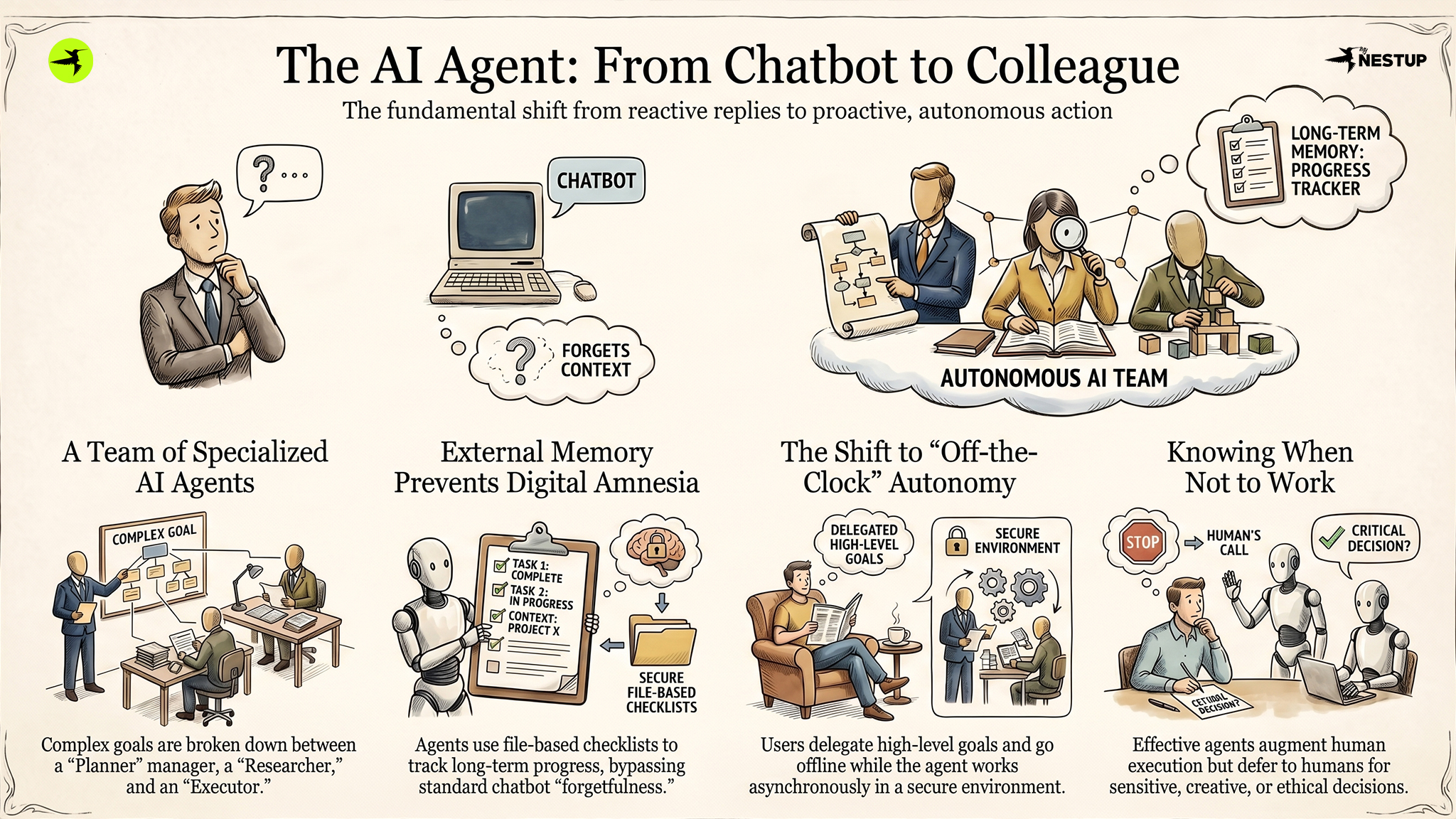
When we interact with a chatbot, it feels like we're talking to a single, all-knowing entity. Autonomous agents, however, operate more like a highly efficient project team. This is known as a "multi-agent system," where a complex goal is broken down and assigned to specialized sub-agents, each with a distinct role.
The key players on this AI team include:
- The Planner Agent: Acts as the project manager, breaking down a high-level goal into a clear, step-by-step plan.
- The Knowledge/Research Agent: Functions as the team's researcher, using web browsers and other tools to gather necessary data.
- The Execution/Code Agent: This is the "doer" that writes and runs code, manages files, and builds the final output.
- The Verifier Agent: Serves as the quality assurance lead, checking progress against the plan and handling errors as they arise.
This division of labor is a game-changer. It allows the system to tackle complex, multi-step projects, and it even enables advanced strategies like parallel processing. For example, to conduct a large-scale analysis, the system can deploy multiple research agents at once in a "Wide Research" mode, dramatically speeding up data collection in a way a single monolithic model never could.
2. It Overcomes "Forgetting" by Taking Its Own Notes
A common frustration with chatbots is their limited "memory." In a long conversation, they can forget instructions or details mentioned earlier due to context window limits. Autonomous agents must solve this problem to work on tasks that last for hours or even days.
Systems like Manus AI achieve this with "File-Based Persistent Memory." In simple terms, the AI keeps its own project files—like a todo.md checklist—to track its plan, what it has completed, and any intermediate results. This work isn't random; it follows a systematic, iterative loop: Analyze → Plan → Execute → Observe → Repeat. By writing its "thoughts" and progress to files in each cycle, it creates a permanent record that isn't limited by a conversational context window. This allows the agent to work on a task, be interrupted, and then pick up right where it left off, just like a human worker would.
The system avoids context window limits by externalizing information to the file system, supporting long-term recall for complex tasks.
3. The Real Goal Is to Go Offline and Get the Job Done
Chatbots operate in a "Human-in-the-Loop" workflow; they depend on your continuous input and guidance. While systems like Manus AI can support this kind of human oversight, their real power lies in their "Fully Autonomous" workflow. This ability to work independently for hours is only possible because of the features we just discussed: a coordinated team of agents (Takeaway 1) that can remember its long-term plan using persistent memory (Takeaway 2).
The core design philosophy is to empower the user to delegate, not just converse. You can give the agent a high-level goal, such as "Create a market report on EV trends," and then go offline. The agent runs the entire project asynchronously in the cloud. To do this, it's given its own secure computer—a "sandboxed Linux virtual environment"—complete with its own set of tools. Its primary way of taking action is by writing and executing code, a method known as the "CodeAct" approach. It's actively browsing websites, running scripts, and managing files in its own secure workspace.
This represents a paradigm shift. The AI isn't just a tool you actively use; it's an agent that works for you. The real magic of its autonomy is its ability to self-correct errors and adapt plans as it encounters unexpected obstacles, all without needing your intervention.
4. It's Smart Enough to Know What It's Bad At
A key feature of a mature and practical AI system is its ability to recognize its own limitations. Autonomous agents are not designed to be a universal solution for every problem. Their greatest strength is in augmenting human capabilities, not replacing human judgment in areas where it is essential.
Knowing when not to use an agent is as important as knowing when to use one. These systems are ill-suited for:
- Simple or quick queries: A standard chatbot is much faster and more efficient for asking a basic question or brainstorming a quick idea.
- Highly sensitive decisions: Actions with legal, financial, or medical consequences require human accountability and should not be delegated to an agent that can make errors.
- Creative or subjective work: Tasks that depend on unique human insight, emotional nuance, or ethical judgment are best left to people.
- Data Privacy Risks: Be cautious with confidential data, as agents may need to access external tools and services to complete their work.
The true value of agents is augmenting humans in execution-heavy, multi-step, repeatable workflows—reserving human effort for strategy, final verification, and ethical judgment.
From Answering Questions to Achieving Goals
The evolution from chatbots to autonomous agents marks a significant turning point in artificial intelligence. We are moving from tools that reactively answer our questions to proactive partners that can independently execute complex plans to achieve our goals. By assembling specialist teams, maintaining long-term memory, and working autonomously, these agents open up new possibilities for automation and productivity.
This shift leaves us with a compelling question to consider: Now that an AI can manage a multi-hour project on its own, what complex goals will you finally have the freedom to pursue?