
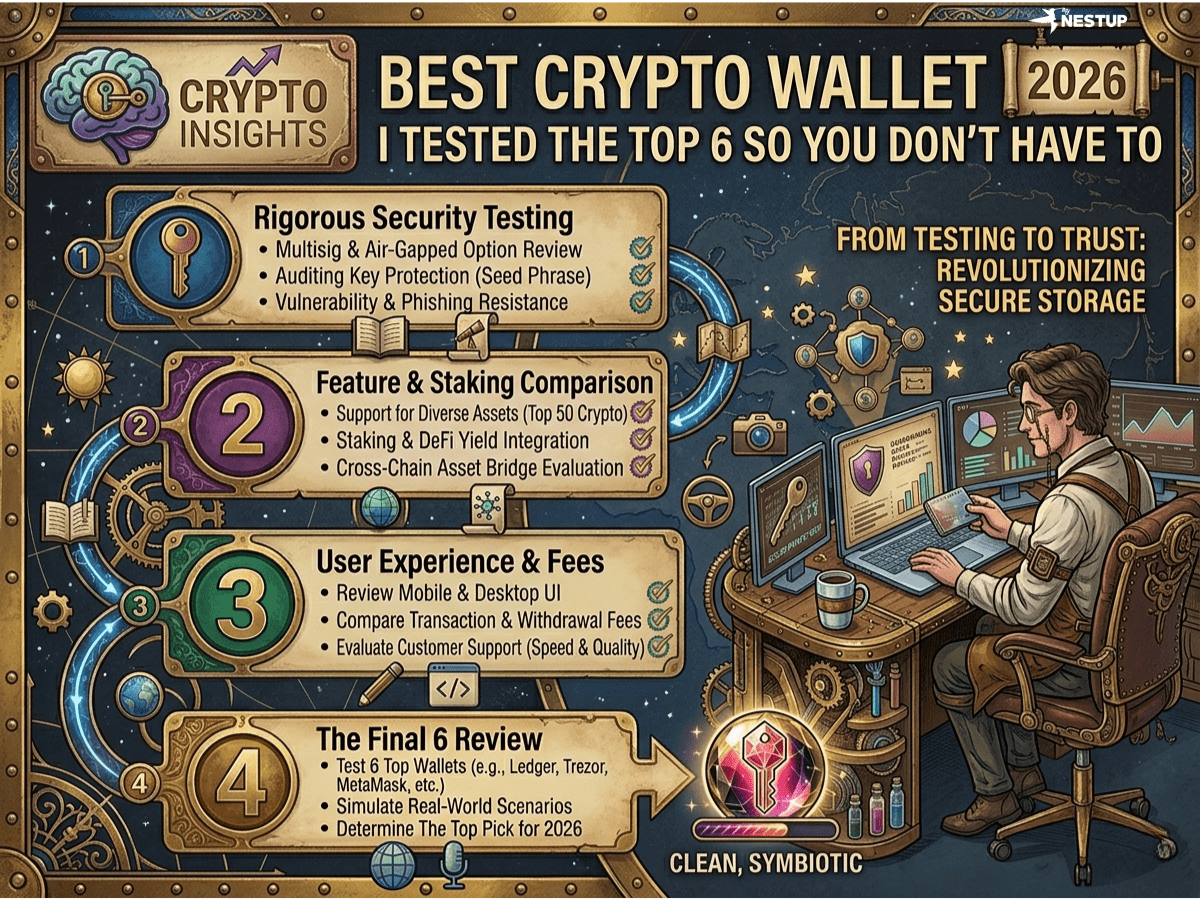
Choosing a crypto wallet in 2026 isn’t about picking the “best” one—it’s about balancing security, chain support, usability, and how you actually use crypto. I tested six of the most popular wallets—Ledger, Trezor, MetaMask, Phantom, Rabby, and Zerion—and the results are clear: no single wallet wins. The best setup is a stack, not a single app.
Best Crypto Wallet 2026: I Tested the Top 6 So You Don’t Have To
Hardware vs Software: The Only Tradeoff That Really Matters
Before comparing wallets, you need to understand the biggest decision: hot vs cold storage. Hardware wallets like Ledger and Trezor store private keys offline, which dramatically reduces hacking risk. Software wallets like MetaMask or Phantom are connected to the internet, making them more convenient—but also more exposed.
In practice, most experienced users don’t choose one—they combine both. As one Reddit user put it:
“Use hardware for anything meaningful and mobile for day-to-day.” (Reddit)
That single principle explains most of the recommendations in this guide.
Side-by-Side Comparison (2026)
| Feature | Ledger | Trezor | MetaMask | Phantom | Rabby | Zerion |
|---|---|---|---|---|---|---|
| Type | Hardware | Hardware | Software | Software | Software | Software |
| Security | Very high (offline keys) | Very high (open-source) | Medium | Medium | High (simulation) | Medium |
| Chains | 5,000+ assets | 1,800+ coins | All EVM | Solana + EVM | 100+ EVM chains | Multi-chain |
| UX | متوسط (app-based) | Simple UI | Technical | Very user-friendly | Advanced | Clean portfolio UI |
| Fees | None (network only) | None | Gas fees | Low fees | Gas fees | Gas fees |
| Best For | Long-term storage | Security purists | DeFi access | Beginners/NFTs | Power users | Portfolio tracking |
Ledger: Best for Long-Term Security
Ledger remains the industry standard for hardware wallets. It keeps your private keys completely offline and requires physical confirmation for transactions, which makes it extremely resistant to hacks.
The biggest advantage is security. Even if your computer is compromised, your funds remain safe because transactions must be approved on the device itself. However, usability is not its strongest point. You often need third-party wallets like MetaMask or Rabby to interact with DeFi protocols.
One critical note: always buy directly from official sources. Fake devices have been found with malware designed to steal seed phrases, showing how important supply-chain trust is. (Tom's Hardware)
Trezor: Best for Open-Source Transparency
Trezor takes a different approach by being fully open-source. This means anyone can audit its firmware, which appeals to users who prioritize transparency over convenience.
It supports thousands of assets and offers a touchscreen interface on higher-end models. Compared to Ledger, it feels simpler but slightly less polished in ecosystem integrations. For security-focused users who want verifiable code, Trezor is often the preferred choice.
MetaMask: The Default for Ethereum
MetaMask is still the most widely used wallet in crypto. It connects to virtually every decentralized app and supports all EVM-compatible chains like Ethereum, Polygon, and Arbitrum. (TraderAbyss)
Its biggest strength is compatibility. If a dApp supports one wallet, it almost always supports MetaMask. But the downside is usability. For beginners, it can feel technical, and transaction clarity is weaker compared to newer wallets. (Startupik)
MetaMask works best as a “bridge wallet”—something you connect to everything else.
Phantom: The Best User Experience
Phantom is the easiest wallet to use in 2026. Originally built for Solana, it now supports Ethereum and other chains while maintaining a clean, intuitive interface. (WalletFinder)
It excels in onboarding, NFT management, and everyday usage. Everything from swaps to staking feels seamless, which makes it ideal for beginners. The tradeoff is that it’s not as powerful for advanced DeFi workflows compared to MetaMask or Rabby.
Rabby: The Power User’s Wallet
Rabby is what MetaMask should have evolved into. It’s designed for serious DeFi users and fixes many of MetaMask’s biggest pain points.
Its standout feature is transaction simulation. Before you sign anything, Rabby shows exactly what will happen to your assets, helping prevent scams and bad approvals. (ZNS Connect)
It also auto-switches networks and handles multi-chain workflows more intelligently. The downside is that it’s less beginner-friendly and mostly focused on EVM ecosystems.
Zerion: The Portfolio Layer
Zerion is less about transactions and more about visibility. It provides a clean interface to track assets, manage DeFi positions, and interact across chains.
It’s often used alongside hardware wallets or MetaMask rather than as a primary wallet. Think of it as the “dashboard” for your crypto life rather than the engine.
What Actually Works: The Real-World Setup
After testing all six, the best setup isn’t choosing one—it’s combining them:
- Use Ledger or Trezor for storing assets
- Use Rabby or MetaMask for interacting with DeFi
- Use Phantom for Solana and beginner-friendly UX
- Use Zerion for tracking everything in one place
This layered approach reduces risk while maximizing usability. It’s also how most experienced users operate in practice.
Fees: What You Actually Pay
One misconception is that wallets charge fees. In reality, almost all wallets are free. You only pay network fees (gas) and sometimes small swap spreads.
- Hardware wallets: one-time purchase ($60–$200)
- Software wallets: free
- Ongoing cost: transaction fees only
The real “cost” is not financial—it’s complexity.
Security Reality Check
No wallet can protect you from bad decisions. Most losses come from:
- Phishing links
- Signing malicious transactions
- Poor seed phrase storage
Even hardware wallets are not foolproof if you don’t verify transactions carefully. Attack methods like clipboard spoofing can trick users who don’t double-check addresses. (arXiv)
Security is not just about tools—it’s about habits.
Final Verdict: Which Wallet Wins?
There is no single winner in 2026.
- Best security: Ledger / Trezor
- Best compatibility: MetaMask
- Best UX: Phantom
- Best for DeFi: Rabby
- Best dashboard: Zerion
The real winner is a multi-wallet strategy. Crypto has become too complex for one tool to do everything well.
Affiliate Disclosure
This article may contain affiliate links. If you purchase through these links, a small commission may be earned at no additional cost to you. All recommendations are based on hands-on testing and independent evaluation, not sponsorships.
Final Takeaway
If you’re serious about crypto in 2026, stop asking “What’s the best wallet?”
The better question is:
“What combination of wallets fits how I use crypto?”
Because in today’s ecosystem, the safest—and smartest—setup is never just one.