
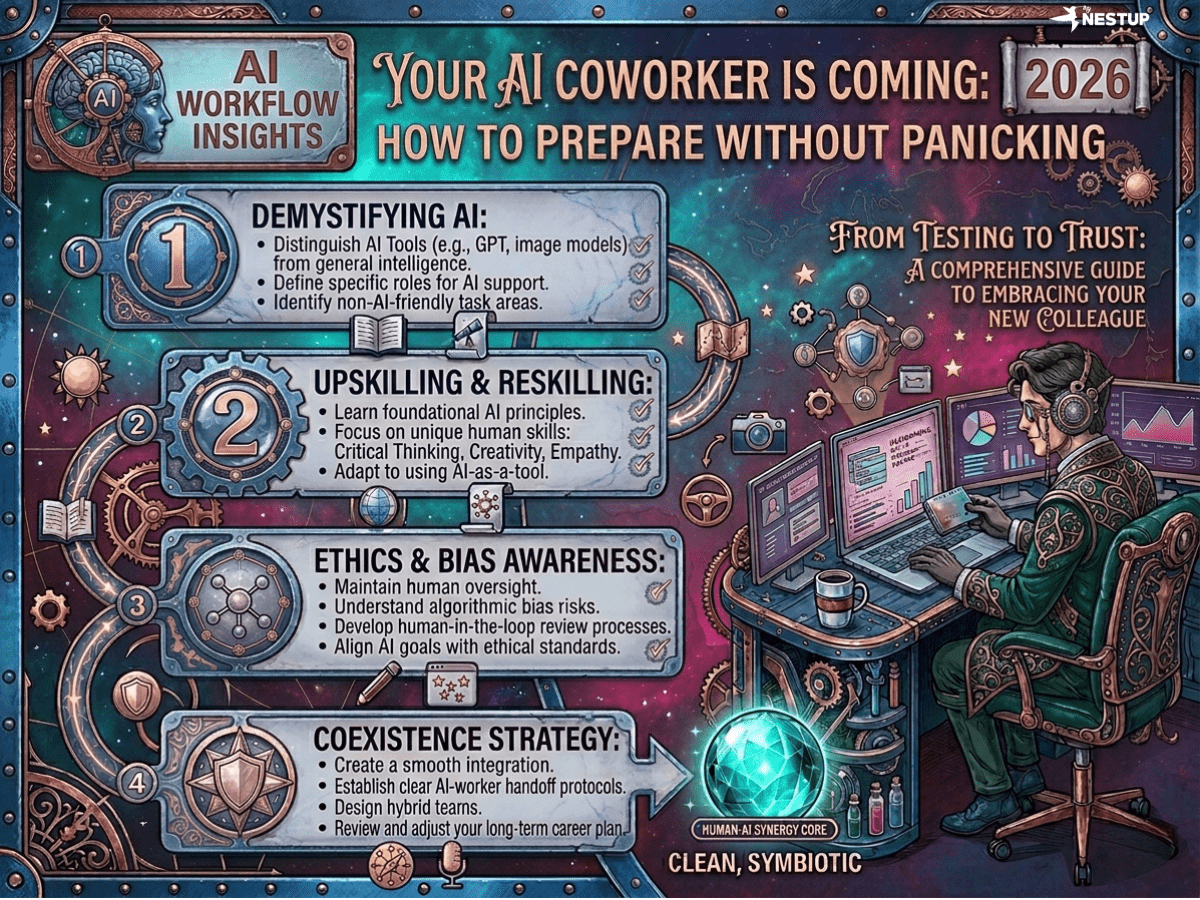
The Shift Is Real—But It’s Not What You Think
AI is no longer just a tool you open in a tab. It’s becoming a coworker—handling tasks, drafting work, analyzing data, and even making recommendations. Systems like ChatGPT, Claude, and Gemini are already embedded in workflows across companies. The instinctive reaction is fear: Will AI replace my role? But that framing misses the real shift. Most jobs aren’t disappearing—they’re being restructured. The people who adapt fastest won’t be the ones who fight AI, but the ones who learn how to work alongside it.
From Individual Contributor to AI-Orchestrator
The biggest change is not in what work gets done, but how it gets done. Instead of executing every task yourself, you increasingly coordinate between human judgment and AI output. This is the rise of the “AI orchestrator”—someone who defines problems, delegates tasks to AI, reviews outputs, and integrates results into meaningful work.
This role requires a different mindset. You’re no longer judged only by what you produce directly, but by how effectively you can guide systems to produce outcomes. Think less “doer” and more “director.” The better you become at assigning the right tasks to AI and refining the results, the more valuable you become.
Skill Development: What Actually Matters Now
As AI handles more routine tasks, the skills that matter shift upward. Clear thinking becomes critical. If you can’t define a problem precisely, AI won’t solve it well. Communication—especially in the form of structured prompts and instructions—becomes a core professional skill. The ability to ask the right questions often matters more than knowing the answers.
At the same time, domain expertise doesn’t go away. It becomes your advantage. AI can generate outputs, but it can’t fully understand the nuances of your industry, your company, or your specific context. The combination of deep knowledge and AI fluency is what sets top performers apart.
Documentation Is Your New Superpower
One of the most underrated changes is the importance of documentation. AI systems work best when they have clear context—processes, guidelines, examples, and structured information. If your workflows live only in your head, AI can’t help you effectively.
By documenting how you work—your decision criteria, recurring tasks, and standard processes—you make your work scalable. You’re essentially creating a playbook that AI can follow. This doesn’t just improve efficiency; it positions you as someone who builds systems, not just completes tasks.
Learning to Trust—but Verify
Working with AI requires a balance between trust and skepticism. AI can produce high-quality outputs quickly, but it can also make subtle mistakes or miss context. Your role is to review, refine, and validate.
This means developing a habit of checking assumptions, verifying critical details, and understanding when AI is likely to be wrong. Over time, you’ll learn where it excels and where it struggles. This calibration is what separates effective AI users from those who blindly rely on it.
Relationship-Building Still Wins
It’s easy to assume that as AI becomes more capable, human relationships will matter less. In reality, the opposite is happening. As routine work becomes automated, the value of trust, collaboration, and communication increases.
AI can generate content, but it can’t build relationships with your team, align stakeholders, or navigate organizational dynamics. The people who succeed will be those who combine technical adaptability with strong interpersonal skills. Being easy to work with, reliable, and clear in your communication becomes even more important in an AI-augmented workplace.
Redefining Productivity
AI changes how productivity is measured. It’s no longer about how many hours you work or how many tasks you complete manually. It’s about the quality of outcomes you deliver.
A single well-structured prompt can replace hours of effort. A clear system can eliminate repetitive work entirely. This means you need to rethink how you approach your day. Instead of focusing on doing more, focus on designing better workflows. The goal is not to work harder, but to work smarter with the tools available.
Common Mistakes to Avoid
Many people either overestimate or underestimate AI. Some assume it can do everything and stop thinking critically. Others ignore it entirely and fall behind. Both approaches are risky.
Another common mistake is using AI in an ad hoc way without building consistent workflows. Random usage leads to inconsistent results. The real gains come from integrating AI into repeatable processes that improve over time.
Positioning Yourself for the Future
If you want to stay ahead, focus on becoming the person who understands both the work and the tools. Volunteer to experiment with AI in your team. Share what you learn. Help others adopt it effectively. This positions you as a bridge between technology and execution.
Over time, this role becomes increasingly valuable. Companies don’t just need people who can use AI—they need people who can implement it across teams and workflows.
Final Takeaway: Don’t Compete—Collaborate
Your AI coworker isn’t here to replace you—it’s here to change how work gets done. The question isn’t whether AI will be part of your job. It’s whether you’ll learn to use it effectively.
Those who treat AI as a threat will struggle. Those who treat it as a collaborator will gain leverage. In a world where AI can execute faster than ever, the real advantage belongs to those who can think clearly, guide systems, and turn outputs into meaningful results.