
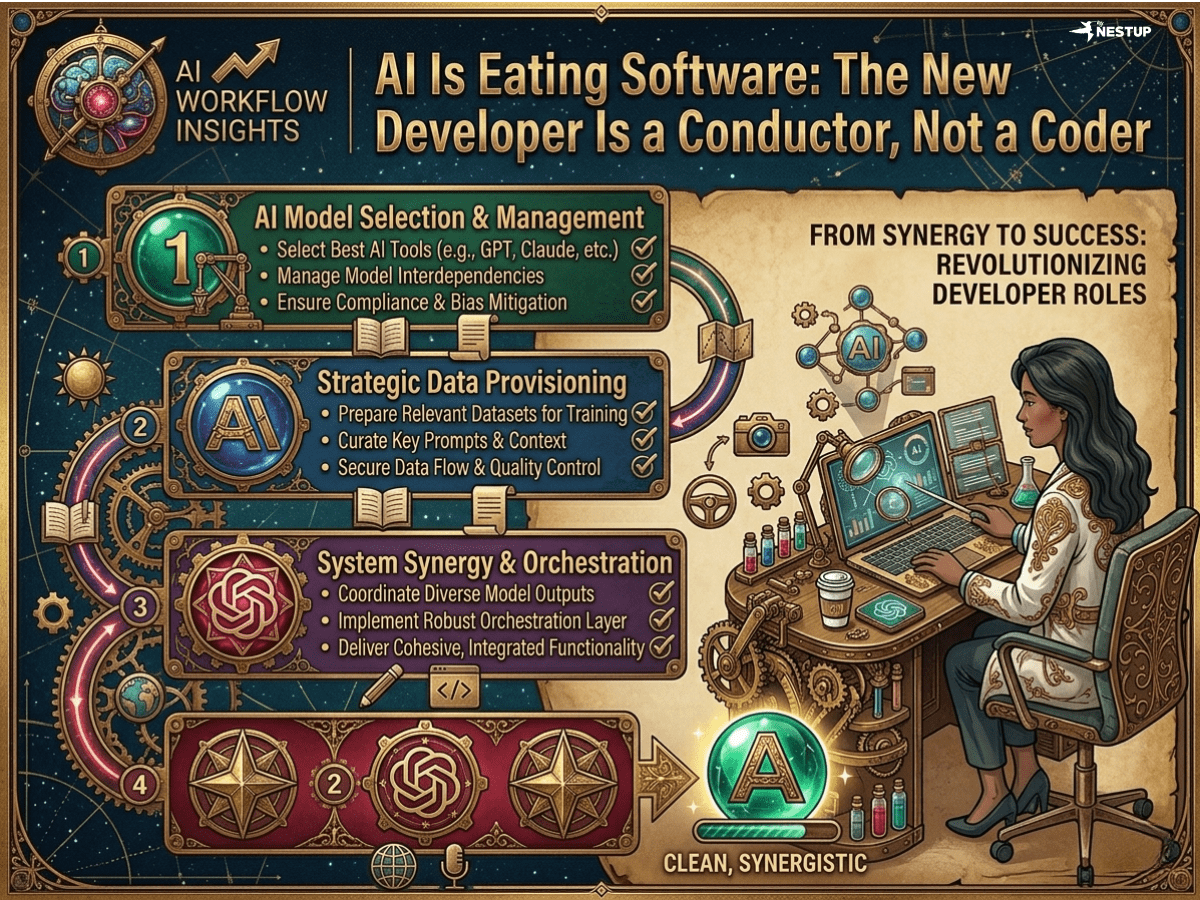
From Writing Code to Directing Outcomes
For decades, software development has been defined by one core activity: writing code. Developers translated human intent into precise instructions that machines could execute. In 2026, that model is starting to invert. With the rise of advanced AI systems like ChatGPT, Claude, and Gemini, developers are increasingly describing what they want rather than manually coding how to do it. The role is shifting from builder to conductor—someone who orchestrates systems, tools, and outcomes rather than writing every line themselves.
The Rise of Intent-Driven Development
Intent-driven development is the emerging paradigm where natural language becomes the primary interface for building software. Instead of starting with syntax, developers begin with intent: “Build a dashboard that tracks user retention,” or “Create an API that processes payments securely.” AI systems translate these instructions into working code, often across multiple languages and frameworks.
This doesn’t eliminate programming—it abstracts it. The developer’s job becomes defining constraints, clarifying requirements, and iterating on outputs. The skill is no longer just technical precision, but the ability to express intent clearly and refine it intelligently.
Natural-Language IDEs Are Replacing Traditional Workflows
Integrated development environments are evolving rapidly. Tools are emerging that allow developers to interact with their codebase conversationally, rather than navigating files manually. You can ask questions like “Where is this function used?” or “Refactor this module for performance,” and receive actionable changes instantly.
These natural-language IDEs blur the line between coding and communication. Instead of searching documentation or debugging line by line, developers collaborate with AI in real time. This dramatically reduces the friction of context switching and accelerates development cycles.
Autonomous Maintenance Is Becoming the Norm
One of the most significant shifts is happening after the code is written. Maintenance—traditionally one of the most time-consuming aspects of software development—is increasingly being handled by AI. Systems can now monitor performance, detect bugs, suggest fixes, and even implement updates automatically.
This changes the economics of software. Instead of large teams dedicated to maintaining legacy systems, a smaller group can oversee AI-driven maintenance pipelines. Developers move from reactive problem-solving to proactive system design, focusing on preventing issues rather than constantly fixing them.
The Developer as a System Architect
As AI takes over routine coding tasks, the developer’s role expands upward. Architecture, system design, and decision-making become more important than ever. Choosing the right tools, defining system boundaries, and ensuring scalability are now core responsibilities.
In this environment, a developer is less like a craftsman writing code and more like an architect designing systems. The ability to see the big picture—how components interact, where risks lie, and how systems evolve over time—becomes a defining skill.
New Skills That Actually Matter
The shift toward AI-driven development is changing which skills are valuable. Writing perfect syntax is no longer the primary differentiator. Instead, developers need to focus on skills that AI cannot easily replicate.
Clear thinking and problem definition are at the top of the list. If you cannot articulate what you want to build, AI cannot help you build it. Communication skills, both with humans and machines, become critical. Understanding how to guide AI systems, evaluate their outputs, and iterate effectively is now part of the core workflow.
At the same time, foundational technical knowledge still matters. Developers need to understand how systems work under the hood to validate AI-generated code, identify errors, and make informed decisions. The difference is that this knowledge is used more for oversight than for manual execution.
The Risk of Over-Automation
While the benefits are clear, there are real risks in this transition. Over-reliance on AI can lead to shallow understanding, where developers accept outputs without fully grasping how they work. This can create fragile systems that are difficult to debug when something goes wrong.
There is also the risk of homogenization. If many developers rely on the same AI tools, software may start to look and behave similarly, reducing innovation. The challenge is to use AI as an amplifier of creativity, not a replacement for it.
Collaboration Is Becoming Human + AI
Software development is no longer just a team of humans—it’s a collaboration between humans and intelligent systems. Developers are learning how to delegate tasks to AI, review outputs, and integrate results into larger workflows.
This changes team dynamics as well. Smaller teams can achieve more, and individual developers can take on projects that previously required entire organizations. The bottleneck shifts from execution to decision-making and coordination.
What This Means for the Future of Software
The phrase “AI is eating software” reflects a deeper transformation. Software is becoming more dynamic, more adaptive, and more closely aligned with human intent. The barriers to building applications are lowering, which will lead to an explosion of new tools, products, and ideas.
At the same time, the definition of a developer is expanding. It’s no longer just someone who writes code—it’s someone who can design systems, think critically, and orchestrate complex workflows.
Final Takeaway: The Conductor Mindset
The developers who thrive in this new era will not be the ones who resist change, but those who adapt their mindset. They will treat AI as a collaborator, not a threat, and focus on higher-level thinking rather than low-level execution.
In 2026, the best developers are not just coders. They are conductors—guiding systems, shaping outcomes, and turning intent into reality with the help of increasingly powerful tools.