
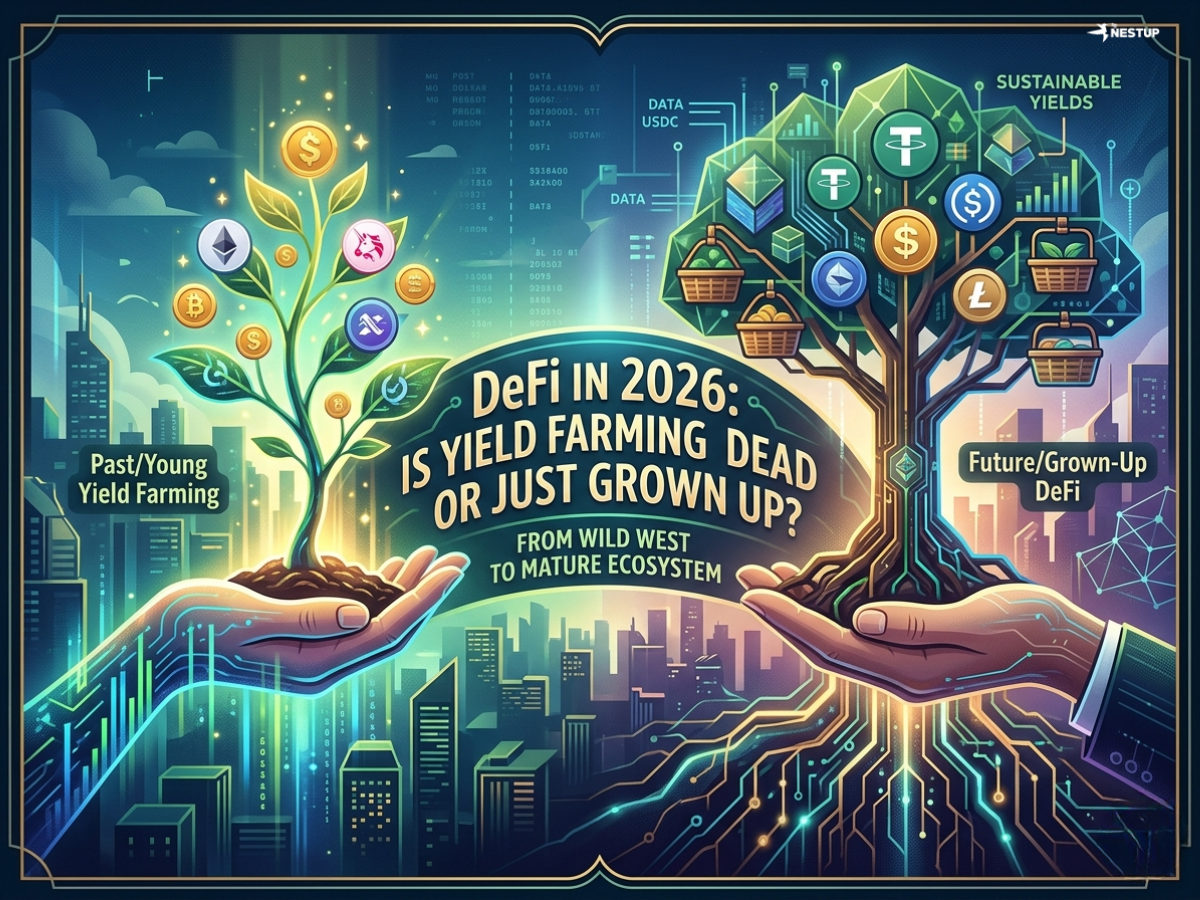
The Short Answer: It Didn’t Die—It Evolved
After the brutal 2022–2023 shakeout, decentralized finance didn’t collapse—it matured. The era of unsustainable “farm and dump” yields is largely over, replaced by something far more durable. In 2026, DeFi looks less like a casino and more like a financial system. Yield farming hasn’t disappeared—it has been rebuilt around real revenue, institutional capital, and stricter economics.
TVL Trends: Recovery Without the Hype
The clearest signal of DeFi’s evolution is Total Value Locked (TVL). After crashing to around $50 billion during the crisis years, TVL has rebounded to roughly $130–$140 billion in 2026. (CoinLaw)
But the composition of that capital has changed. Instead of speculative liquidity chasing token rewards, more funds are now tied to:
- Staking and restaking infrastructure
- Stablecoin systems
- Institutional-grade lending
Liquid staking alone now represents over $58 billion in TVL, with another ~$19 billion in restaking protocols. (AMINA Bank)
This isn’t just recovery—it’s consolidation. Capital is concentrating in fewer, more trusted protocols rather than spreading across hundreds of risky experiments.
The Rise of Real Yield: Revenue Over Tokens
The biggest structural shift in DeFi is the move toward “real yield.” Early DeFi rewarded users with inflationary tokens, creating high APYs that were often unsustainable. In 2026, that model has largely been abandoned.
Modern protocols generate yield from actual economic activity—trading fees, lending interest, or asset productivity—and distribute that revenue to users. (Blockchain App Factory)
A clear example is GMX, which pays users directly in ETH or AVAX from trading fees rather than issuing new tokens. (Binance)
This shift changes everything. Yield is no longer about chasing the highest percentage—it’s about understanding the underlying business model.
Protocol Rankings: Where Capital Actually Lives
By 2026, a handful of protocols dominate the DeFi landscape, not just by TVL but by utility and sustainability.
Top DeFi Protocols (2026 Snapshot)
| Protocol | Category | Why It Matters |
|---|---|---|
| Lido | Liquid Staking | Backbone of Ethereum staking, massive TVL |
| Aave | Lending | Institutional-grade borrowing/lending |
| MakerDAO | Stablecoins | DAI + real-world asset exposure |
| Uniswap | DEX | Deep liquidity + trading volume |
| Curve | Stablecoin DEX | Efficient stablecoin swaps |
| EigenLayer | Restaking | New yield layer for ETH |
| Pendle | Yield Tokenization | Fixed yield + structured products |
These protocols win because they generate real fees, integrate deeply with the ecosystem, and attract long-term capital—not just short-term liquidity. (Debut Infotech)
Yield Farming Then vs Now
To understand how much DeFi has changed, compare the two eras.
In 2020–2021, yield farming meant chasing triple-digit APYs funded by token emissions. It worked—until it didn’t. When incentives dried up, liquidity vanished.
In 2026, yield farming looks more like:
- Staking ETH and earning 3–5%
- Providing liquidity and earning trading fees
- Holding tokenized real-world assets like Treasury yields
- Using structured products with predictable returns
The yields are lower—but far more sustainable. The mindset has shifted from speculation to capital efficiency.
Real-World Assets (RWA): The Institutional Bridge
One of the most important developments is the rise of tokenized real-world assets. DeFi protocols now integrate assets like U.S. Treasuries, credit markets, and real estate.
This creates something DeFi lacked before: a baseline yield tied to real-world interest rates. (Blockchain App Factory)
Protocols like MakerDAO have already integrated RWAs into their systems, attracting institutional capital that demands predictable returns and regulatory clarity. (Wikipedia)
This is a major shift. DeFi is no longer isolated—it’s becoming an extension of global finance.
Institutional DeFi: From Experiment to Infrastructure
Institutional adoption is accelerating rapidly. Permissioned DeFi pools—designed to meet compliance requirements—now manage over $100 billion in capital and continue to grow. (Crypto Rand Group)
Institutions are entering DeFi through:
- Regulated lending pools
- Tokenized assets
- Custody-integrated protocols
- Compliance layers (KYC, identity, reporting)
Protocols like Morpho are even building infrastructure specifically for institutional lending and integration with traditional finance platforms.
The result is a hybrid system: decentralized rails with centralized compliance overlays.
What Replaced “DeFi Degens”?
The user base has changed just as much as the technology. Early DeFi was dominated by retail traders chasing yield. In 2026, the ecosystem includes:
- Institutions seeking predictable returns
- DAOs managing treasury capital
- Long-term stakers earning passive yield
- Automated AI agents optimizing strategies
Yes, speculation still exists—but it’s no longer the foundation of the system.
The New Risks (They Didn’t Disappear)
Maturity doesn’t mean safety. DeFi still faces real risks:
- Smart contract vulnerabilities
- Systemic risk from interconnected protocols
- Liquidity shocks in volatile markets
- Regulatory uncertainty
What has changed is awareness. Risk management is now a core design principle, not an afterthought.
Final Verdict: Yield Farming Grew Up
Yield farming isn’t dead—it just lost its hype-driven version of itself.
In 2026:
- High APY farming is mostly gone
- Real yield and revenue-sharing dominate
- Institutions are entering at scale
- DeFi is becoming financial infrastructure, not a trend
The question is no longer “Where can I get 100% APY?”
It’s:
“Where is the yield actually coming from—and will it last?”