
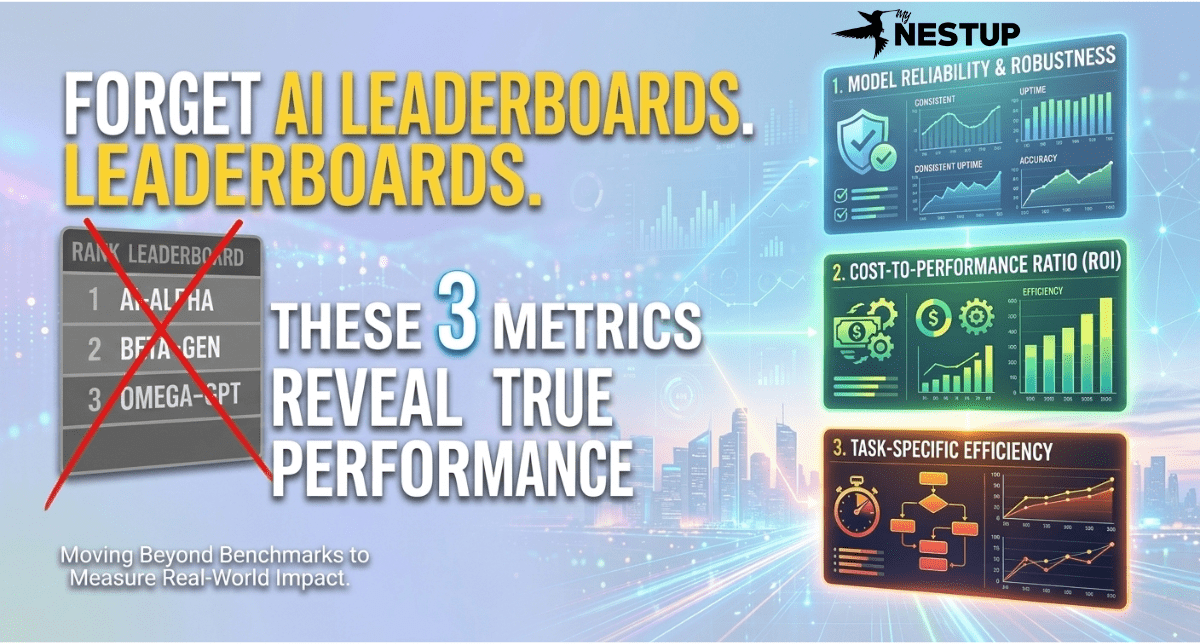
We are constantly bombarded with AI benchmarks and performance scores. We see models competing for the top spot on leaderboards like MMLU, with each new release claiming higher accuracy and better performance. While these metrics are interesting, they often miss the most critical question for anyone using these tools in their daily work: What is the real-world value? How does this AI actually make my job easier, my team more productive, or my company more efficient?
The most important metrics for evaluating an AI's impact are often surprising and counter-intuitive. They have less to do with acing a trivia test and more to do with tangible outcomes. This article reveals three key takeaways that will help you look beyond the superficial scores and start unlocking—and measuring—the true potential of AI.

Forget Perfect Scores: Why 'Usefulness' Beats 'Accuracy' Every Time
There is a fundamental difference between an AI being 'accurate' and it being 'useful'. Accuracy measures how factually correct or precise an output is, often against a predefined benchmark. Usefulness, on the other hand, assesses how effectively an AI solves a real-world problem, provides actionable insights, or saves you time.
For example, an AI might be highly accurate, capable of scoring perfectly on a general knowledge trivia test, but completely fail to provide practical advice for a complex business challenge. The trivia answers are accurate, but they aren't useful. Crucially, analyses show that reference-free metrics (like direct human scoring of usefulness) often correlate better with expert judgments than automated, accuracy-focused scores like BLEU or ROUGE, especially for open-ended creative and analytical tasks.
This is why we must shift our focus. Instead of asking "Is this answer 100% correct?", we should ask "Did this tool help me accomplish my goal?". Usefulness is measured through practical impact metrics that often correlate better with human judgment. These aren't abstract concepts; they are concrete measures like user preference ratings, task completion success rates, and time saved—metrics that directly answer whether the AI solved a real-world problem.
The ROI Is Astronomical—and You Can Actually Measure It
While many of AI's benefits can feel "soft" or hard to quantify, the return on investment (ROI) is often concrete, measurable, and massive. By tracking the right inputs and outputs, you can build a clear business case for AI adoption and prioritize the most valuable applications.
The data reveals just how significant the returns can be:
- Organizations with a structured AI strategy often see 3–10x returns on their investment within just 12–24 months.
- In healthcare, AI documentation tools have been shown to yield a 333% ROI over three years primarily through time savings.
- In manufacturing, AI used for quality control (including enhancing radiologist efficiency) has delivered an ROI between 451–791%.
- Across knowledge work, AI tools drive productivity gains of 20–30% and save between 5–90 hours per employee monthly.
The key is to start small before thinking big. Begin by tracking ROI at the individual use-case level—for instance, calculating the time saved on a single, recurring task. Once you've established value on a small scale, you can aggregate those gains to understand the broader impact on your team or organization.
To Get Exceptional Results, Treat Your Prompts Like Code
An AI's performance is not static; it's a direct result of how you interact with it. The most effective way to improve its output is through a continuous, iterative process of refinement. This involves a surprisingly powerful mental shift: applying the discipline of software development to the art of prompt engineering.
Instead of treating prompts as one-off questions, treat them as assets that can be systematically improved over time. Key strategies include:
Iterative Testing: A/B test different prompt variations to see which phrasing, structure, or examples produce the best results. For complex tasks, this can include advanced techniques like providing few-shot examples or using chain-of-thought reasoning to guide the model.
Feedback Loops: Systematically incorporate feedback to guide the AI's improvement. This can be as simple as using user ratings or as advanced as asking the AI to critique and refine its own output.
Version Control: Track changes to your most important prompts and their impact on performance, just as a developer would track changes to source code.
This methodical approach ensures that your AI workflows don't just work—they get better, more reliable, and more valuable over time.
Continuous cycles of test-measure-refine turn good AI systems into exceptional ones, compounding value over time.
To truly harness the power of AI, we must move our focus from abstract benchmarks to tangible results. The path to mastery involves three core shifts: prioritizing practical usefulness over theoretical accuracy, diligently quantifying the massive ROI to justify and guide your efforts, and adopting a disciplined, iterative approach to continuous improvement. Embracing these principles is the difference between simply using AI and mastering it to drive exceptional, compounding value.
Now that you know how to measure real value, what is the first workflow you'll transform with AI?