The Hook: Why 2026 is the Year of the “Informed Beginner”
By 2026, the friction of the “old world” has largely dissolved. The harrowing days of waiting 72 hours for a wire transfer to clear or navigating glitchy offshore gateways are over. Today, the entry point is a slick mobile app powered by instant bank transfers and ubiquitous stablecoin support. On the surface, the “buy” button is as frictionless as ordering a latte.
However, this streamlined interface masks a profound design challenge. Modern crypto forces the user to wear three high-stakes hats simultaneously: you are your own Banker, your own IT Department, and your own Investment Manager. In the traditional financial world, these roles are outsourced to institutions with billion-dollar insurance policies; in the decentralized world, that responsibility is a party of one.
This gap—between the ease of access and the weight of the responsibility—is the defining hurdle of 2026. The technology has matured, but the “Informed Beginner” must now bridge the distance between clicking a button and understanding the plumbing of a sovereign financial system.
Takeaway 1: Your First Buy is a Tuition Fee, Not an Investment
The most common mistake for a 2026 newcomer is swinging for a “moonshot” before understanding the mechanics of the launchpad. In a market still haunted by the allure of meme coins, the professional approach is counter-intuitive: treat your initial $20 to $100 as a non-refundable tuition fee.
Starting small isn’t about hedging against market volatility; it’s about practicing “on-chain hygiene.” You are paying for the right to make mistakes while the stakes are low. If you lose $20 because you botched a transfer, it’s a lesson. If you lose $20,000, it’s a tragedy. By focusing on the “plumbing”—calculating fees, navigating exchanges, and moving assets—you build the muscle memory required for the high-stakes games to come.
“The first crypto purchase isn’t really about investing. It’s about learning a new financial system.”
Takeaway 2: The “Identity Paradox” in a Decentralized World
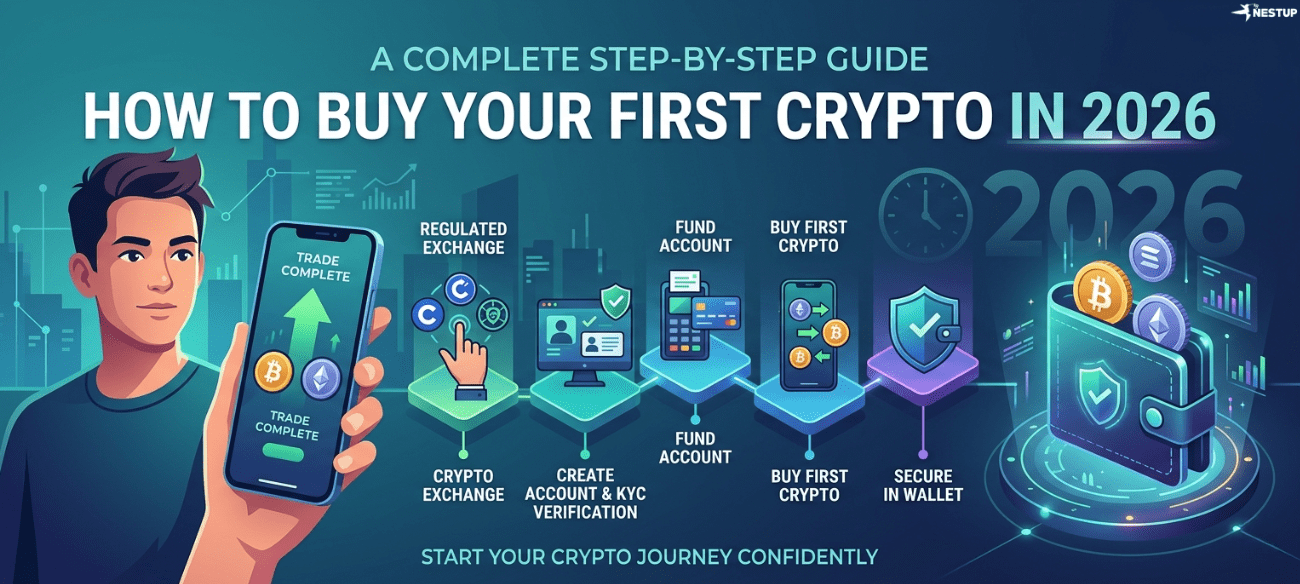
While the original ethos of crypto was anonymity, the reality of 2026 is defined by a “Identity Paradox.” To access the most secure and liquid corners of the market, you must prove exactly who you are. This transition from the “Wild West” to a world of “regulatory moats” is the clearest signal of the industry’s maturity.
However, your experience is now dictated by your passport. In the EU, the MiCA framework has standardized the experience, while in the United States, tax reporting compliance is non-negotiable. Meanwhile, in regions like Pakistan, where banking support fluctuates, users often navigate the more complex world of P2P marketplaces. This fragmentation means that while the technology is global, your legal and operational safety net is strictly local. Providing a selfie and a government ID to a “legitimate” exchange is no longer an intrusion; it is the price of entry for participating in a system that interfaces with traditional banking.
Takeaway 3: The Critical Choice of “Custody”
Once you’ve acquired your assets, you face a fork in the road that defines your entire risk profile. In 2026, the choice between convenience and sovereignty is the most important decision a beginner will make.
The Convenience of the Exchange
Platforms like Coinbase, Kraken, Binance, and OKX offer a “walled garden” experience. They handle the security, provide account recovery, and offer a user-friendly bridge to your bank account. The trade-off? You are a tenant, not an owner. If the exchange freezes, your assets freeze with it.
The Sovereignty of the Wallet
True ownership requires moving assets to a software wallet like MetaMask or Phantom, or for larger holdings, a hardware device like Ledger or Trezor. This removes the middleman but places the “sovereign risk” entirely on your shoulders. There is no “forgot password” link for a lost recovery phrase.
“Not your keys, not your coins.”
Takeaway 4: The Network Trap (A Technical “Gotcha”)
Beginners often obsess over price charts, but the “Network Trap” is a far more lethal threat. In the multi-chain ecosystem of 2026, sending assets on the wrong blockchain network—such as Ethereum assets over an incompatible chain—is the most expensive click you will ever make.
Because these transactions are final and decentralized, there is no customer support to reverse a mistake. A technical error is more dangerous than a 20% market crash because the loss is 100% and irreversible. To mitigate this, the “Professional Standard” for 2026 is the test transaction: always send a tiny amount first to verify the path is clear before moving your full capital.
Takeaway 5: Tax Tracking is Now a Day-One Requirement
The regulatory landscape has shifted from “wait and see” to “track and report.” In India, strict TDS (Tax Deducted at Source) rules and flat taxes on gains make every move visible. In the US and EU, authorities have clarified that “swapping” one token for another is a taxable event—not just selling for cash.
Attempting to reconstruct hundreds of transactions years later is a logistical nightmare that invites audits. A professional mindset requires integrating tools like CoinTracker or Koinly from your very first trade. Tracking your “on-chain” footprint from day one isn’t just about compliance; it’s about maintaining a clear-eyed view of your actual performance after the taxman takes his cut.
Takeaway 6: The Real Threat Isn’t the “Crash”
The media focuses on market volatility, but for the beginner, the real danger is rarely a red candle on a chart. It is avoidable security errors. You are more likely to lose your portfolio to a phishing scam or a lost seed phrase than a total market collapse.
Most catastrophic losses in 2026 stem from three failures:
- Poor 2FA Hygiene: Relying on SMS-only authentication rather than robust app-based or hardware 2FA.
- Seed Phrase Negligence: Taking a screenshot or storing a recovery phrase in a cloud note, making it “low-hanging fruit” for hackers.
- Social Engineering: Falling for “guaranteed returns” or DeFi protocols that sound too good to be true. (Hint: They always are.)
Conclusion: Beyond the Buy Button
The evolution of fintech has made buying crypto in 2026 look like a game, but the underlying stakes are anything but. Success in this era isn’t defined by the speed of your entry, but by the discipline of your systems. The smartest participants are those who trade the “hype” for a cold, technical understanding of exchanges, wallets, and security protocols.
Now that the tools are ready for you, are you ready for the responsibility of owning your own financial future?