By 2026, the tech industry has finally matured past the search for a “God Model.” The antiquated notion that a single, universal champion—whether from the house of Anthropic, OpenAI, or Google—can dominate every metric is a relic of the 2024 hype cycle. Today, “better” is no longer an objective ranking; it is a contextual variable. As a strategist, I no longer ask which model is the most powerful; I ask which model is the right tool for the specific architecture of the task at hand.
The End of Generalization: The Rise of Specialization
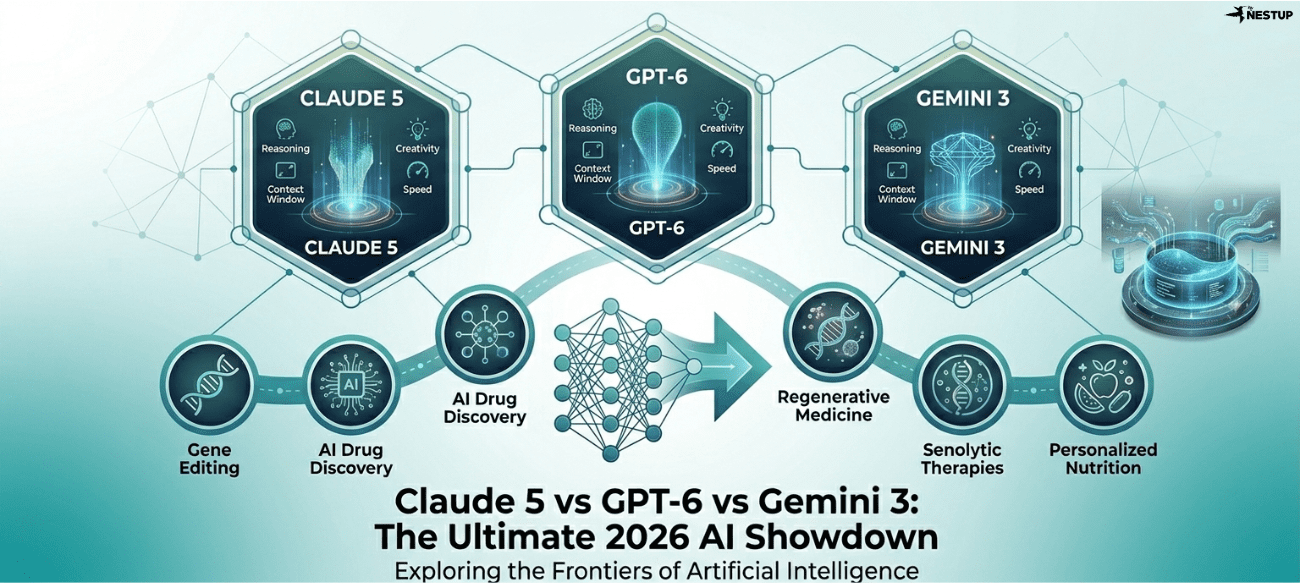
The most significant regime change in the 2026 AI landscape is the collapse of all-rounder dominance in favor of extreme specialization. We have transitioned from an era of “picking a favorite” to one of “building a toolkit.” In this environment, blind model loyalty has become a strategic liability. To remain competitive, enterprises must pivot from monolithic dependencies to a modular approach where Claude handles deep work, GPT-6 (evolved from the GPT-5.x lineage) manages quantitative reliability, and Gemini 3 serves as the high-speed multimodal engine.
“The AI race isn’t about one model dominating everything—it’s about specialization.”
Gemini 3 is the New Scientific Heavyweight
Gemini 3 has secured its competitive moat as the premier R&D engine of the trio. While its rivals are formidable, Gemini 3 dominates benchmarks requiring high-level abstract reasoning and PhD-level scientific inquiry. It currently holds a staggering 94.3% on the GPQA (PhD science) benchmark and a 77.1% on ARC-AGI.
The “Real Insight” here isn’t just the score; it’s Gemini’s unique ability to handle “never-seen-before” logic. While older architectures often relied on pattern matching from training data, Gemini 3 excels at solving novel problems that exist outside its training set. For research-intensive organizations tackling the next frontier of physics or bio-engineering, Gemini 3 is the undisputed choice for navigating uncharted intellectual territory.
Claude is the Poet and Architect of the 2026 Frontier
While the competition chases raw throughput, Claude remains the preferred choice for high-stakes creative architecture and sophisticated communication. Claude consistently leads the GDPval—the industry-standard professional writing benchmark—by producing prose that feels natural and human-like, rather than “AI-generated.”
In the technical domain, Claude’s superiority is defined by “architecture-level thinking.” With an 80.8% score on the SWE-Bench for coding, it isn’t just generating snippets; it is managing multi-file changes and complex debugging cycles. For developers, this is the difference between a simple autocomplete and a collaborator capable of understanding how a change in the backend impacts the entire system architecture. For high-fidelity work where nuances in prose and structure are non-negotiable, Claude remains the gold standard.
GPT-6 Owns the Quantitative Domain
GPT-6 represents a regime change for technical problem-solving. By achieving a near-perfect score of ~99% on the AIME and Math Olympiad benchmarks, OpenAI has effectively solved the reliability problem that plagued earlier iterations. This level of symbolic reasoning and step-by-step accuracy makes GPT-6 the essential engine for financial modeling, autonomous agents, and rigorous analytics.
Beyond the numbers, GPT-6 is the most balanced model for general intelligence, benefiting from significantly reduced hallucinations. This reliability makes it the ideal anchor for tool integrations. When you need an agent to execute a series of actions across multiple software platforms without losing the logical thread, GPT-6’s lineage from the GPT-5.x series provides a level of factual stability that its competitors are still struggling to match.
The Economic Reality of “Massive Context”
In 2026, processing a million tokens is no longer a luxury; it’s a commodity. However, the economic implications of how that context is handled are vast. While Claude and Gemini 3 both offer 1M token windows (with GPT-6 ranging from 400K to 1M), the differentiator is efficiency versus premium quality.
Gemini 3 is the clear efficiency leader, priced at approximately $2 per 1M input tokens. Furthermore, it offers the most consistent retrieval performance across that massive context window. In contrast, Claude Opus is positioned as a premium service, with input costs at $5 and output at $25 per 1M tokens. For an enterprise processing billions of tokens monthly, the choice between Gemini and Claude isn’t just a matter of preference—it’s a multi-million dollar strategic decision. You pay the Claude premium for “architecture,” but you scale with Gemini for “volume.”
The “Multi-Model Hybrid” is the Real 2026 Winner
The most sophisticated AI playbooks in 2026 have moved past the “single-vendor” mindset. The real winners are those who have built hybrid stacks that route tasks dynamically based on model strengths. To maximize your competitive advantage, your routing playbook should look like this:
- Route to Claude for high-stakes professional writing, code reviews, architectural planning, and deep-thinking workflows.
- Route to GPT-6 for advanced mathematics, complex analytics, autonomous agent deployments, and research-heavy technical tasks.
- Route to Gemini 3 for multimodal processing (video/audio), massive document analysis, and high-volume, cost-sensitive scaling.
Conclusion: A New Era of Intelligence
The era of the monolithic AI is dead. In its place, we find a modular ecosystem where intelligence is a plug-and-play commodity, fragmented across specialized strengths. In 2026, the “best” AI is a moving target that shifts with every new objective.
The forward-looking strategist must view intelligence as a modular utility rather than a singular platform. As you refine your own operations, the critical question is no longer “Which model should I buy?” but rather: How will you adapt your own workflow to a world where the best AI for the job depends entirely on what you are trying to achieve this hour?