
For decades, the human-computer relationship has been defined by a specific type of labor: the mastery of the tool. We learned to navigate complex ribbon menus, manipulate cell formulas, and organize nested folders. We were digital artisans, and our value was often tied to how well we could "work the software." But we are currently witnessing a seismic architectural pivot. The era of the digital tool-user is being cannibalized by the era of the outcome-achiever.
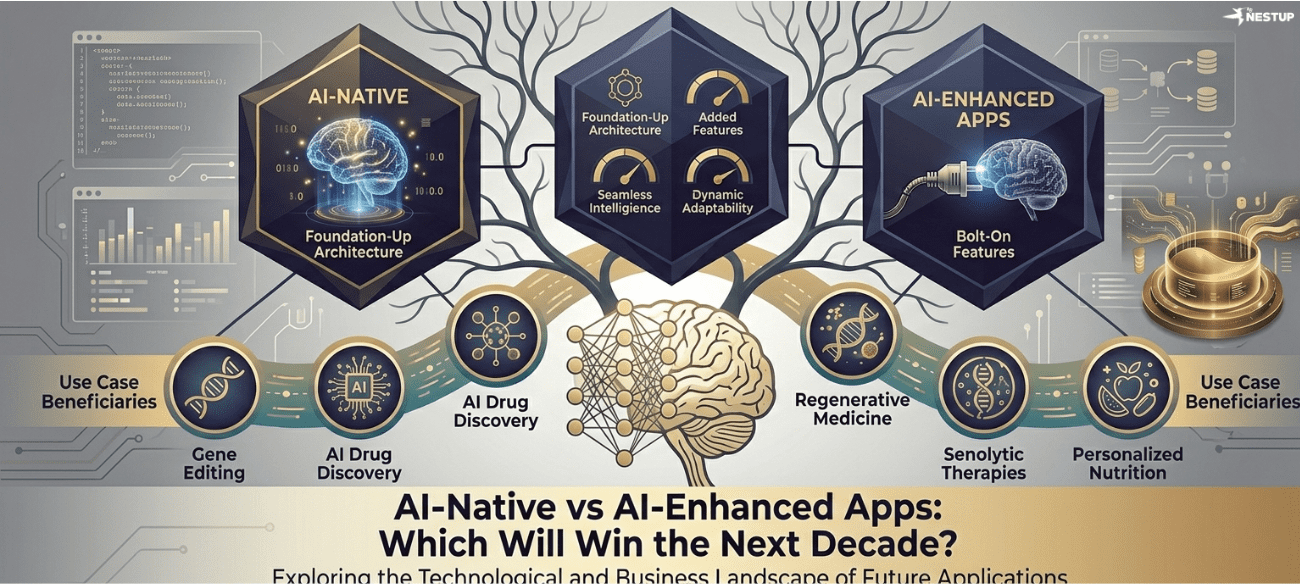
This evolution has triggered a "software schism," a fundamental divide in the SaaS landscape between AI-Native and AI-Enhanced design. This isn't merely a debate over features; it is a battle over the future of human agency.
The "Tell" vs. "Use" Philosophical Divide: From Pilot to Director
The industry is currently splitting along a sharp philosophical fault line. In the legacy model, the user acts as a "pilot," hands firmly on the controls, navigating a specific path to reach a destination. In the emerging AI-driven model, the user is promoted to "director."
As a director, the "how" of the software’s internal logic becomes secondary to the "what" of the desired result. You are no longer required to understand the friction of the process; you are only required to have the clarity of the vision.
"AI-native = 'You tell the software what you want.' AI-enhanced = 'You still use the software, but faster.'"
AI-native products treat the large language model as the product itself, while AI-enhanced products treat AI as a high-octane fuel for existing engines. This shift implies a radical conclusion: if the director only cares about the result, the interface—the very thing we have spent forty years perfecting—is increasingly a barrier to be removed.
Where Autonomy Cannibalizes Augmentation: The AI-Native Edge
In categories where the primary goal is the extraction of information or the elimination of a chore, AI-native applications are not just winning—they are rendering traditional workflows obsolete. The market is shifting toward a preference for "Answers over Links" and "No notes over Better notes."
Search is the first major casualty. AI-native platforms like Perplexity AI are disrupting the status quo because search is fundamentally about retrieval, not navigation. Similarly, in the meeting space, tools like Granola succeed because they prioritize automation over augmentation. Users don't want a "better" way to take notes; they want the note-taking process to vanish entirely.
This "Native" dominance is characterized by:
- Natural Language First: The prompt is the interface; the dashboard is a relic.
- Minimalist UI: Maximum automation leads to a disappearing interface.
- Outputs instead of Tools: The delivery of a finished result (a summary, a slide deck, a codebase) replaces the workspace.
However, a "Split Market" has emerged in Creative and Coding tools. AI-native tools (like prompt-to-app generators) are cannibalizing early-stage ideation and rapid prototyping, where speed is the only metric that matters. Meanwhile, for "precision and polish," users still retreat to the controlled environments of enhanced tools.
The Incumbent Moat: Why Distribution Defeats Raw Innovation
Despite the agility of AI-native startups, the titans of Enterprise SaaS—Microsoft, Notion, and Salesforce—remain remarkably resilient. This isn't just about brand recognition; it is a calculation of economic reality and behavioral inertia.
For a large organization, the cost of switching is not just a line item; it is a massive disruption of established workflows. "Bolt-on" AI is often the preferred path for enterprises because it requires no significant behavior change.
Incumbents maintain their dominance through three primary moats:
- High Switching Costs: The deep structural integration of tools like Microsoft 365 makes a "rip and replace" strategy for AI-native alternatives nearly impossible for large-scale operations.
- Data Sovereignty: Trust, compliance, and control over proprietary data are non-negotiable for enterprise leaders.
- Distribution Power: An incumbent can deploy an "enhanced" AI feature to millions of seats overnight, effectively neutralizing the novelty of a startup’s "native" feature.
In this environment, "good enough" AI that lives where the work already happens is often more valuable than "revolutionary" AI that requires a new tab.
The High Price of Autonomy: Balancing Speed and Control
There is no "perfect" model; there is only the right tool for the specific level of risk and precision required.
| Dimension | AI-Native | AI-Enhanced |
| Speed | ⚡ Very High | Medium |
| Control | Low–Medium | High |
| Learning Curve | Low | Low |
| Reliability | Medium | High |
| Innovation Potential | 🚀 High | Incremental |
The "High Speed, Low Reliability" profile of AI-native tools currently relegates them to lightweight workflows and early-stage creation. When the stakes are high—such as in mission-critical coding or financial modeling—the "Pilot" (the human) still requires the granular controls of an AI-enhanced system to ensure the result is both precise and polished.
The Ultimate Convergence: Moving Toward Result-Centric Software
The "Software Schism" is a temporary state. We are accelerating toward a blend of both models—the AI-first hybrid.
As native startups mature, they will be forced to adopt the structure and reliability of enterprise tools. Simultaneously, the legacy giants will move past the "bolt-on" phase, replacing manual steps with autonomous workflows.
The most impactful strategic insight is this: we are moving from a Workspace-centric world to a Result-centric world. In the past, the "software" was the place where you did the work. In the future, the software is the work.
Conclusion: The End of the Interface
We are witnessing the final stage of software’s evolution before it becomes an invisible utility. The distinction between "native" and "enhanced" will eventually matter as little as the distinction between a cloud-hosted or locally-hosted application does today.
The only true metric for success will be: "Did it get the job done for me?"
As the interface recedes, we must ask ourselves: Do we want to remain the masters of complex tools, or are we ready to be the recipients of finished results? The answer defines whether we see the disappearance of software as a loss of control or the ultimate liberation of our time. Regardless, the outcome is the same: the tool is fading, and only the result remains.