The rapid evolution of artificial intelligence has been defined by a persistent challenge: reliability. For all their power, large language models have been plagued by a tendency to “hallucinate”—confidently stating incorrect information. This makes it difficult to trust them for high-stakes tasks, moving them from indispensable tools to unreliable novelties. We’ve learned that evaluating an AI’s true capability requires looking beyond simple academic test scores.
True performance is a complex blend of factual accuracy, real-world usefulness, and even contextual understanding. A recent analysis of Grok’s performance in real-world production environments provides a clearer picture of what makes an AI not just smart on paper, but genuinely reliable in practice. The findings are guided by a core design philosophy focused on truth-seeking.
Grok is designed to prioritize factual accuracy, even on controversial topics.
This principle is not just an aspiration; it’s a measurable engineering goal. The results reveal four key takeaways that are reshaping our understanding of AI accuracy.
Takeaway 1: Hallucinations Aren’t Just Being Reduced—They’re Being Crushed
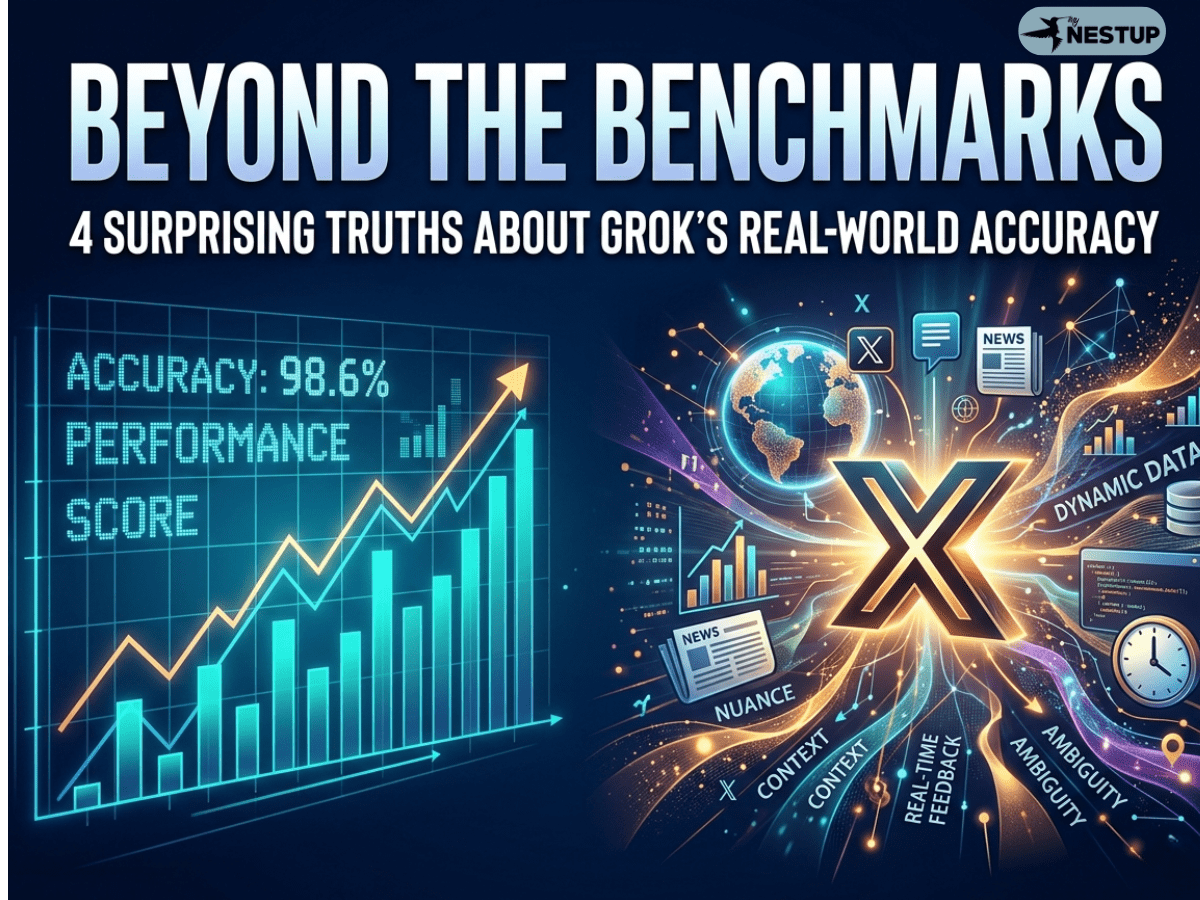
One of the most significant hurdles for any language model is its tendency to invent facts. A model that can’t be trusted for basic information retrieval has limited practical value. Recent evaluations show a dramatic improvement in this area for Grok, with the hallucination rate on information-seeking queries dropping from approximately 12% to just 4%.
This represents a ~65% relative reduction in fabricated information—a massive leap in reliability. For professional applications like market research, threat monitoring, and compiling intelligence briefings, this shift is transformative. It moves the needle from a system that requires constant, meticulous fact-checking to one that can be relied upon for a much higher degree of factual precision. This dramatic leap in reliability isn’t accidental; it’s the direct result of a core architectural decision: grounding answers in real-time, verifiable data, which we’ll explore further.
Takeaway 2: It’s Not Just Smarter, It’s the People’s Choice
While standardized academic benchmarks are useful, real-world user preference is often the ultimate test of an AI’s value. LMArena (also known as Chatbot Arena) provides exactly that: a crowd-sourced platform where thousands of users blindly vote for the best AI responses in head-to-head matchups.
According to the latest data, Grok 4.1 Thinking is ranked #1 on LMArena, leading the field by a significant margin with an Elo score of 1483+. This top ranking reflects its practical usability in areas like conversation and reasoning. This result is further supported by separate blind tests where Grok achieved a 64%+ preference over its predecessors, cementing its status as the user-preferred choice for real-world interactions.
Takeaway 3: The Focus is Shifting from Raw IQ to Emotional IQ
A surprising and counter-intuitive development in AI evaluation is the inclusion of metrics for emotional intelligence. The latest benchmarks show that Grok now leads on the EQ-Bench3, a test designed to measure a model’s capabilities in empathy, insight, and roleplay scenarios.
This focus highlights a crucial shift in what we demand from AI. For an AI to function as a truly effective assistant, partner, or collaborator, it must do more than just process raw data. It needs to understand conversational nuance, interpret user intent with greater subtlety, and engage in a way that is contextually appropriate. Excelling in emotional IQ is a strong indicator of a model’s ability to handle the complex, human-centric tasks of the future.
Takeaway 4: The Secret to Accuracy Isn’t Just a Bigger Brain—It’s a Multi-Pronged Strategy
The secret to this new level of accuracy isn’t a single magic bullet but a sophisticated strategy combining real-time grounding with advanced training and reasoning techniques. The most visible component is “grounding”—the ability to base answers on current, verifiable information rather than relying solely on static training data.
Grok accomplishes this through its deep integration with tools like web search and X search. The model is designed to “autonomously search for verification,” effectively fact-checking itself against real-time data before delivering a response. This mechanism is the practical engine behind the dramatic reduction in hallucinations. This is reinforced by other advanced techniques, including large-scale reinforcement learning (RL) to reward factuality and specialized reasoning modes that allow the model to “think longer” and self-correct. It’s this comprehensive engineering philosophy—not just one feature—that delivers a verifiably more accurate result.
Conclusion: A More Reliable Future for AI
The most meaningful measures of AI progress are found at the intersection of raw intelligence, demonstrable reliability, user preference, and even emotional insight. The evolution of Grok demonstrates a clear focus on building a system that is not only powerful but also verifiably accurate and grounded in reality. As AI models continue on this trajectory, it begs a critical question: how will our relationship with them change from one of cautious verification to one of trusted collaboration?