
What Are Sodium-Ion Batteries?
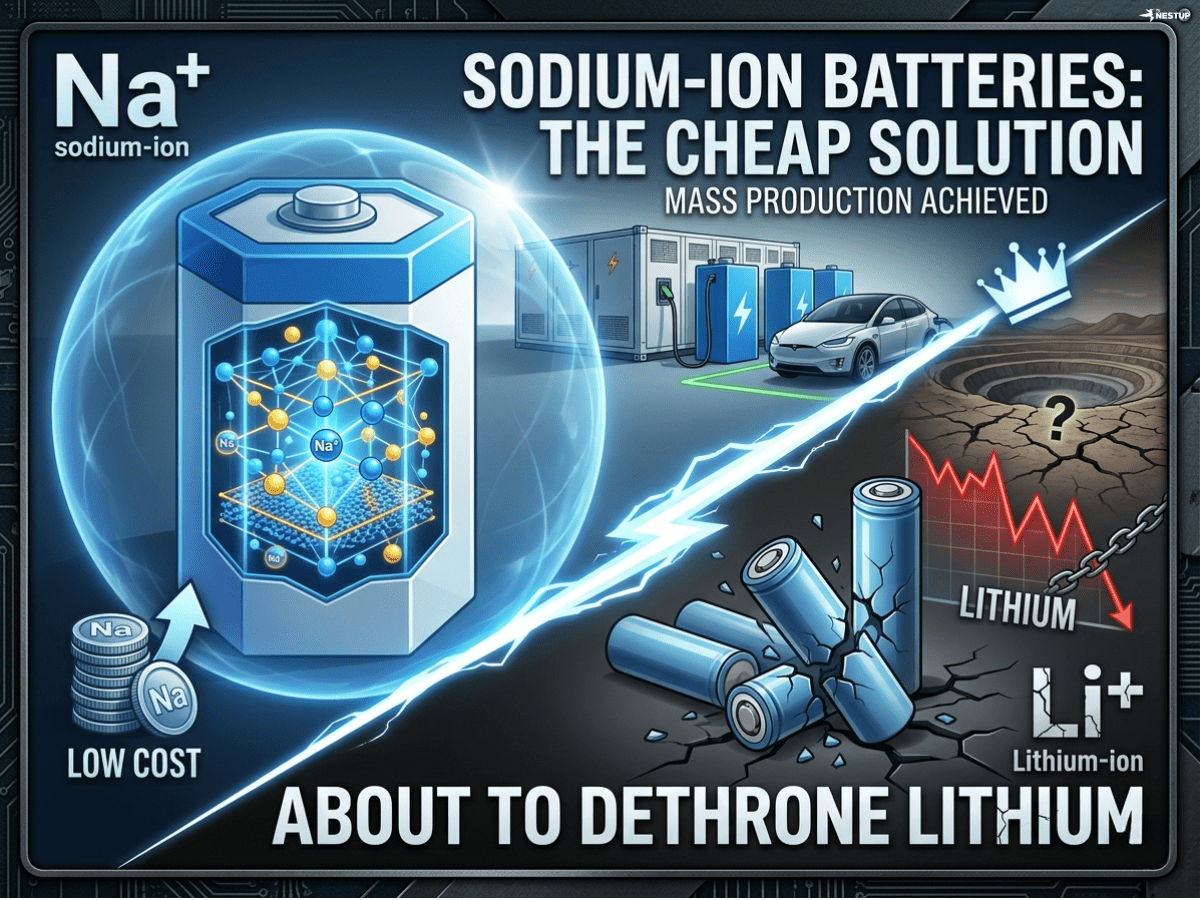
Sodium-ion batteries work on a similar principle to lithium-ion batteries, but replace lithium with sodium as the charge carrier. Chemically, the structure is comparable—ions move between a cathode and an anode during charging and discharging—but the materials involved are far more abundant and easier to source.
That difference is what makes sodium-ion so disruptive. Sodium is one of the most abundant elements on Earth, found in seawater and common minerals. Unlike lithium, it does not rely on geographically concentrated supply chains or politically sensitive mining regions.
Why Everyone Is Talking About Them Now
For years, sodium-ion technology was stuck in the lab due to lower energy density. But by 2026, that barrier has narrowed significantly. Commercial cells now reach around 160–175 Wh/kg—close to lithium iron phosphate (LFP) batteries used in mainstream EVs. (Editorialge)
At the same time, manufacturing breakthroughs have solved earlier challenges like moisture sensitivity and material stability. This has pushed sodium-ion from experimental status into real-world deployment.
In fact, 2026 is widely seen as the turning point where sodium-ion transitions from research to mass commercialization. (MySteel)
The Cost Advantage: Why Sodium Could Win
The biggest reason sodium-ion batteries are attracting attention is cost. On paper, they offer a structural advantage that lithium simply cannot match.
Raw materials are dramatically cheaper. Sodium compounds cost a fraction of lithium, and the chemistry avoids expensive elements like cobalt and nickel. Even more importantly, sodium-ion batteries can use aluminum instead of copper in key components, reducing manufacturing costs further. (Energy Solutions)
By 2026, estimated sodium-ion cell costs are in the range of $55–70 per kWh, roughly 30–40% cheaper than comparable lithium-ion technologies in theory. (Energy Solutions)
However, there’s an important nuance. At current production scale, sodium-ion is often cost-competitive rather than dramatically cheaper. The real price advantage is expected to emerge as manufacturing scales over the next few years. (SANSU.PRO)
This is why analysts see sodium-ion as a future cost disruptor, not yet a fully dominant one.
Safety and Supply Chain: The Hidden Advantages
Cost is only part of the story. Sodium-ion batteries are also safer and more resilient from a supply chain perspective.
They are less prone to thermal runaway—the overheating that can lead to fires in lithium-ion batteries. (Live Science)
They also perform better in extreme temperatures, retaining capacity even in freezing conditions where lithium batteries degrade. (CarNewsChina.com)
From a geopolitical standpoint, sodium eliminates reliance on lithium, cobalt, and nickel—materials that are often concentrated in a few regions. This makes sodium-ion strategically attractive for countries trying to localize energy infrastructure.
The Key Players: CATL and BYD
Two companies are leading the charge in sodium-ion development.
CATL is currently the global leader. It has already built significant production capacity and plans full-scale mass production starting in late 2026. (MySteel)
The company has also secured large-scale deals for energy storage, including multi-gigawatt-hour deployments—an early signal that the technology is commercially viable. (Reuters)
BYD is following closely, integrating sodium-ion into its broader battery strategy. While best known for lithium-based Blade batteries, BYD is investing heavily in sodium-ion for affordable vehicles and grid applications.
Together, these companies are effectively creating a parallel battery ecosystem alongside lithium.
Where Sodium-Ion Actually Makes Sense
Despite the hype, sodium-ion is not a universal replacement for lithium. Its strengths and weaknesses make it better suited to specific applications.
The most immediate opportunity is grid-scale energy storage. Here, energy density matters less than cost, safety, and durability. Sodium-ion batteries are ideal for storing renewable energy from solar and wind, helping stabilize electricity grids.
Another strong use case is affordable electric vehicles, especially in urban markets. Sodium-ion batteries can support ranges of 300–400 km, which is sufficient for most daily driving. (Editorialge)
They are also well-suited for:
- Two- and three-wheelers
- Backup power systems
- Cold-climate applications
Where they struggle is in high-performance EVs, where long range and compact size are critical. Lithium-ion still dominates that segment due to higher energy density.
The Timeline to Mass Adoption
The timeline for sodium-ion adoption is becoming clearer.
- 2025–2026: Early commercial deployments begin, especially in China
- Late 2026: Mass production ramps up, led by CATL (MySteel)
- 2027–2028: Rapid scaling in grid storage and low-cost EVs
- 2030+: Potential cost leadership over lithium in multiple segments
Some models suggest sodium-ion could reach full cost competitiveness with lithium-ion by the early 2030s, depending on scaling and raw material trends. (arXiv)
Importantly, the future is likely not “sodium replaces lithium,” but rather a dual-battery world where each chemistry dominates different use cases.
The Reality Check: Why Lithium Isn’t Dead Yet
Despite bold headlines, lithium-ion batteries are not going away anytime soon. They still offer higher energy density, better performance for long-range EVs, and a mature global supply chain.
Sodium-ion’s role is more strategic. It lowers costs, reduces supply risk, and expands access to energy storage. Instead of replacing lithium, it complements it—at least in the near term.
Final Thoughts: A Quiet Revolution in Energy
Sodium-ion batteries may not have the hype of solid-state batteries or next-gen EV breakthroughs, but they could be just as transformative.
They solve a different problem. Not maximum performance, but minimum cost and maximum scalability.
That’s why they matter. As renewable energy expands and electrification accelerates, the world doesn’t just need better batteries—it needs cheaper ones.
And sodium-ion might be the first technology capable of delivering that at global scale.