
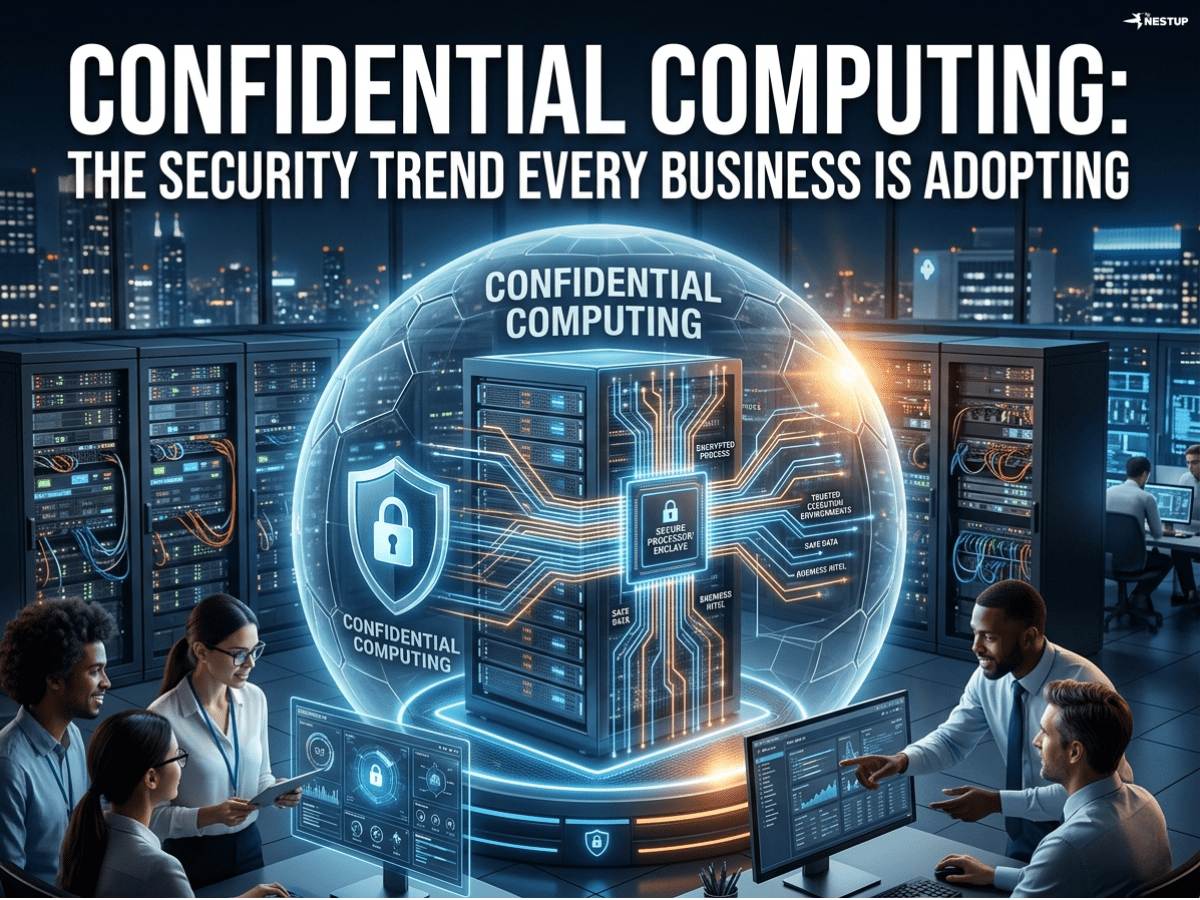
What Is Confidential Computing?
Confidential computing is a security approach designed to protect data while it’s being processed, not just when it’s stored or transmitted. Traditionally, encryption secures data at rest (on disks) and in transit (over networks), but leaves a gap when data is actively in use in memory.
Confidential computing closes that gap using hardware-based protections called Trusted Execution Environments (TEEs). These are secure enclaves within a processor where sensitive data can be processed in isolation, shielded even from the operating system, cloud provider, or system administrators.
In simple terms, it allows businesses to compute on encrypted data without exposing it.
Why It Matters Now
The rise of cloud computing and AI has made this approach increasingly important. Companies are processing highly sensitive data—financial records, healthcare information, proprietary models—on shared infrastructure.
This creates a trust problem. Even if a cloud provider is secure, organizations still worry about insider threats, data leaks, or regulatory exposure.
Confidential computing addresses this by making the data inaccessible to everyone except the code running inside the secure enclave. That shift is why it’s gaining traction across industries like finance, healthcare, and government.
The Core Technology: Trusted Execution Environments
At the heart of confidential computing are TEEs. These environments isolate specific workloads so that data remains encrypted and protected during execution.
The security guarantees come from hardware-level enforcement. Even if the rest of the system is compromised, the enclave remains protected. This is a major leap from traditional software-based security models.
TEEs also support remote attestation, which allows a system to prove that it is running trusted code in a secure environment before sharing sensitive data.
Key Technologies Powering the Trend
Several major technology companies are driving confidential computing forward with their own implementations.
Intel SGX
Intel’s Software Guard Extensions (SGX) is one of the earliest and most widely known TEE technologies. It allows developers to create secure enclaves directly within Intel CPUs.
SGX is particularly useful for applications that require strong isolation, such as secure data processing, digital rights management, and confidential analytics. However, it has faced challenges around scalability and memory limitations.
AMD SEV
AMD’s Secure Encrypted Virtualization (SEV) takes a different approach by encrypting entire virtual machines rather than individual application enclaves.
This makes it easier to deploy at scale, especially in cloud environments. SEV is widely used for protecting workloads in virtualized infrastructure, offering strong isolation without requiring significant application changes.
Microsoft Azure Confidential Computing
Cloud providers are making confidential computing more accessible. Microsoft Azure offers a suite of confidential computing services that integrate TEEs into cloud workflows.
This allows businesses to run sensitive workloads—such as financial modeling or healthcare analytics—on the cloud while maintaining strict data privacy guarantees. Azure’s approach combines hardware security with developer-friendly tools, accelerating adoption.
Why AI Is Driving Adoption
Artificial intelligence is one of the biggest catalysts for confidential computing. AI models require vast amounts of data, much of which is sensitive. At the same time, organizations are increasingly outsourcing AI training and inference to the cloud.
This creates a dilemma: how do you leverage powerful cloud infrastructure without exposing your data?
Confidential computing provides a solution. It enables secure model training and inference by ensuring that data remains protected even during computation. This is especially important for use cases like:
- Healthcare AI using patient data
- Financial fraud detection
- Proprietary model training with sensitive datasets
It also opens the door to collaborative AI, where multiple parties can contribute data to a shared model without revealing their individual datasets.
Real-World Use Cases
Businesses are already applying confidential computing in practical ways. In finance, banks use it to analyze encrypted transaction data without exposing customer information. In healthcare, researchers can process patient records securely while complying with strict privacy regulations.
Another growing use case is secure data sharing between organizations. For example, companies can collaborate on analytics or AI models without actually sharing raw data, reducing both risk and legal complexity.
This capability is especially valuable in industries where data privacy laws are strict and penalties for breaches are high.
Challenges and Limitations
Despite its promise, confidential computing is not without challenges. Performance overhead can be an issue, as encryption and isolation add computational cost. Some implementations also require developers to modify applications, which can slow adoption.
There are also concerns about hardware vulnerabilities. While TEEs are designed to be secure, they are not immune to sophisticated attacks, and ongoing research continues to test their limits.
Finally, the ecosystem is still maturing. Standards, tooling, and interoperability are improving, but not yet fully standardized across platforms.
The Bigger Picture: A Shift in Trust
Confidential computing represents a fundamental shift in how trust is established in digital systems. Instead of trusting infrastructure providers or administrators, organizations can rely on cryptographic and hardware guarantees.
This is particularly important in a world where data is increasingly distributed, shared, and monetized. It enables new business models while maintaining strong privacy protections.
Final Thoughts
Confidential computing is quickly moving from a niche concept to a mainstream security standard. Technologies like Intel SGX, AMD SEV, and Microsoft Azure Confidential Computing are laying the foundation for a more secure computing environment.
As AI adoption accelerates and data privacy concerns grow, the ability to process sensitive information without exposing it will become a necessity rather than a luxury.
For businesses, the message is clear: protecting data at rest and in transit is no longer enough. The future of security lies in protecting it while it’s being used.