
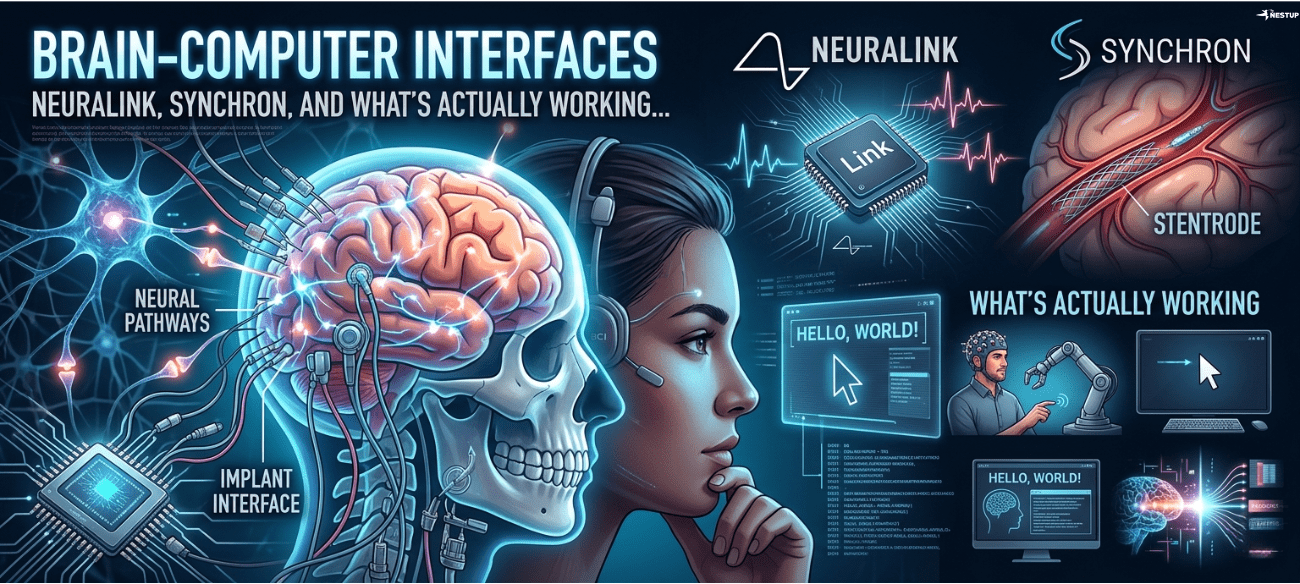
The Mind-Machine Connection Moves from Lab to Life
For decades, the Brain-Computer Interface (BCI) was the ultimate "vaporware" of the transhumanist imagination—a concept perpetually trapped in the amber of science fiction or the highly sterilized confines of academic laboratories. We have long been captivated by the promise of direct neural communication, yet the leap from demonstrating basic motor control in a lab setting to deploying a viable, long-term medical device has remained the industry's "valley of death."
That valley is now being bridged. We have officially pivoted from the era of speculative engineering into the high-stakes world of human clinical trials. This is no longer about demonstrating that a computer can read a thought; it is about the grueling process of proving that an implanted device can survive the corrosive environment of the human body while maintaining high signal fidelity. This transition is governed less by the "move fast and break things" ethos of Silicon Valley and more by the rigorous safety profiles and clinical endpoints required by the FDA.
As a strategic analyst looking at the current status report of the sector, the focus has shifted from "can we?" to "how durable is the link?" With heavyweights like Neuralink, Synchron, and Precision Neuroscience now operating under Investigational Device Exemption (IDE) pathways, the BCI landscape is being reshaped by the harsh realities of neurosurgery, biocompatibility, and regulatory scrutiny.
Neuralink’s Leap into Human Subjects: Bandwidth and Biocompatibility
The initiation of human clinical trials for Neuralink marks a fundamental shift in the company’s strategic maturity. By transitioning its high-bandwidth interface from animal models to human patients, Neuralink is finally testing the long-term stability of its "threads"—ultra-fine electrodes designed to minimize tissue damage while maximizing data transfer. The primary challenge here isn't just the initial signal, but the biological response; the brain is a hostile environment for foreign electronics, and the industry is watching to see how Neuralink’s penetrating electrodes hold up against the inevitable glial scarring.
This transition shifts the strategic narrative from sheer data throughput to clinical longevity. For Neuralink, the goal is to prove that its high-density array can maintain a high signal-to-noise ratio over months and years. This isn't just about moving a cursor; it is about proving that a high-bandwidth, fully implanted system can become a reliable, invisible extension of the user’s nervous system without requiring frequent surgical revisions.
Synchron and the "Stentrode": The Endovascular Strategic Path
Synchron has adopted a radically different strategic posture by bypassing open-brain surgery entirely. Their "stentrode" device is delivered via the vascular system—specifically through the jugular vein—and navigated into the superior sagittal sinus adjacent to the motor cortex. By utilizing interventional neuroradiology, a practice already common in stroke treatment, Synchron avoids the risks of craniotomies and the direct piercing of brain tissue.
This endovascular approach represents a brilliant regulatory "path of least resistance." While the signal resolution from inside a blood vessel may not match the granular bandwidth of a penetrating electrode, the safety profile is inherently more attractive to risk-averse medical regulators. Synchron’s strategy prioritizes speed to market and surgical accessibility, betting that a "good enough" signal delivered through a safer, minimally invasive procedure will become the commercial standard before more invasive high-bandwidth options can clear their regulatory hurdles.
Precision Neuroscience: Scalability through Non-Destructive Arrays
Precision Neuroscience occupies the strategic middle ground, focusing on high-resolution data without the destructive nature of penetrating needles. Their technology utilizes a thin-film micro-electrode array that sits on the surface of the brain (the cortical surface) rather than being driven into it. This "surface array" approach aims to provide a massive number of channels—potentially exceeding the density of their competitors—while maintaining the integrity of the underlying neural tissue.
The strategic advantage for Precision is scalability and reversibility. Because the array does not pierce the cortex, the risk of inflammatory response and permanent tissue damage is significantly reduced. In the competitive landscape of the BCI race, Precision is positioning itself as the high-fidelity, low-trauma alternative, targeting a market that demands sophisticated control but is wary of the long-term biological costs associated with penetrating implants.
Medical Utility vs. Consumer Hype: The Regulatory Filter
While the tech press often conflates BCIs with telepathic consumer gadgets, the strategic reality is firmly anchored in MedTech. We are currently in a "medical-first" era, where the target audience is not the curious "prosumer" but the patient with profound motor impairment. The industry's current focus is on restoring lost function—specifically for conditions like ALS, stroke, or spinal cord injury—where the risk-benefit ratio justifies the intervention.
“We are moving past the 'Black Mirror' era of BCI into the 'MedTech' era, where success is measured in regulatory approvals, not Twitter impressions. The goal is no longer a lifestyle upgrade, but a standard-of-care medical necessity.”
This distinction is critical for investors and observers. The path to a widely available BCI is not through a consumer electronics store, but through the rigorous, multi-year validation process of clinical efficacy. Every breakthrough we see today is being filtered through the lens of therapeutic utility, prioritizing the restoration of biological agency over the convenience of digital lifestyle enhancements.
Mapping the Realistic Timeline: From IDE to Standard of Care
The trajectory for BCI adoption is governed by a clash of cultures: the rapid iteration of hardware and software versus the slow, methodical "prove safety first" culture of modern medicine. The industry is currently moving through a structured, multi-phase timeline that looks like this:
- Feasibility and Pilot Studies (Current Phase): Small-scale human trials under FDA IDEs to prove basic safety and fundamental signal acquisition.
- Pivotal Trials: Larger patient cohorts intended to prove clinical efficacy and support a formal Premarket Approval (PMA) application.
- Regulatory Clearance and Market Entry: The transition from experimental status to a commercially available medical device for specific indications.
- Standard of Care Integration: The point where BCI implantation becomes a routine procedure, supported by insurance reimbursement and established surgical protocols.
This timeline suggests that while we are witnessing a "frontier" moment, the wide-scale adoption of these technologies is a marathon, not a sprint. The bottleneck is no longer the code or the silicon; it is the time required to prove that these devices remain safe and effective inside a living human being for a decade or more.
Conclusion: The Future is Under Trial
The BCI landscape has successfully migrated from the chalkboard to the operating room. Through the competing strategies of Neuralink’s high-bandwidth penetration, Synchron’s endovascular safety, and Precision’s surface-level scalability, the field is maturing into a legitimate medical industry. We are no longer debating whether the mind can be interfaced; we are now calculating the surgical risks, the signal stability, and the regulatory pathways that will turn these devices into a standard of care.
As we watch these trials unfold, the most profound question is no longer technical, but personal: How will your understanding of your own agency change when the boundary between your motor cortex and the digital world is no longer a skin-deep barrier, but a permanent, high-speed bridge?