
Introduction: Why This Comparison Matters
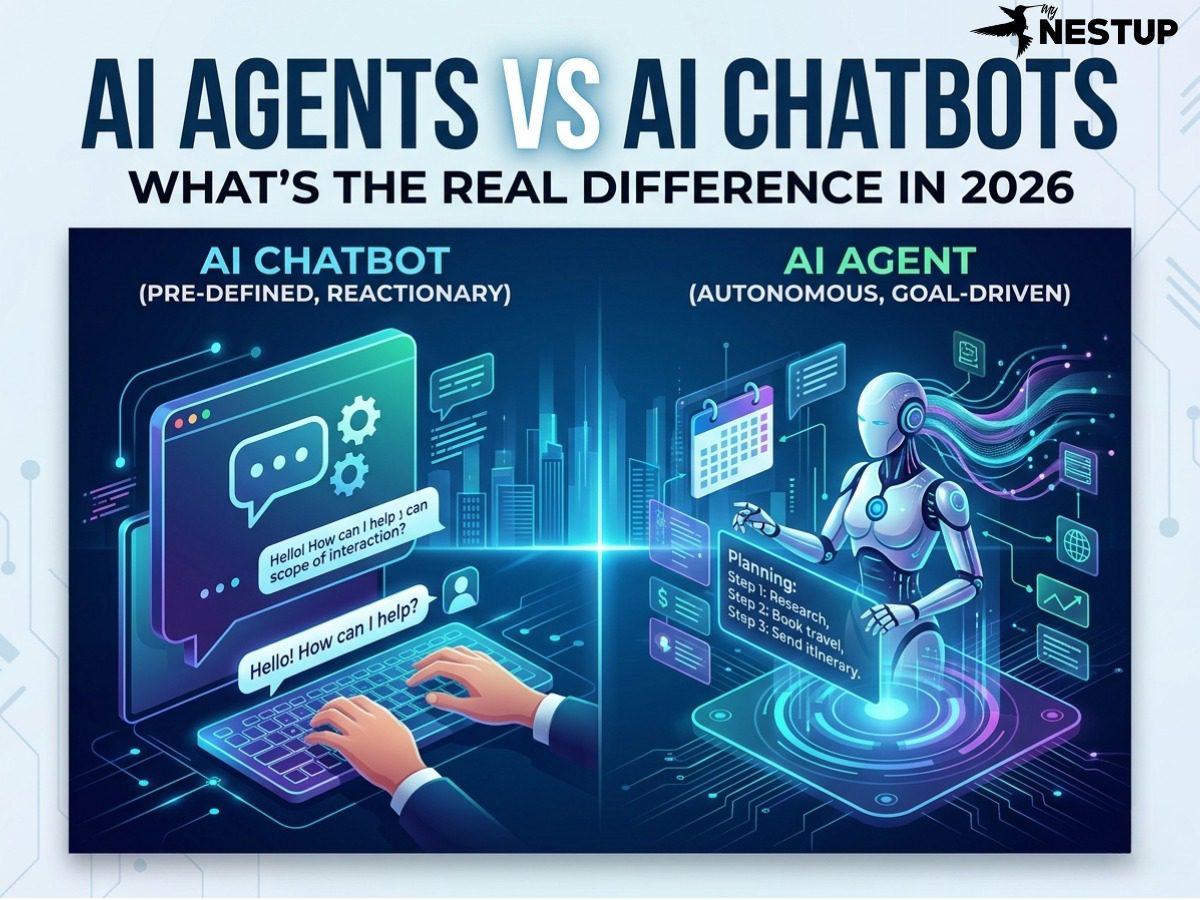
If you’re just starting to explore AI, it’s easy to assume that AI agents and AI chatbots are essentially the same thing. After all, both can hold conversations, answer questions, and appear intelligent. But in 2026, the difference between them goes far beyond conversation. It comes down to how they are built, how they operate, and what they are capable of doing in real-world scenarios.
Chatbots: Built for Conversation
At a basic level, a chatbot is designed to respond to user input, while an AI agent is designed to achieve a goal. Chatbots are conversation-first systems. They rely on predefined flows, prompts, or trained language models to generate responses based on what a user asks. Even advanced chatbots powered by large language models still operate within a reactive framework. They wait for input, process it, and return an answer. Their architecture is relatively straightforward and optimized for dialogue, which makes them effective for handling structured interactions like customer support queries, FAQs, or simple transactions.
AI Agents: Built for Action
AI agents, on the other hand, are built as systems rather than single interfaces. They combine a language model with additional components such as memory, planning modules, and tool integrations. This allows them to move beyond simple question-and-answer interactions. Instead of just responding, an AI agent can break down a goal into steps, decide what actions to take, use external tools like APIs or databases, and adjust its behavior based on the results it observes. This loop of planning, acting, and refining is what defines agentic architecture and separates it from traditional chatbot design.
Autonomy: Reactive vs Proactive Systems
One of the clearest differences between the two lies in autonomy. Chatbots have low autonomy. They depend entirely on user prompts and operate within a limited scope. They do not initiate actions or complete workflows on their own. AI agents, however, are designed with higher autonomy. They can take a goal such as “analyze this sales data and generate a report,” then independently gather information, process it, and deliver results. This makes them far more suitable for complex, multi-step tasks where decision-making is required.
Memory: Stateless vs Persistent Intelligence
Memory is another key factor that highlights the architectural gap. Many chatbots are either stateless or limited to short session memory, meaning they forget context once the conversation ends. This restricts personalization and continuity. AI agents, in contrast, can maintain both short-term and long-term memory. They can remember past interactions, user preferences, and previous outcomes, which allows them to improve over time and provide more relevant, context-aware results. This persistent memory is what makes agents feel closer to digital assistants than simple chat interfaces.
Tool Use: Information vs Execution
The ability to use tools is arguably the most transformative difference. Chatbots primarily provide information. They might guide users or suggest next steps, but they rarely execute tasks. AI agents are built to act. They can send emails, update customer records, retrieve data from external systems, run code, or even coordinate across multiple applications. This shift from providing answers to taking actions is what enables AI agents to deliver real outcomes rather than just information.
Real-World Examples: From Support to Execution
Real-world examples make this distinction clearer. The fintech company Klarna has used AI chatbots to handle a large volume of customer service interactions. These systems are highly efficient at resolving common queries and reducing the workload on human support teams, but their role remains largely conversational and task-limited. In contrast, Salesforce is advancing the use of AI agents through its agentic platforms, where AI can operate within business workflows. These agents can analyze customer data, generate insights, and take actions across sales and service processes, demonstrating a clear shift from assistance to execution.
When to Use Chatbots vs AI Agents
Choosing between a chatbot and an AI agent depends on the nature of the task. Chatbots are ideal when the goal is to deliver fast, consistent, and predictable responses, especially in high-volume environments like customer support or lead qualification. AI agents are better suited for scenarios that involve multiple steps, require integration with different tools, or demand outcomes rather than just answers. Tasks such as automated reporting, workflow automation, and intelligent decision support are where agents truly excel.
The Hybrid Future: Why Companies Use Both
In practice, most organizations in 2026 are not choosing one over the other. Instead, they are combining both approaches. Chatbots often serve as the front-facing interface that interacts with users, while AI agents operate behind the scenes to execute more complex tasks. This hybrid model allows businesses to balance control and efficiency with flexibility and intelligence.
Final Takeaway: Communication vs Action
Ultimately, the real difference between AI agents and AI chatbots is not just about how smart they are, but about what they are designed to do. Chatbots are built to communicate, while AI agents are built to act. As AI continues to evolve, this shift from conversation to action marks a fundamental change in how technology supports work and decision-making.