
 N
N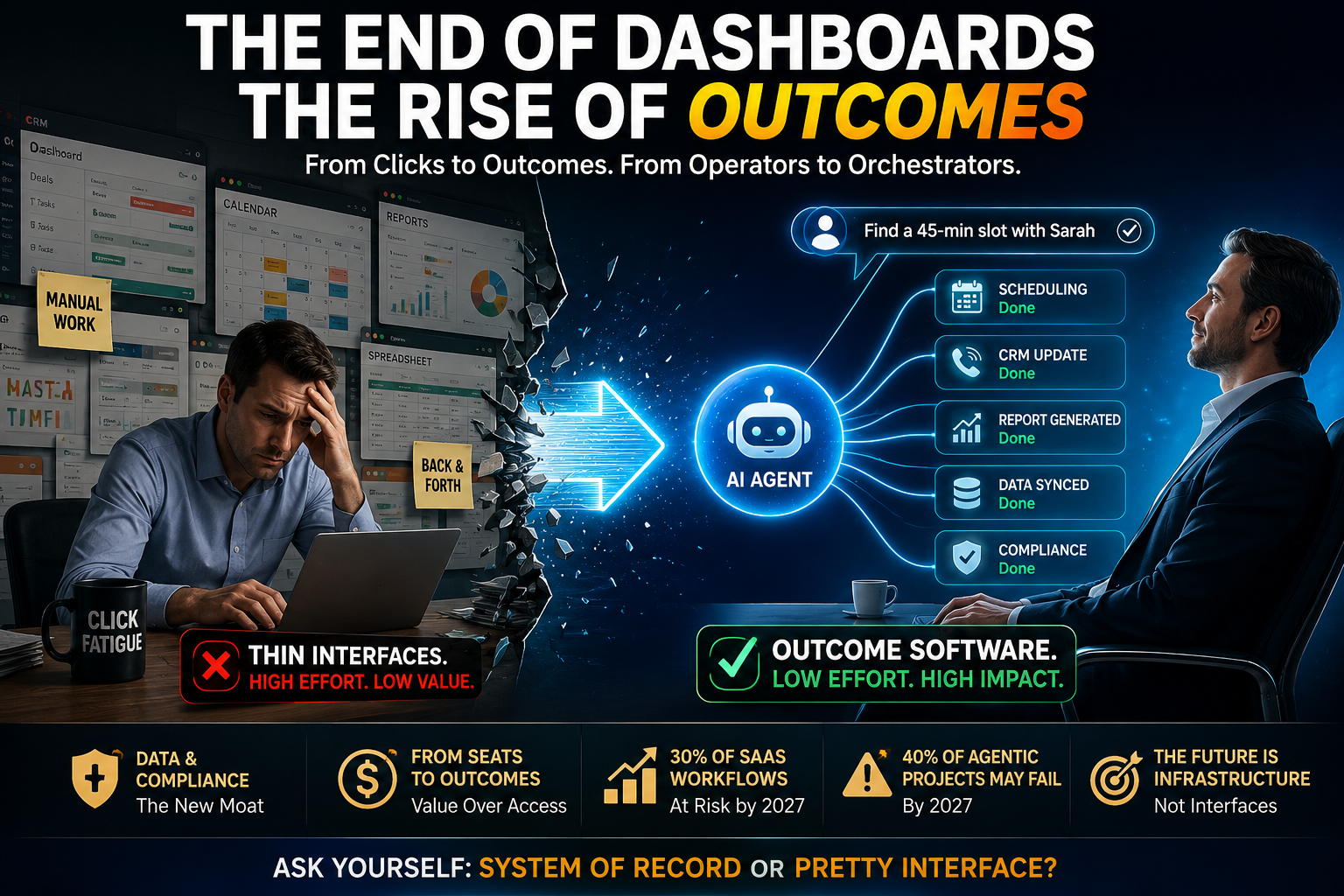
How AI Agents Will Replace 30% of SaaS Tools by 2027
AI agents are set to replace approximately 30% of current SaaS workflows by 2027, as they transition from merely displaying information to executing tasks autonomously. This shift will transform SaaS applications into real-time workflow services, making interfaces largely invisible.
Key takeaways
- AI agents will absorb 30% of SaaS workflows by 2027, according to Deloitte.
- "Thin SaaS" interfaces, with repetitive workflows, are most at risk of obsolescence.
- Scheduling and CRM management are the first categories to become "invisible" through AI automation.
- Proprietary data and compliance are becoming key competitive advantages in SaaS.
- The pricing model for SaaS is shifting from "per seat" to "outcome" based on workflow success.
Why is the Shift from Dashboards to Outcome Software Happening?
For two decades, users have experienced "click fatigue," manually navigating between applications to achieve business outcomes. This era is ending as AI agents take over workflows, making the software experience more seamless and efficient.
What is the Impact of the "Thin SaaS" Interface?
The "Thin SaaS" layer is vulnerable as it often consists of repetitive workflows with minimal differentiation. In an agent-driven environment, the need for high-fidelity dashboards diminishes, as agents can execute tasks directly through APIs, rendering the interface unnecessary.
As one observer noted on Reddit, “The SaaS products getting crushed are the ones that were basically a pretty frontend on top of a database query.” Applications that rely heavily on user interfaces without deep logic are prime candidates for obsolescence.
Which Categories Will Become "Invisible" First?
The transition to invisible infrastructure is particularly evident in categories with high administrative burdens, such as scheduling and CRM management.
The Old Way of Scheduling:
- Scheduling: Involves navigating booking links and manual calendar checks.
- CRM: Requires sales professionals to log calls and update records manually.
The New Agentic Way:
- Scheduling: A simple command like “Find a 45-minute slot with Sarah” allows the agent to manage the entire process autonomously.
- CRM: Transforms into a backend database where agents summarize calls and update records without human input.
How Will Research and Reporting Change?
AI agents are compressing the traditional "Research Assembly Line" into a single conversational workflow. This process typically includes:
- Exporting data from various sources.
- Cleaning and normalizing data.
- Building visualizations.
- Writing summaries and insights.
- Distributing reports to stakeholders.
Agents can now execute this entire sequence autonomously, leading to a divide in professional roles:
- High Exposure: Roles focused on business reporting and KPI tracking.
- Lower Exposure: Roles requiring strategic thinking and complex judgment.
Why Are Data and Compliance Important?
As the user interface loses its competitive edge, the focus shifts to the underlying logic. Proprietary data and compliance are now critical assets, as agents need reliable data to operate effectively.
| Defensive Moat | Strategic Significance |
|---|---|
| Proprietary Data | Agents need exclusive data layers for unique value. |
| Compliance Infrastructure | Complex regulations resist generic automation. |
| Workflow Orchestration | Multi-step systems are harder to replace than single-task apps. |
| Deep Integrations | Reliable APIs are essential for complex tasks. |
| Network Effects | Collaboration systems remain valuable. |
| Industry Specialization | Domain-specific logic resists commoditization. |
Complex systems like ERPs are safer than lightweight apps because they maintain the "system of record" that agents need.
What is the Future of SaaS Pricing?
The shift to invisible interfaces requires a change in SaaS monetization. The traditional "per seat" pricing model is becoming obsolete as humans no longer need to log in. The industry is moving toward "outcome" or "usage" pricing based on successful workflows.
As noted in industry discussions, “Agents don’t replace SaaS. They commoditize the interface.” Vendors must adapt by focusing on the reliability of their services rather than just access to a UI.
What Lies Ahead for SaaS?
SaaS is not disappearing; it is evolving into the "invisible infrastructure" of modern enterprises. While the trajectory is clear, challenges remain. Gartner predicts that 40% of AI projects may fail by 2027 due to governance and operational issues.
Enterprises will still need audit trails and deterministic workflows, but they won't need numerous dashboards. As you evaluate your software stack, consider: Is this tool a valuable system of record, or just a superficial interface likely to fade away?