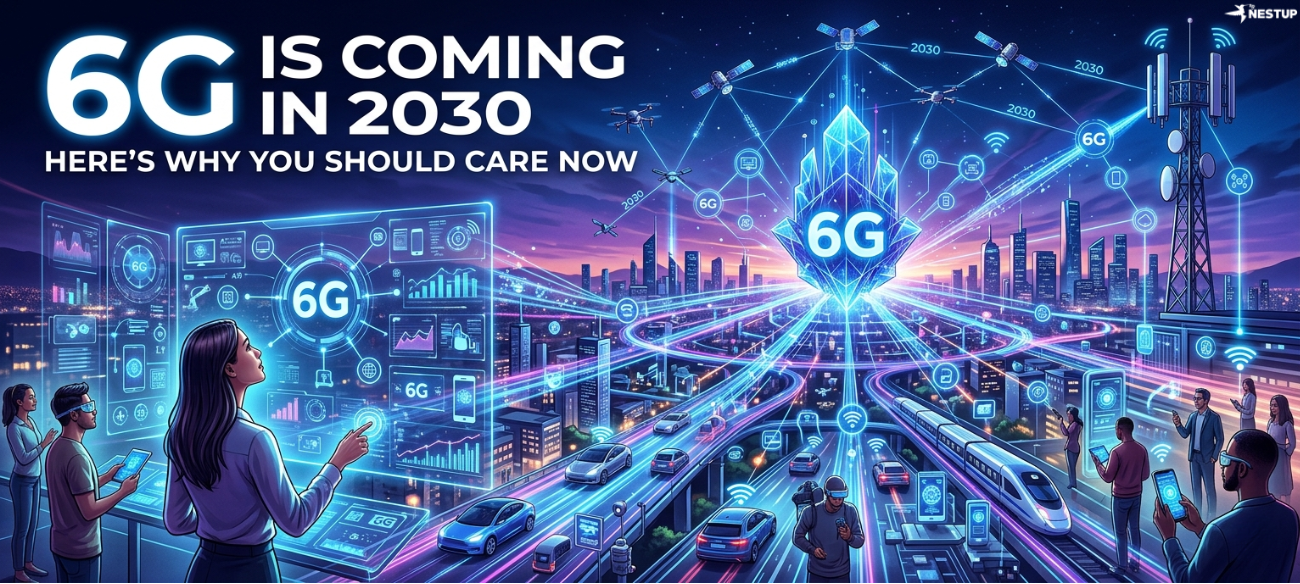
While the world is still acclimating to the promises of 5G, the true architects of our digital future have already moved their chess pieces. We are currently witnessing a race that began before the finish line of the last one was even crossed. Governments and tech titans are no longer just looking for “faster internet”; they are engineering a fundamental shift in the fabric of human experience. We are moving away from a world of connected devices and toward an era of connected intelligence. By 2030, the digital divide will not just narrow—it will dissolve, replaced by an intelligent, immersive layer that integrates so deeply into our physical lives that the two will become indistinguishable.
1. Beyond the Bitrate: The Era of Instantaneous Presence
In the visionary landscape of 6G, “fast” is an understatement. If 5G was a highway, 6G is a teleportation gate. The “North Star” for this new era is the achievement of terabit-per-second potential, a staggering leap that places 6G at up to 100 times the speed of its predecessor. However, the true revolution lies in “near-zero latency.” This isn’t just about a faster download; it is about reaching the threshold of human perception.
When digital signals move at speeds that mimic the human nervous system, the friction of distance evaporates. We are evolving from “streaming” content—where we act as passive observers of data—to experiencing “presence.” In a world of near-zero latency, you are no longer watching a video of a remote location; your consciousness is effectively transported there.
“5G connects devices. 6G connects intelligence.”
2. The Sentient Network: Intelligence as Infrastructure
Unlike every generation of connectivity before it, 6G is being birthed as an AI-native network. This isn’t a passive system that merely carries data; it is a sentient environment that thinks, adapts, and anticipates. By weaving artificial intelligence into the very DNA of the network, 6G moves from a reactive utility to an active decision-maker.
Through sophisticated orchestration, the network will handle:
- Performance Optimization: Constantly recalibrating signal paths using new antenna designs to maintain peak efficiency.
- Predictive Management: Utilizing AI to forecast and resolve congestion before a single user experiences a slowdown.
- Real-Time Anomaly Detection: Identifying and neutralizing security threats with a speed that human-managed systems could never match.
This shift means the network becomes like oxygen: vital, ever-present, and completely invisible. It will adapt to your behavior, silently optimizing the world around you to ensure that your digital life never skips a beat.
3. The Death of the Screen: From Pixels to Presence
The sheer bandwidth of 6G will finally break us free from the tyranny of the two-dimensional screen. We are moving into a realm of 3D holographic interaction and spatial collaboration, where “calling someone” becomes “being with someone.” This transition will bridge the final gap between digital and physical existence, rendering the concept of “remote” obsolete.
The source identifies key sectors where this will trigger a paradigm shift:
- Remote Work: Collaborative spaces where colleagues appear as lifelike holograms, restoring the nuances of body language and eye contact.
- Telemedicine: Advanced procedures and consultations where specialists can operate within a 3D digital twin of a patient in real-time.
- Virtual Classrooms: Immersive educational environments that feel physical, tactile, and social, regardless of geography.
4. The Terahertz Frontier: Building the New Digital Atmosphere
To reach these visionary heights, we must conquer the Terahertz (THz) spectrum. These ultra-high frequencies are the key to massive data throughput, but they present a formidable physical challenge: they have a notoriously short range and are easily blocked by walls or even humidity.
Overcoming this requires more than just more towers; it requires a revolution in materials science and infrastructure. We are looking at a future defined by:
- Dense Micro-Networks: A ubiquitous web of micro base stations integrated into the very architecture of our cities.
- Advanced Materials: The development of new semiconductor technologies and antenna designs capable of manipulating THz waves.
- Unified Connectivity: A seamless integration of ground-based networks with satellite and airborne systems, creating a “connectivity blanket” that covers the planet from the stratosphere to the deepest valley.
5. The Invisible War: Geopolitics and the Patent Throne
The struggle for 6G is not merely a technical competition; it is an invisible war for global dominance. Because the infrastructure required—from the semiconductors to the micro-stations—is so complex and expensive to build, the nations that set the standards will essentially hold the keys to the global economy.
The United States, China, the EU, Japan, and South Korea are locked in this high-stakes race because setting standards equals unrivaled power. Those who own the patents will collect the “technological tax” of the next two decades, influencing global infrastructure and gaining a strategic edge in security and intelligence. This race is less about download speeds and more about which vision of the future will become the global reality.
Conclusion: Connectivity as an Environment
As we approach 2030, 6G will not arrive as a sudden replacement, but as part of a hybrid network environment, gradually weaving itself alongside 5G. It marks our transition from using the internet as a tool to living within it as an environment. We are building a new digital layer over reality—one where data privacy will become more critical and complex than ever before, as our lives become fully transparent to the “intelligent” air around us.
The groundwork is being laid today in labs and orbital launches. We must now prepare for a world where connectivity is no longer a utility we turn on and off, but the very atmosphere in which we exist.
How deeply will you allow an intelligent, immersive environment to integrate into your daily life?
Connectivity is no longer just a utility; it is becoming the very environment in which we live.