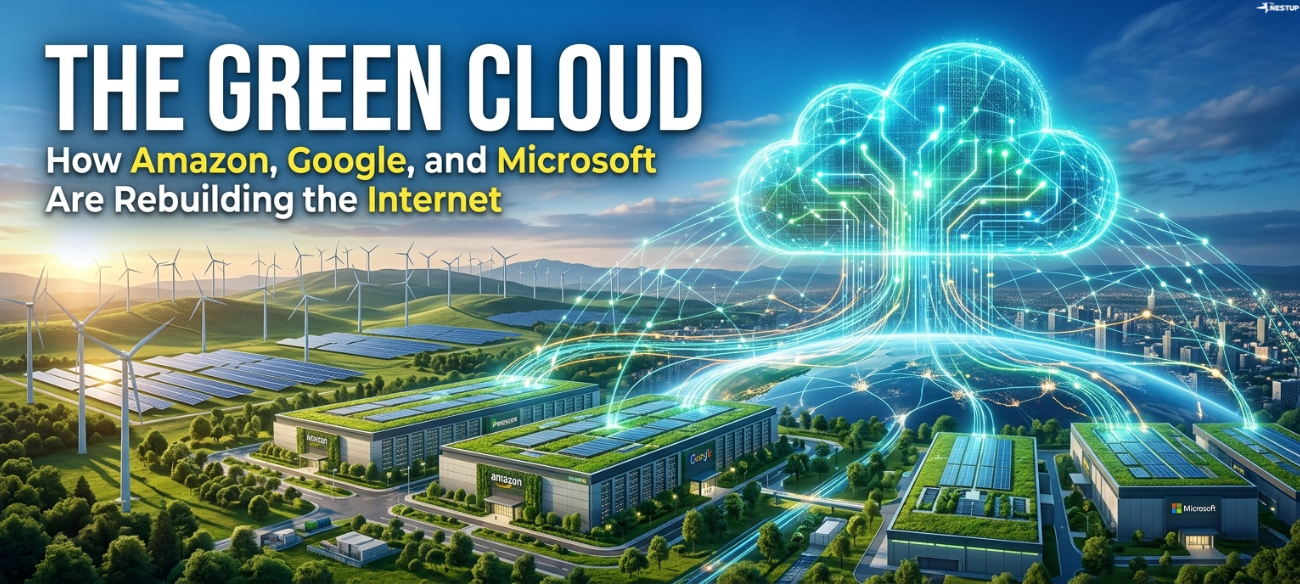
The digital world often masquerades as an ethereal, weightless collection of data—an invisible “cloud” accessible with a single click. However, this illusion masks a massive and increasingly aggressive expansion of physical infrastructure. Modern internet services run on vast networks of data centers that consume staggering amounts of electricity and water. As artificial intelligence accelerates the demand for raw computing power, a profound systemic tension has emerged: while corporate sustainability pledges grow more ambitious, the underlying resource consumption is rising even faster. Your digital footprint is no longer just a set of files; it is a physical force actively reshaping the planet’s resource maps.
The Efficiency Paradox (AI’s Insatiable Appetite)
Modern cloud infrastructure has evolved far beyond hosting websites; it is now the high-density engine powering complex generative AI models and global enterprise systems. The scale of this demand is unprecedented and serves as a primary driver of global energy shifts. By 2026, global data center electricity consumption is projected to exceed 1,000 TWh annually, a figure roughly equivalent to the total energy usage of Japan.
This surge exposes a core “efficiency paradox.” While hyperscalers have successfully made the cloud more efficient on a per-unit basis, these incremental gains are being swallowed by the sheer volume of new AI clusters. A single large AI cluster can now consume as much electricity as a small city, proving that “greener” hardware cannot solve a problem where total consumption is skyrocketing toward an ecological breaking point.
The Nuclear Pivot and the New Energy Lords
Renewable energy sources like wind and solar remain the standard for green branding, but they face a critical limitation: intermittency. AI workloads require 24/7 baseload power, a requirement that weather-dependent renewables cannot meet without massive storage. Consequently, Big Tech has aggressively pivoted toward nuclear energy, focusing on Small Modular Reactors (SMRs) and the resurrection of legacy plants.
In a landmark move, Microsoft partnered with Constellation Energy to restart the Three Mile Island nuclear facility to secure hundreds of megawatts of continuous power. This shift signals a structural metamorphosis: hyperscalers are no longer merely customers of the energy sector; they are becoming energy infrastructure developers. They are effectively building a “parallel layer of the internet”—a private infrastructure that includes its own power generation and environmental management systems, often operating outside traditional public grid oversight.
“Big Tech is no longer just buying energy—it’s reshaping the energy grid itself.”
The Accounting Gap in “100% Renewable” Claims
To maintain their “100% renewable” branding, hyperscalers rely heavily on Power Purchase Agreements (PPAs)—long-term contracts that fund green energy projects. Microsoft, for instance, has contracted approximately 40 gigawatts of renewable capacity across 26 countries. However, investigative scrutiny reveals a significant “accounting gap” in these claims.
The catch is that these agreements are often carbon accounting maneuvers rather than physical realities. Many companies use Renewable Energy Certificates (RECs) to match their annual usage on paper, while their data centers draw fossil-fuel-heavy power from the local grid in real-time when the sun isn’t shining. This gap between annual offsets and actual real-time grid impact remains one of the most contentious aspects of “green cloud” marketing.
The Thirsty Cloud (The Hidden Water Crisis)
Energy is not the only constraint on the cloud’s expansion; water has become a critical flashpoint. Data centers require massive cooling systems, and current water-intensive methods consume hundreds of thousands of gallons daily per facility. In 2025, North American data centers alone used nearly 1 trillion liters of water. This consumption is no longer just an environmental metric—it is a business risk. Growing community concerns over local water security have already led to high-profile project delays and cancellations.
While hyperscalers promote innovations like closed-loop cooling, liquid cooling for AI chips, and water replenishment, a “transparency problem” persists. Reporting remains inconsistent, often relying on relative metrics. More concerning is the widespread omission of third-party data centers from corporate reporting, which effectively cloaks a significant portion of the industry’s total water footprint from public and investor view.
The Inconvenient Truth of Rising Emissions
Despite a decade of high-profile sustainability pledges, the raw data confirms that the industry’s total environmental footprint is expanding. Demand for AI infrastructure is simply growing faster than efficiency gains can mitigate, leading to substantial emission increases across the sector:
- Google: Emissions up nearly 50%
- Amazon: Emissions up 33%
- Microsoft: Emissions up 23%
The underlying systems logic is simple: even if every individual data center is engineered to be greener than the last, the total volume of new construction is so vast that absolute emissions continue to climb.
Conclusion: Growth vs. Limits
The “Green Cloud” is currently defined by a paradox: it is becoming greener per unit of compute, but “heavier” in terms of its total impact on the planet’s finite resources. While hyperscalers are driving genuine innovations in carbon-free energy and cooling technology, they are also building a massive private infrastructure that threatens to outpace the global transition to sustainability.
The future of the digital world now hinges on a singular, uncomfortable question: Can the tech industry’s model of “growth at any cost” ever be reconciled with measurable planetary limits, or is the “Green Cloud” fundamentally a dream at odds with reality?