Imagine waking up to an urgent video call from your company’s CEO. The face on the screen has the familiar lines of leadership; the voice carries the exact cadence and authoritative tone you’ve heard in a dozen boardrooms. The request is high-stakes: a major deal is closing, and they need you to wire funds immediately to finalize the contract. You execute the transfer, only to discover hours later that the real CEO was fast asleep. You weren't speaking to your boss; you were interacting with a hyper-realistic digital puppet.
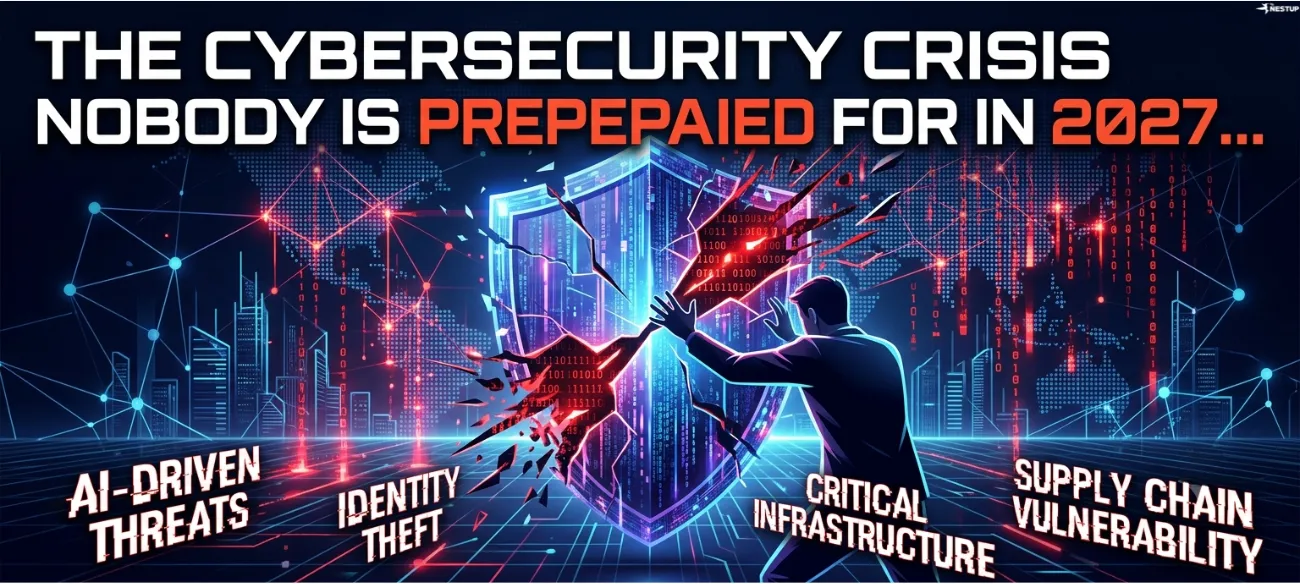
This isn't a scenario from a futuristic thriller; it is the frontline of a shifting battlefield. By 2027, the "Digital Ghost" will be the primary weapon of cybercrime. Scammers are no longer just writing clunky code or sending emails riddled with typos; they are leveraging agentic AI to launch attacks that are smarter, faster, and fundamentally indistinguishable from reality.
The Breach of the Identity Perimeter (Deepfakes)
For decades, the bedrock of workplace security was "common sense." If an email looked strange or a request felt "off," employees were told to trust their gut. However, as a cybersecurity strategist, I can tell you that the Identity Perimeter has been effectively breached. AI has obliterated the reliability of our physical senses as a security layer.
Using just a few minutes of publicly available audio or video—scraped from a keynote speech, a podcast, or a social media reel—scammers can now clone a person’s likeness and voice with terrifying fidelity. These deepfakes exploit the deepest layer of human vulnerability: trust.
"You send it—only to find out later that the real CEO was asleep, and you were just talking to a hyper-realistic digital puppet."
When the evidence of your eyes and ears can be perfectly manipulated, "trusting your gut" becomes a liability. By 2027, the realization that our biological sensors can be bypassed will force a total reconstruction of how we verify identity in a digital space.
The Automation of Intimacy (AI Phishing)
The era of the "Nigerian Prince" email and broken English is over. AI has refined social engineering from a blunt instrument into a precision tool. This is the automation of intimacy: the ability for a machine to create thousands of 1-to-1 personal connections simultaneously.
Hackers now deploy AI tools to research targets automatically. These systems scour public social media profiles to identify your employer, your professional network, and even your personal hobbies. The AI then synthesizes this data to generate a perfectly tailored, grammatically flawless email that appears 100% legitimate. Because this operates at a massive scale, an attacker can target an entire multinational corporation with thousands of unique, personalized lures in the time it used to take to write one manual phishing note.
The Silent Killer: Agentic Malware
Traditional malware is static; once a security tool recognizes its "fingerprint," it can be blocked. The new threat, however, is agentic malware. These are AI "agents" capable of autonomous decision-making once they enter a network.
Unlike traditional viruses, agentic malware functions as a thinking adversary that stays hidden by:
- Evaluating security defenses: It scans the infected network in real-time to identify the path of least resistance.
- Changing its own code: It mutates its structure on the fly to bypass specific security blocks, rendering signature-based defense useless.
- Mimicking normal user behavior: It adopts the patterns of a legitimate employee, allowing it to remain resident for months, quietly exfiltrating data without triggering a single alarm.
This "silent" nature is what makes it so lethal; it doesn't just break in—it blends in.
The Digital Domino Effect (Supply Chain Poisoning)
Modern business is a fragile web of interdependency. Companies rely on a massive stack of third-party tools for everything from payroll to cloud storage. Cybercriminals are now using AI to scan millions of lines of open-source software code to identify hidden vulnerabilities that human auditors might miss.
This creates a "digital domino effect." In this landscape, agentic malware is often the payload delivered via a poisoned supply chain. By finding a single backdoor in one minor software vendor, a hacker gains access to the "crown jewels" of thousands of clients. A single successful breach of the supply chain in 2027 won't just hit one company; it has the power to cripple entire industries overnight.
A Modern Defense Posture: The 2027 Survival Guide
To navigate this high-risk environment, we must move beyond outdated "check-the-box" security and adopt a more rigorous defensive posture.
For Organizations
- Zero Trust Policies: Adopt a "never trust, always verify" architecture. No internal request—even those appearing to come from a verified voice or video—should be honored until confirmed through a secondary, out-of-band channel like a pre-arranged code word.
- AI-Powered Defense: Humans cannot fight AI at machine speed. Organizations must deploy defensive AI tools that monitor network behavior for the subtle, anomalous movements of agentic malware.
- Deepfake Simulation Drills: Organizations must evolve their training. Regular live drills using simulated deepfakes are necessary to teach employees to maintain skepticism in the face of high-pressure, realistic requests.
For Individuals
- Establish a Family Code Word: Create a secret phrase known only to your inner circle. If you receive an urgent call for money or help from a loved one, the code word is your only proof that you aren't talking to an AI clone.
- Implement Credit Freezes: AI-driven identity theft is increasingly automated. A credit freeze is a strategic necessity to prevent unauthorized accounts from being opened in your name.
- Social Media Lockdown: Audit your digital footprint. Limit the amount of public audio and video you share. The less raw data you provide, the harder it is for an attacker to build a convincing "ghost" of you or your children.
Moving Slower in a Faster World
As we approach 2027, the digital landscape is defined by the weaponization of speed and realism. The "digital ghosts" of the future are designed to make us react before we think. Our best defense is a strategic paradox: we must learn to slow down.
The Golden Rule for 2027 is a strategic necessity: The more urgent the request, the slower you should move. Always take a breath, verify the request through a separate, trusted route, and never trust a digital voice blindly.
We must all eventually confront a chilling reality: If an AI can build a ghost of you using only three minutes of your voice, how much of yourself are you willing to leave online?