 N
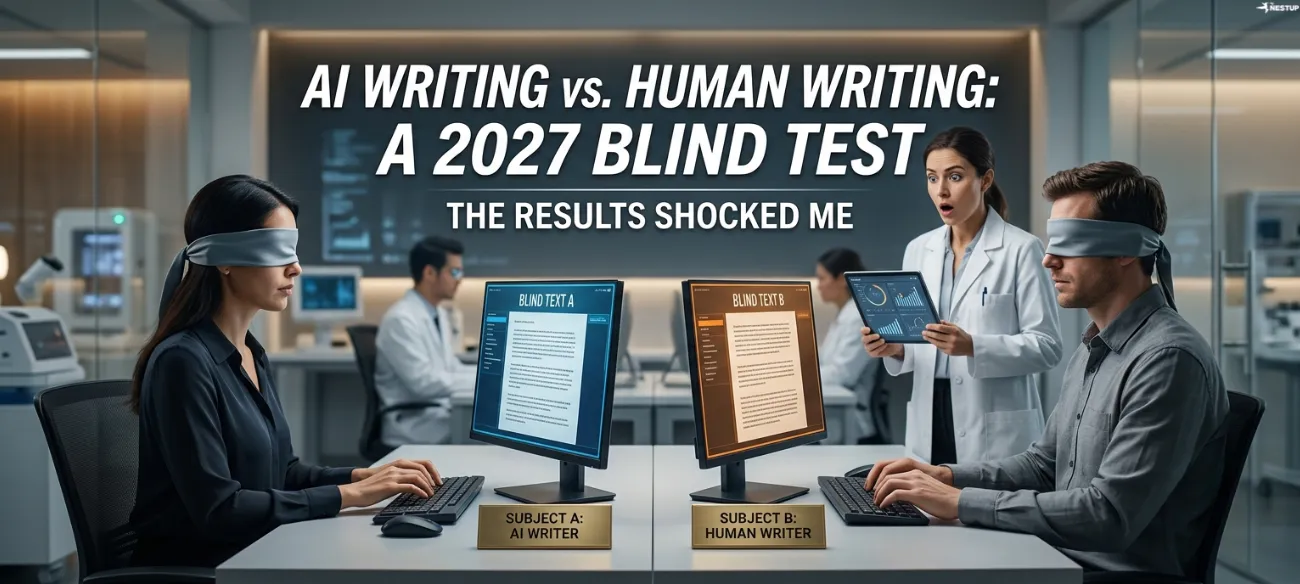
Picture a sterile room where the tension is thick enough to trigger a sensor. On one side, a panel of fifty casual readers; on the other, ten veteran copy editors with eyes trained to spot a misplaced comma at fifty paces. Before them lie ten documents—a mix of raw human emotion and cold algorithmic calculation. This was the setting of a high-stakes double-blind experiment designed to answer the defining question of our era: Has AI finally developed a soul, or are we simply becoming better at ignoring the machine in the room?
The results didn’t just rattle the cages of the literati; they redefined the boundary between soul and silicon. While the machine is masquerading as a professional with terrifying efficiency, the data proves that when we look for depth, the "robotic seams" aren't just visible—they practically glow.
AI Has Already Won the "Casual Blog" Category
If you make your living writing "5 Tips for Productivity" or "The Best Ways to Organize Your Desk," consider this a final warning. In the Casual Blog Post category, the AI didn't just compete; it dominated. A staggering 84% of casual readers were fooled, with only 16% correctly identifying the machine.
There is a biting irony here. In the world of digital content, we have spent a decade training readers to value "cleanliness" above all else: perfect grammar, bulleted lists, and a predictable, structured layout. Because LLMs are essentially hyper-efficient mirrors of our own professional standards, they produce the ultimate "standard" prose. For the average reader, the machine’s lack of friction is mistaken for expertise. AI wins on clarity and speed because it has no ego to get in the way of a sub-heading.
The Research Essay: A Middle Ground of "Beautiful Fraud"
The Research Essay category provided the first real crack in the machine's armor. While it managed to confuse nearly half of the casual readers (45% guessed correctly), it couldn't bypass the gatekeepers. Professional editors saw right through the veneer, with 85% identifying the AI.
The "Research Essay" results highlight a dangerous middle ground. The AI can build a structurally flawless argument, but it lacks the intellectual "weight" that comes from actual synthesis. In this test, the machine produced a gorgeous academic structure but completely fabricated two historical citations—a classic "hallucination." It provides the illusion of depth without the substance, proving that while AI can mimic the look of an expert, it cannot yet replicate the rigorous logic of one.
Creativity Requires "Unpolished" Humanity
When the experiment moved into the realm of fiction, the "Creative Collapse" was total. In the Creative Story category, humans won by a landslide. While casual readers still struggled somewhat, 90% of professional editors spotted the AI immediately.
The machine's downfall in storytelling is its inherent obsession with the "average." Because it predicts the most probable next word, it defaults to clichéd metaphors and "safe" plot twists. It cannot simulate the "vulnerable details"—those odd, unpolished, and hyper-specific fragments of lived experience that a human writer sprinkles into a narrative. Real life is messy, irrational, and specific; AI is clean, logical, and general. You can program a machine to describe a sunset, but it cannot tell you how the light specifically hit a chipped coffee mug during a breakup.
The "Tells": How to Spot the Stylistic Fingerprint
Editors involved in the study noted that AI produces a predictable frequency—a digital residue that professional eyes can smell from a mile away. If you want to spot the machine, look for these markers:
- The Vocabulary Trap: To appear sophisticated, AI often falls into a "high-entropy" trap, overusing specific content words like delve, tapestry, testament, and supercharge. These are the linguistic fingerprints of a system trying too hard to sound human.
- Uniform Sentence Rhythm: This is the clearest indicator of the machine's mathematical nature. AI pacing is governed by probability-based next-token prediction, leading to a steady, monotonous rhythm where sentences often share a similar length. Human thought is biological and erratic; we fluctuate between short, punchy stabs and long, winding, emotional reflections.
- The "Perfect but Shallow" Paradox: If a text is grammatically flawless but feels strangely hollow or contains "hallucinated" facts (like the fake historical citations found in the research test), it’s likely a machine. AI prioritizes the form of truth over the truth itself.
The Death of the Lazy Writer
The future of the writing profession isn't a funeral; it’s a culling. The results of this experiment suggest that we are entering an era where "competence" is no longer a competitive advantage.
"AI is not replacing the human writer; it is replacing the lazy writer."
If your output is limited to formulaic information—SEO-driven listicles, generic LinkedIn thought leadership, or basic summaries—you are already obsolete. You are competing with a tool that works in seconds and never gets writer's block. The human competitive advantage has shifted entirely to the "weird": unique perspectives, unpredictable creativity, and the kind of critical thinking that refuses to follow a template.
The Future of the Written Word
The "stylistic fingerprint" of AI reminds us that while code can mimic the structure of a sentence, it cannot yet capture the erratic pulse of a human mind. We are moving toward a world where technical perfection is cheap, and "human messiness" is the new luxury.
The question for every creator is no longer "Can I write this?" but rather: "Am I leaning into the unique, unpredictable voice that only I possess, or am I merely producing a high-quality imitation of myself that a machine could replicate with a single prompt?"