
 N
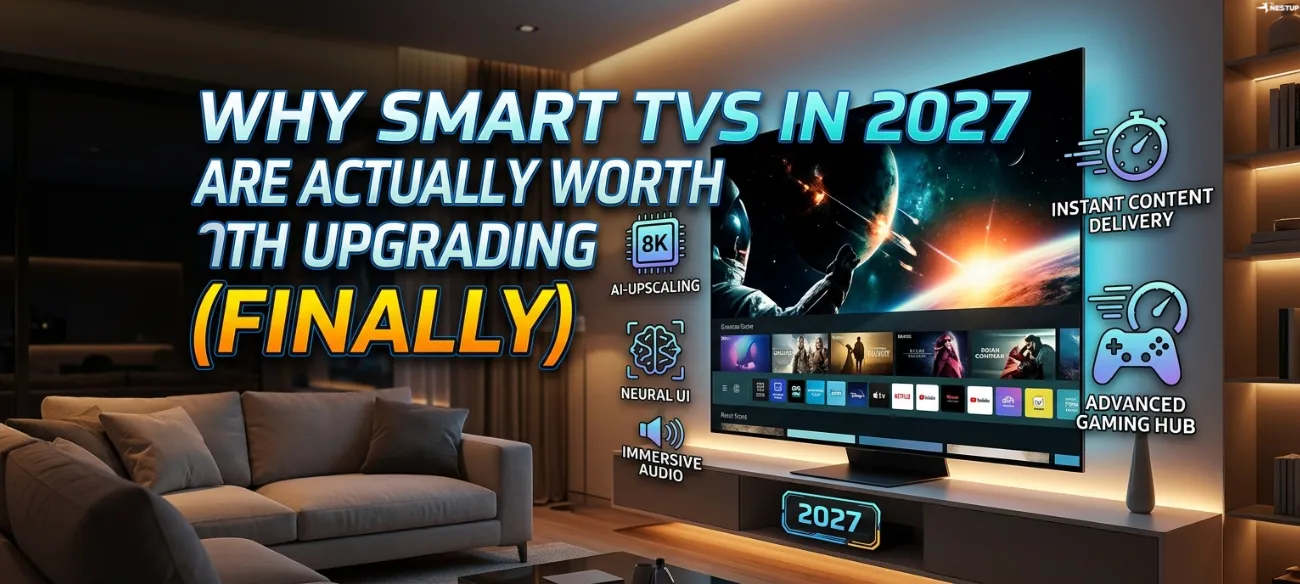
If you bought a high-end 4K television between 2020 and 2024, you’ve likely spent the last few years feeling a justified sense of "upgrade fatigue." For the first half of this decade, the industry largely coasted on minor, incremental updates buried under layers of dense marketing jargon. Most of these "innovations" were iterative at best, hardly justifying a premium price tag for anyone with a functional set.
However, in 2027, the industry has finally blinked. We are witnessing a "quiet convergence" where panel technologies have matured, and processing silicon has taken a generational leap. This isn’t just another coat of paint; it’s a alignment of hardware and software that makes 2027 the first genuine window for a meaningful home theater upgrade in over half a decade.
QD-OLED Has Finally Conquered Its Demons
Quantum Dot OLED (QD-OLED) was always meant to be the "forever" display. By marrying the infinite contrast and perfect blacks of OLED with the vibrant color volume of Quantum Dots, it promised a visual experience without compromise. Yet, early engineering hurdles held it back—specifically, high costs and a frustrating habit of turning deep blacks into a muddy purple when faced with ambient light.
In 2027, these legacy issues have been systematically dismantled. Manufacturers have moved past the prototype phase to deliver hardware that actually works in a real-world living room:
- The Death of Glare: Specialized anti-reflective filters, most notably Samsung’s "Glare Free" tech, now allow these panels to maintain obsidian-black levels even with open windows or bright lamps.
- A Spec for Every Need: Flagships like the Samsung S95H now boast an ultra-smooth 165Hz refresh rate, catering to elite gamers, while pushing past 2,500 nits in HDR highlights.
- The LG Alternative: For those who demand Dolby Vision support—which Samsung still famously lacks—the LG G6 Series has emerged as a powerhouse. By utilizing Tandem OLED tech and Hyper Radiant Technology, LG has successfully closed the brightness gap, making the choice between the two brands a matter of preference rather than a sacrifice in quality.
Infinite contrast is no longer a luxury reserved for bat-cave home theaters; it is now entirely practical for sunlit spaces. As the technology has matured, it has finally delivered on its original promise:
"the perfect display: the infinite contrast and pure blacks of OLED combined with the vibrant colors and high brightness of Quantum Dots."
The "Micro-LED" Dream Gets a Reality Check
For years, Micro-LED has been the "luxury sports car" of the display world—stunning, non-organic, and priced at a level that requires a second mortgage. While giant-wall-sized panels remain a billionaire's plaything, manufacturers have finally brought the dream down to earth with "Micro RGB" arrays.
The Samsung R85H and R95H series represent a realistic premium tier. While QD-OLED has made strides in bright rooms, Micro RGB remains the undisputed king of peak luminance. If you are dealing with a "blindingly bright" environment where direct sunlight hits the glass, even the best anti-reflective coating can only do so much. In these scenarios, Micro RGB provides the raw power needed to cut through the glare without the risk of organic degradation.
AI Processing is No Longer Just a Marketing Buzzword
You can have the most advanced panel in the world, but if the "brain" behind it is weak, you’re essentially looking at a high-performance engine running on low-grade fuel. Most of what we actually watch—720p sports broadcasts, 1080p YouTube videos, or compressed Netflix streams—is far from pristine.
The 2027 class of silicon, specifically the Samsung NQ4 AI Gen3 and LG Alpha 11 processors, has shifted the conversation from "blurry upscaling" to "Pixel-Level Reconstruction."
- Real-Time Reconstruction: These chips recognize objects—the texture of grass on a pitch, the pores on a face—and reconstruct missing details rather than just stretching the image.
- Three-Dimensional Depth: By isolating backgrounds from foregrounds through dynamic contrast mapping, the processors add a sense of depth that makes flat streaming content pop.
- Smoothing the Action: They track fast-moving objects to eliminate motion blur in sports without introducing the dreaded, artificial "soap opera effect."
Your TV is Now a Productivity and Gaming Hub
The smart platforms of 2027 have moved beyond simple app grids, consolidating into three distinct ecosystems tailored to how you actually live:
- webOS (LG): The specialist's choice for the "home office" crossover. It is fast, highly customizable, and features deep integration with Microsoft Copilot and Google Gemini for productivity tasks.
- Tizen OS (Samsung): The undisputed champion for gamers. Its dedicated gaming hubs and seamless integration with cloud gaming services make it the center of the gaming universe, even if the UI remains a bit crowded.
- Google TV (Sony/Hisense/TCL): Still the king of content discovery. It uses the best algorithms in the business to aggregate watchlists and now features built-in Gemini assistants for a truly unified, voice-controlled home screen.
The 2027 Buying Guide
If you’re ready to pull the trigger, here is how the current market shakes out:
- Best Overall Picture Quality: Samsung S95H (for color volume and 165Hz gaming) or the LG G6 (if you require Dolby Vision and Tandem OLED brightness).
- Best Value for Most Consumers: LG Evo C5 or C6. These models provide the vast majority of flagship performance and AI processing at a significantly more accessible price point.
- Best for Super Bright Rooms: Samsung R95H (Micro RGB). It cuts through glare like a knife and delivers the daytime performance that OLED still can't quite match.
A New Window of Innovation
The hardware and software leaps we are seeing in 2027 represent a significant break from the "smoke and mirrors" marketing of the last four years. From the resolution of OLED's brightness hurdles to the emergence of truly intelligent AI reconstruction, the technology has finally caught up to the promises.
If your current display is starting to feel "washed out" when the sun comes up, or if you’re tired of the lag and muddy upscaling of an aging processor, it’s time to stop waiting. Is your old screen finally holding back your viewing experience? In 2027, the answer is likely a resounding yes.