 N
Introduction: The 19th-Century Habit Trap
Every January, millions of people commit to "reading more books," only to see their momentum evaporate by March. This failure isn't a lack of character or discipline; it is a fundamental design flaw. Most readers are attempting to force a 19th-century habit—sitting for uninterrupted hours with a 400-page tome—into a 21st-century schedule that simply doesn't have the room.
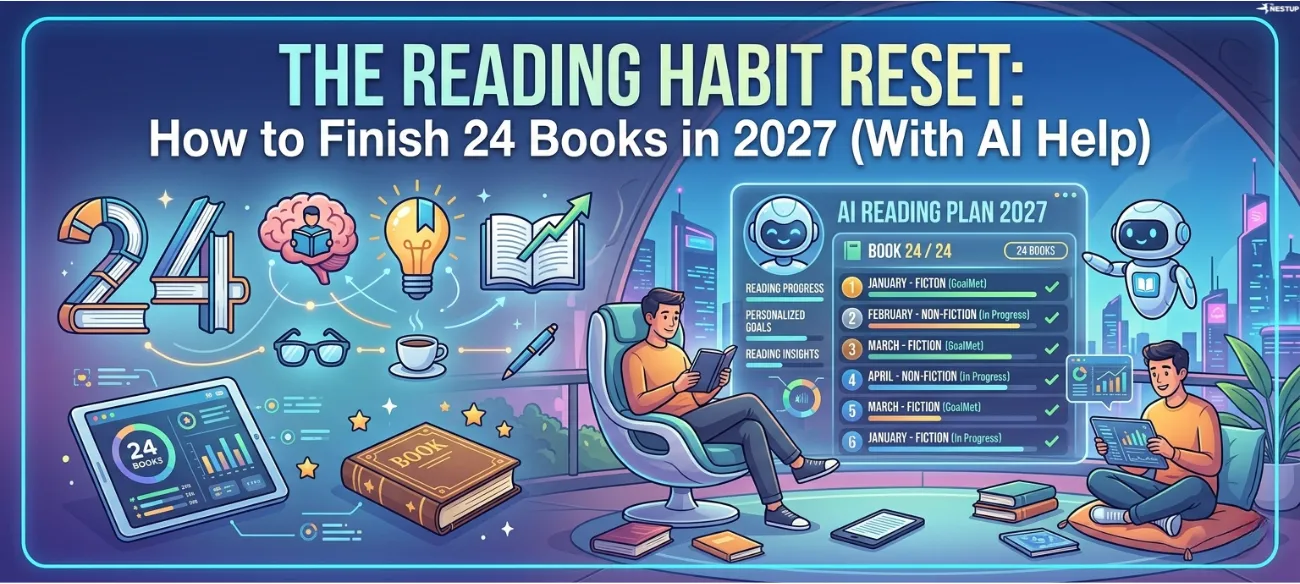
To win in the modern attention economy, we must stop viewing reading as a monolithic chore and start treating it as a high-velocity "Information Pipeline." By adopting the 2027 Tech Stack—a systematic blend of AI and curated summary tools—you can master 24 books a year without superhuman effort. The goal is to move away from outdated expectations and toward a system where knowledge acquisition is a natural, automated byproduct of your daily life.
Stop Reading Every Book Cover-to-Cover
The greatest barrier to intellectual growth is the archaic belief that every book deserves 10 hours of your undivided attention. In reality, many non-fiction books contain exactly one valuable chapter wrapped in 300 pages of fluff. To navigate this, use Blinkist for "Filter and Triage."
Blinkist provides 15-minute "Blinks" that distill a book’s core thesis. This serves as your discovery layer, allowing you to quickly determine if a book is worth a deeper investment or if the summary alone provides the necessary value. Using a summary to "give up" on a book isn't a failure; it’s a high-leverage productivity win. It protects your schedule from low-value content, ensuring that you only dedicate your deep-focus hours to material that truly merits the effort.
The "Custom Professor" in Your Pocket
Passive reading often leads to shallow understanding, especially when dealing with complex or idea-dense texts. To achieve true comprehension, you must move from consumption to dialogue. By using Claude as an interactive sounding board, you effectively gain a "Custom Professor" who can stress-test your understanding in real-time.
Avoid generic "summarize this" requests. Instead, upload a chapter or PDF and use highly specific, outcome-driven prompts to move from theory to execution:
- "Extract the top 3 actionable frameworks from this chapter and apply them to a digital marketing agency context."
- "What are the underlying assumptions the author is making here, and what is the strongest counterargument to their point?"
Shifting to an active AI dialogue forces you to confront the author’s logic and apply concepts to your specific reality. This interaction transforms a static page into a dynamic learning session.
Mastering "Heavy" Books Without the Slog
For foundational business, strategy, or philosophy books, a 15-minute skim is insufficient, yet the original text may be unnecessarily dense. Shortform serves as the ultimate "Study Companion" for these scenarios. Unlike basic summary apps, Shortform offers massive 20-to-30-page analytical guides that break down material chapter-by-chapter.
These guides include exercises, critiques, and comparisons to other thinkers. Crucially, Shortform includes high-quality human narration for its guides, making them accessible during the "Passive Audio Windows" of your day. Engaging thoroughly with a Shortform guide allows you to master a book’s content—understanding the frameworks and the counterarguments—without the slog of the original text. In the 2027 Tech Stack era, if you have mastered the ideas, you have mastered the book.
Diversify Your Reading Portfolio to Prevent Burnout
Intellectual burnout occurs when reading feels like a second job. To maintain long-term momentum, you must manage your reading list like a "Portfolio Strategy," balancing different genres to keep your neural pathways engaged:
- 35% Execution & Strategy (8 Books): High-utility nonfiction processed via Shortform and Claude for immediate deployment in your career.
- 25% Perspective & Biography (6 Books): History, philosophy (such as Stoicism), and biographies that build long-term mental models.
- 20% High-Concept Fiction (5 Books): Sci-Fi or psychological thrillers. Fiction is a vital tool to prevent "information fatigue" and protect your brain from high-intensity learning burnout.
- 20% Wildcard / Deep-Dive Lore (5 Books): Niche interests like Decentralized Finance (DeFi) architecture or True Crime history that keep the habit fun and personally rewarding.
Reclaiming the "Empty Spaces" in Your Day
A successful reading habit does not require blocks of free hours; it requires reallocating the "empty spaces" in your existing schedule. By following a low-friction blueprint, progress becomes inevitable.
Monday – Friday: The Low-Friction Routine
- The Morning Skim (15 Mins): During breakfast, open Blinkist or your Readwise Daily Review to wake up your brain with high-quality ideas instead of reactive social feeds.
- The Passive Audio Window (30 Mins): Listen to an audiobook or the human-narrated Shortform guides during commutes, walks, or chores.
- The Evening Unwind (20 Mins): Dedicate the time before sleep to your fiction or "wildcard" pile to screen-detox.
Saturday or Sunday: The Deep Work Session
- The Heavy Lifting Block (45 Mins): This is the engine of the pipeline. Pick one morning to sit down with your execution or philosophy material. Open Claude on your laptop alongside your reading. Actively take notes, challenge the author's logic, and map out how to apply the ideas to your real-world projects.
"The traditional New Year’s resolution to 'read more books' almost always fails for the same reason: we try to force a 19th-century habit into a 21st-century schedule."
Ending the "Tragedy of Forgetting"
Reading without retention is a waste of your most valuable resource: time. To solve the "tragedy of forgetting," use Readwise to create a "Retention Loop." This tool automatically syncs your highlights from Kindle, Apple Books, and your summary apps into a centralized vault.
Readwise utilizes spaced repetition to resurface your best highlights over time. This ensures that the most important insights from your reading list move from the digital page into your long-term memory. Without a system like Readwise, your best ideas disappear within weeks; with it, your reading list becomes a permanent mental asset that grows in value over time.
From Consumption to Mastery
The transition from a struggling reader to a master of information is not a matter of willpower, but of systems. When you stop viewing a reading list as an imposing mountain of pages and start treating it as an automated information pipeline, the pressure disappears.
By leveraging the 2027 Tech Stack—Blinkist, Shortform, Claude, and Readwise—and balancing your portfolio, reading becomes a high-yield byproduct of your day. Ask yourself: what could you achieve if your reading list was no longer a chore, but an efficient, automated system for constant growth?