
For over a century, industrial power was forged in the "deep time" of the geological clock. We relied on the remnants of ancient carbon—oil and gas—extracted from the earth and forced into utility through the blunt instruments of the smokestack era: extreme heat, toxic solvents, and massive pressure. This was manufacturing as an act of extraction and conquest.
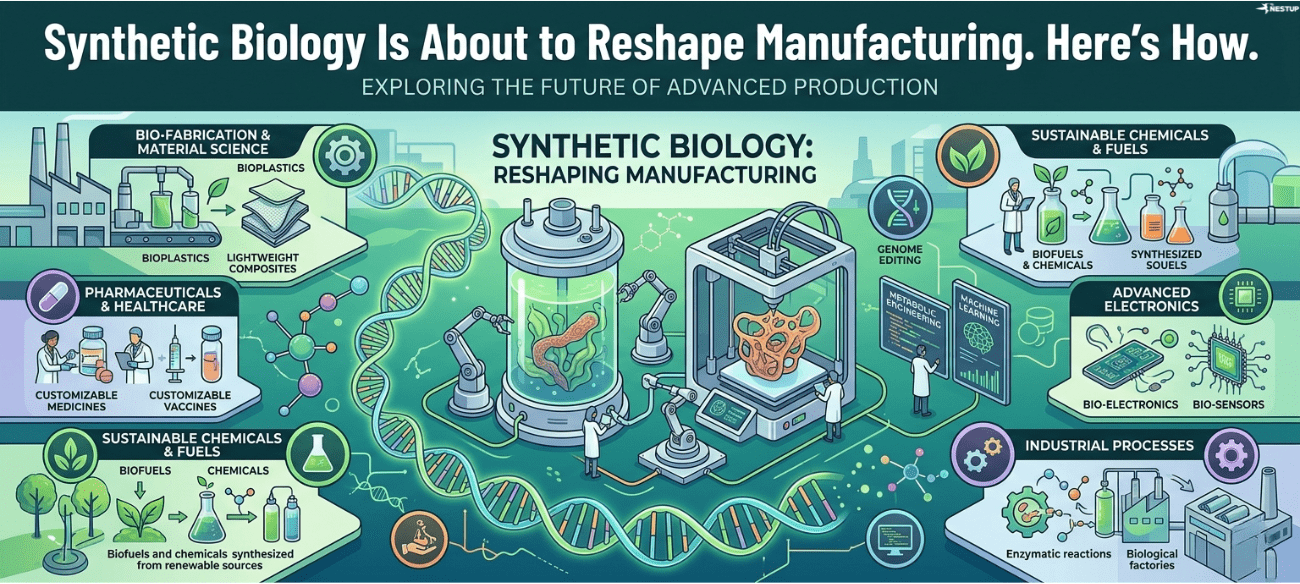
Today, we are witnessing the decoupling of manufacturing from this geological legacy. We are entering the era of the "programmable factory," where the assembly line is replaced by the metabolic pathways of a living cell. By treating DNA as programmable code and microbes as biological foundries, we are moving from the era of shaping matter to the era of growing it. As of 2026, this is no longer a matter of science-fiction speculation; it is the beginning of a practical industrial deployment that will redefine the global supply chain.
The Shift: Manufacturing Becomes a Software Discipline
The radical transition in synthetic biology lies in its methodology. We are moving away from the "trial and error" of traditional biotechnology toward a systematic engineering discipline. This is the moment biology moves from a mystery we observe to a platform we program.
In this framework, DNA is the source code, and metabolic pathways are the logic gates. By combining genetic engineering with machine learning, we can now design biological systems more predictably. But the advantage isn't just digital; it is profoundly physical. While traditional industrial chemistry requires the energy-intensive "brute force" of high temperatures, biological systems operate at room temperature, utilizing renewable feedstocks and far lower energy inputs.
"Synthetic biology could eventually reshape parts of manufacturing the same way software transformed information industries: by turning biology itself into a programmable platform."
The "AWS of Biology" and the Infrastructure Pivot
Just as Amazon Web Services allowed startups to scale without buying their own servers, the "platformization" of biology is lowering the barrier to entry for industrial innovation. Companies like Ginkgo Bioworks are pioneering a vision where biological infrastructure is a service, not a capital-intensive burden.
Instead of every company building a laboratory from scratch, they utilize automated biofoundries that treat biology as an engineering discipline driven by robotics and massive datasets. These platforms provide:
- Organism Engineering: Custom-designing microbes—yeast, bacteria, or fungi—for specific industrial tasks.
- Genetic Design Tools: Software-driven DNA editing and optimization.
- High-Throughput Screening: AI-assisted robotics testing thousands of biological variants simultaneously to find the most efficient producers.
The Margin Trap: Why Biology is "Messier" Than Code
The road to the biological factory is littered with the remains of companies that treated cells like silicon. The collapse of Zymergen stands as the industry’s most sobering cautionary tale. In the clean world of software, code executes exactly as written. In the "messy" world of biology, cells evolve, metabolic pathways behave unexpectedly, and scale-up often breaks laboratory assumptions.
The lesson was brutal: scientific feasibility does not automatically equal industrial viability. Moving from a lab flask to a 100,000-liter fermentation tank introduces massive hurdles:
- Contamination Risk: A single stray microbe can ruin a massive industrial run.
- Metabolic Instability: Engineered organisms often "drift" or stop producing the desired compound as they scale.
- Purification Costs: Extracting a tiny amount of product from a "biological soup" can be economically catastrophic if not perfectly optimized.
"The collapse became symbolic of a broader synthetic biology reality: scientific feasibility does not automatically equal industrial viability."
The Strategic Shift: High-Margin Niches vs. The Petrochemical Giant
Post-Zymergen, the industry has abandoned the "replace everything" hubris. The reality is that the petrochemical industry is a titan of efficiency, optimized over a century with massive infrastructure and global scale. Replacing bulk commodities like plastic or fuel with biology will take decades, not years.
Instead, the winners are focusing on high-margin sectors where the precision of biology offers a competitive edge that chemistry cannot match. Pharmaceuticals remain the primary testing ground due to high R&D tolerance, followed closely by specialty materials like spider-silk-inspired fibers and bio-based dyes.
| High-Margin/Specialty Applications | Low-Margin/Commodity Hurdles |
| Vaccines, antibodies, and therapeutic proteins | Bulk petroleum-based plastics |
| Specialty fragrances and flavor compounds | High-volume biofuels |
| Bio-based dyes and advanced coatings | Commodity textiles and fibers |
| Spider-silk-inspired polymers and enzymes | Mass-market replacement chemicals |
Precision Fermentation and the Future of Food
One of the most visible frontiers of this shift is "precision fermentation." We are no longer required to raise a whole cow just to produce milk proteins or collagen. Instead, we can program yeast to brew these proteins directly, much like brewing beer.
The industrial advantages are undeniable:
- Efficiency: Drastic reductions in land use and water consumption.
- Sustainability: A significant drop in greenhouse gas emissions compared to livestock.
- Resilience: The ability to "grow" food ingredients in localized urban centers, shortening supply chains.
However, the "informed optimist" knows that technical success in food isn't enough. The industry still faces the steep mountains of mass-scale cost-competitiveness and the unpredictable nature of consumer adoption.
The Convergence: AI and Dry-Lab Design
The acceleration we see today is driven by the convergence of AI and biological design. We are moving from "wet labs," where every idea must be physically tested, to "dry labs," where machine learning systems simulate biological outcomes before a single cell is engineered.
AI is now predicting protein structures and optimizing metabolic interactions that are too complex for human cognition. This computational approach allows us to "debug" biology in simulation, significantly compressing the timeline for industrial adoption. As we head toward the early 2030s, this AI-bio loop will become the standard for all material science.
Conclusion: Growing the Future
We are living through a philosophical pivot in the human story. For millennia, we shaped the world through extraction and physical force. Now, we are learning to partner with the fundamental machinery of life.
The Industrial Roadmap:
- 2026–2030: Dominance in specialty chemicals, high-value food ingredients, and pharmaceutical manufacturing.
- Early 2030s: Mainstream emergence of bio-manufactured textiles and specialty polymers as AI-driven design matures.
- Long-Term: A slow, multi-decadal challenge to the petrochemical infrastructure as biological costs finally reach commodity parity.
The "factory" is evolving from a building of steel and steam into a living, breathing system. The question for every leader in the coming decade is no longer just how you will make your product, but how you will grow it. When the cell becomes the factory, how does your business model survive the transition?