Liang Wenfeng, the entrepreneur behind AI start-up DeepSeek, seems to have made a lucrative move with the recent stock market debut of Moore Threads Technology in Shanghai.
Liang is not just known for his work in artificial intelligence. He also co-founded the High-Flyer Quantitative Fund, a hedge fund that took a significant position in Moore Threads before its listing. Through two investment entities, High-Flyer snapped up more than 82,000 Moore Threads shares at roughly 114 yuan each. This makes it one of the top institutional investors in the offering. South China Morning Post
Record-Setting IPO Reflects Beijing’s Strategy:
Moore Threads’ IPO comes at a pivotal moment for China’s semiconductor industry. The STAR Market, modeled on the U.S. Nasdaq, was created to help high-technology firms raise capital more easily. Moore Threads’ path to the public markets was unusually fast. Taking just around88days from filing to approval. It is a record speed that reflects both the company’s strategic priority and Beijing’s broader push for domestic chip self-sufficiency. Wikipedia+1
Growth and AI Focus Despite Headwinds:
Founded in 2020 by former Nvidia executive Zhang Jianzhong, Moore Threads has grown rapidly despite facing headwinds, including U.S. sanctions that restricted access to certain advanced technologies and manufacturing partners. Wikipedia
The company began by producing GPUs aimed at gaming and general-purpose computing. It has increasingly focused on products for AI training and inference, the high-performance computing applications that underpin large language models and other next-generation AI systems. euronews
Explosive Market Debut and Investor Profit:
When Moore Threads’ shares began trading, they surged more than fivefold, delivering a swift gain on the fund’s holding. Based on recent closing prices, that translated to an estimated ¥40 million (about US $5.6 million) profit for High-Flyer over just a couple of trading days. South China Morning Post
Moore Threads itself raised roughly 8 billion yuan in its IPO. Making it the second-largest listing in mainland China this year. South China Morning Post
“China’s Answer to Nvidia” & Future Challenges:
The strong market reception for Moore Threads’ shares reflects broader enthusiasm among Chinese investors for domestic chipmakers. The company has been dubbed “China’s answer to Nvidia.” It fits into Beijing’s strategic push for greater technological self-sufficiency, which has become a centerpiece of the country’s economic planning. South China Morning Post
Whether Moore Threads can translate its explosive IPO debut into lasting market success remains to be seen. Analysts note that the company still faces stiff competition. Both from established global players like Nvidia and from domestic rivals with stronger market positions in specific segments. Barron’s
Nonetheless, the company’s rapid entry into public markets and record-setting stock performance signal a bold chapter in China’s chip story. For investors like Liang Wenfeng, these early returns suggest that backing strategic technology firms in China’s burgeoning AI ecosystem can pay off handsomely, albeit in an environment shaped as much by geopolitics as by innovation. mint
The Shifting AI Leadership: From Undisputed to Under Threat.
OpenAI was once the undisputed leader in artificial intelligence. It is now facing a moment of real vulnerability in the rapidly changing landscape of AI development. What seemed like an unshakable edge over tech rivals is now under serious threat.
For years, OpenAI’s ChatGPT was the face of modern AI. Its launch in late 2022 did not just introduce a powerful model. It shifted the entire industry’s expectations about what AI could do. Competitors scrambled to catch up. Even tech giants like Google publicly acknowledged that ChatGPT forced them to rethink their own approaches.
However, that dynamic has shifted. Many in the industry believe the competitive balance is tilting. Thanks to the recent release of Google’s Gemini 3. Early benchmarks and expert reactions suggest Gemini’s capabilities outpace ChatGPT’s particularly on core reasoning and performance tests. Some analysts are calling it the strongest model available right now. High-profile users (including leaders in the tech world) have publicly expressed surprise at the difference in experience. The Atlantic
OpenAI’s Internal “Code Red” and Response.
Inside OpenAI, the response has been unmistakably urgent. People familiar with internal communications stated, CEO Sam Altman declared a company-wide “code red.” He is directing engineers to refocus resources and accelerate improvements to ChatGPT and related products. Projects unrelated to main model performance, from in-app shopping features to social tools, were reportedly put on pause to concentrate on regaining technological ground. The Atlantic
Broader Competitive Landscape and Strategic Challenges.
The challenges extend beyond Google. Other AI developers like Anthropic have gained traction with models that excel in specialized tasks such as coding. Even Elon Musk’s xAI claims competitive performance. Meanwhile, Chinese AI firms have produced highly capable models that match or rival those from major U.S. companies on key benchmarks. LinkedIn
OpenAI’s commercial ambitions have also broadened. The company has been pushing new features that turn ChatGPT into a multipurpose platform attempting to keep users engaged within its ecosystem. From browsing the web to managing emails and calendars. Critics argue that this expansion may have blurred the company’s focus at a time when raw model performance still matters most. The Atlantic
There are signs that OpenAI could rebound. Its researchers have hinted that more powerful internal models are on the way. Historically the company has recovered from competitive pressures by quickly advancing its technology. But in an era when rivals can deploy cutting-edge systems at breakneck speed and embed them into massive existing infrastructures like Google Search, OpenAI’s lead no longer looks as secure as it once did. The Atlantic
Simply put, OpenAI is still a major player in AI. Still the times when it could set the pace with seemingly unbeatable innovations look like they may be over. The race has grown tighter and the next chapter of AI leadership is far from decided.
Electric cars or vehicles run on electricity. Sometimes at least partially. Unlike traditional vehicles that rely on petrol or diesel, electric cars use an electric motor that gets its power from a battery or a fuel cell. Most EVs store electricity in a rechargeable battery that you plug into the grid. While others use hydrogen fuel cells that create electricity on the go. Their key feature is that instead of burning fuel in an engine, EVs use electric motors that run in clean, renewable energy and produce zero emissions while driving.
How Do EVs Work?
At the core of electric vehicle is its battery. It is the main source of power that stores the energy needed to keep the vehicle moving. These batteries are usually made from lithium-ion cells. They are similar to what you’d find in your phone or laptop, just scaled up massively. Once charged, the battery supplies energy to the vehicle. You can easily recharge it by plugging into a dedicated charging station or into a home outlet. Then there is the electric motor. It is really the star of the show. It’s much simpler than a traditional gasoline engine, which means fewer parts to maintain and a much quieter driving experience. The motor converts electrical energy into movement, pushing the car forward with impressive smoothness and efficiency. It is one of the reasons electric cars often feel so quick and responsive. Another great feature of EVs is regenerative braking. When you hit the brakes, the motor actually reverses its role and acts like a generator. It captures some of the energy that would normally be lost and sends it back to the battery. This helps extend your driving range and also reduces wear on the brakes, making it a smart, efficient system all around.
Types of EVs:
Plug-in All-Electric Vehicles (BEVs) These are fully electric cars powered only by a rechargeable battery. Their range depends on the size of the battery, but things like driving fast or going uphill can drain it quicker. Once the battery runs out, you simply plug it in to recharge.
Plug-in Hybrid Electric Vehicles (PHEVs) PHEVs can run on either electricity or traditional fuel. You can plug them in to charge the battery or switch over to gasoline or diesel when needed. They usually offer a longer driving range than BEVs because they have two power sources. However, that also means a bit more maintenance. And when they are running on fuel, they do produce emissions.
Hybrid Electric Vehicles If you are wondering, “Do electric cars ever use gas?” the answer is yes-hybrid electric vehicles do. These cars have a combustion engine that powers the vehicle and charges the battery as well. You do not have to plug them in, instead the engine handles the charging. So they are electric, but still depend on fuel.
Fuel Cell Electric Vehicles (FCEVs) These EVs don’t rely on a battery for power. Instead, they use hydrogen fuel cells. Inside the fuel cell stack, hydrogen and oxygen react to create electricity, which then powers the motor. They produce no carbon emissions or tailpipe pollution.
Benefits of EVs:
More and more people are choosing electric vehicles, and it’s easy to see why. They come with a bunch of perks, like:
Benefits of Electric Cars More and more people are choosing electric vehicles, and it’s easy to see why. They come with a bunch of perks, like:
Cleaner air: Since EVs do not burn fossil fuels, they aren’t releasing harmful emissions into the air around your home and community.
Quiet rides: Electric motors are naturally quieter than traditional engines, making your drive feel calm and peaceful.
Less maintenance: With fewer moving parts under the hood, there’s usually less wear and tear-meaning fewer trips to the mechanic.
No more fuel costs: While EVs can cost more upfront, you will not be spending money on fuel every week. This adds up to big savings over time.
Instant acceleration: Electric motors deliver quick, smooth power the moment you press the pedal.
Cutting-edge tech: Many EVs come packed with modern features and stylish designs, making them feel futuristic and fun to drive.
At the end of the day, choosing an electric vehicle is a small yet meaningful step towards a healthier planet. Along with its fuel saving benefits. Sure there are challenges to face, from charging environment to battery range, but the momentum is heading in the right directions. EVs continue to move towards an everyday reality from just an innovation, as more people get comfortable with the idea of an electronic vehicle.
Generative Artificial Intelligence tools use advanced machines learning models especially LLMs to produce new and original content. These tools can create human-like text, images, videos, 3D designs based on information (prompts) given by users. While traditional search engines that use algorithms that locate existing sources, generative ai tools create new content by predicting what word, pixel, or sound would come next in the pattern. Generative Artificial Intelligence (GenAI) is transforming how we work and discover information. These sophisticated tools utilize advanced machine learning models, primarily Large Language Models (LLMs), to produce new, original content. They create novel outputs, whether it’s human-like text, unique images, dynamic videos, or functional code, by predicting the next word or pixel in a complex pattern based on a user’s input. This rapid evolution is largely driven by continuous competition and innovation from industry giants, particularly Google’s Gemini and the suite of features from OpenAI.
A few examples of such tools are given below,
Text generation: ChatGPT, Google Gemini, Copilot: Creating cohesive articles, summarizing documents, drafting emails, and providing interactive, human-like dialogue.
Image generation: DALL-E, MidJourney: Producing original, high-resolution images and artwork from text descriptions (text-to-image).
Video and Audio generation: Runway ML, Synthesis: Creating realistic video footage, digital avatars, and professional-quality synthesized speech or music from text or existing media.
Code Generation: Assisting developers by auto-completing code, translating between programming languages, and generating entire functions or code snippets.
Research tool: Consensus JSTORE Text Analyze
Google’s Gemini Updates:
Gemini is google/deep minds flagship AI model which is designed to take up all the role which were earlier being carried out by Google Assistant. It now supports various modalities like video, image, audio and this all integrates with Google’s ecosystem like Chrome, workplace etc. Gemini is designed to be natively multimodal. This is a key differentiator: Gemini was built from the ground up to understand, operate across, and combine different types of data. It aims to integrate deeply within the Google ecosystem, transforming services like Search, Chrome, and the Google Workspace (e.g., Docs, Gmail).
Key Updates and Features of the Gemini Series:
Multimodal Capabilities: The latest Gemini models support comprehensive inputs, including long video and audio files (up to approximately 1 hour of video or 8.4 hours of audio, depending on the specific model variant), allowing users to ask questions about the content within the media.
The Model Series: The family includes Gemini 2.5 Pro (the most powerful “thinking” model for complex reasoning and large data analysis) and Gemini 2.5 Flash (optimized for speed, price-performance, and high-volume tasks).
Gemini 2.5 Flash-Lite: A more lightweight version, often used for fast, on-device tasks, showcasing Google’s commitment to efficiency and accessibility.
Deep Integration: Features like Gemini in Chrome/Browser Integration allow the AI to directly interact with and summarize content on a user’s screen. Gemini is also being woven into the Google Workspace, offering automated drafting, summarizing, and organizational tasks.
Enhanced Output Quality: Updates to the Gemini app include improved formatting for responses, utilizing headers, lists, and tables to make complex information clearer. The integration of high-quality visuals, diagrams, and YouTube videos directly into responses helps explain complex topics faster
OpenAI’s Momentum
OpenAI became a household name with the launch of ChatGPT in November 2022. Their strategy involves constantly upgrading their core models and introducing new user-facing features to maintain a competitive edge. The evolution from GPT-3.5 to the current generations demonstrates significant leaps in reasoning, context window size, and multimodal support.
Major Developments and Features
GPT-4 and Beyond: OpenAI continually upgrades its foundational models, moving from the initial GPT-3.5 to GPT-4 and then to even more efficient and capable variants like GPT-4o and newer versions like GPT-5 Instant. These upgrades bring smarter, more coherent responses and improved ability to follow complex instructions.
Multimodal Expansion: While known initially for text, modern GPT models (like GPT-4o) are also multimodal, capable of processing and generating content across text, images, and audio.
GPTs (Custom Assistants): OpenAI introduced the ability for users to create customized versions of ChatGPT, called “GPTs.” These are tailored for specific tasks, offering a way to save and share specialized workflows without needing to retype lengthy prompts.
Advanced Data Analysis: ChatGPT Plus subscribers can access advanced features for data analysis, which includes running and executing code (like Python) in a sandboxed environment to process files, perform calculations, and create charts.
Focus on Safety and Responsibility: Recent updates have centered on improving safety and reliability, including better recognition of and response to signs of mental or emotional distress, aligning with a focus on responsible AI development.
Generative AI isn’t just another tech trend, it’s a creative game-changer. It’s helping people write stories, design visuals, make music, and even brainstorm ideas in ways that feel fresh and exciting. What makes it truly special is how it amplifies our creativity instead of replacing it. Of course, it’s still up to us to use it wisely, keeping ethics and honesty in check as we explore what’s possible. At the end of the day, generative AI is really about expanding human potential and giving our imagination a little extra spark.
Edge computing is centered upon taking the computing power closer to where the data is created. The idea is to cut down on delays (latency) and reduce how much data needs to travel across the internet. So, instead of sending everything to the cloud to be processed, edge computing handles more tasks locally. By bringing computing closer to the “edge” of the network, there’s less long-distance communication between devices and central servers. This makes things efficient and faster. Simply put, edge computing brings some of the storage and processing power closer to where data is created rather than relying entirely on a distant data center. Only the useful results, like real-time insights or maintenance alerts, are sent back to the main data center for further review.
What Makes Edge Computing Different?
In the early days, computers were huge. They could only be used directly or through connected terminals. Then personal computers came along, letting people store data and run programs locally. Later, cloud computing changed the game again by moving data and applications online, making them accessible from anywhere. However, cloud computing can slow things down because data has to travel long distances to big data centers. Edge computing fixes that by bringing processing power closer to where the data is created. Like on local devices or nearby servers. This results in faster speeds and less lag.
How Edge Computing Works?
Edge computing works by moving data processing closer to where the data is created, making everything faster and more efficient. Here’s how it happens step by step:
Data generation: Devices like sensors, IoT gadgets, and connected systems constantly produce massive amounts of data at the “edge.”
Local processing: Instead of sending all that data to the cloud, edge servers handle it right where it’s generated. This makes it easier to process data in all kinds of places, from factories and retail stores to outdoor or high-temperature environments.
Real-time insights: With built-in AI, edge devices can analyze data instantly, which is crucial for time-sensitive tasks like self-driving cars or automated manufacturing.
Smarter data transfer: Only important or summarized information is sent to the cloud, cutting down on bandwidth use and storage costs.
Optimized connection: Edge systems still stay linked with central cloud platforms, so businesses can easily monitor, manage, and scale everything from one place.
Key Benefits:
Low latency: Cloud systems can sometimes lag, causing slow responses and poor user experiences. Especially for time-sensitive tasks. Edge computing fixes that by processing data closer to where it’s created, cutting down on delays and speeding up response times.
Reduced bandwidth use: IoT devices generate massive amounts of data, and sending all of it to the cloud can get expensive. By handling most of the processing at the edge, only essential data gets sent to the cloud, saving both bandwidth and costs.
Better reliability: Internet issues or service disruptions can interrupt data flow and slow operations. Edge computing helps run things smoothly by storing and processing data locally, even in areas with weak or unstable connectivity.
More privacy and control: Since less data is transmitted over the internet, edge computing keeps sensitive and personal information more secure. It also helps organizations follow regional data laws by keeping certain data within specific geographic boundaries.
Cybersecurity refers to protection for people, systems, and data from digital attacks through a mix of technology and well-defined policies. For businesses, it’s a critical part of overall risk management. Especially when it comes to addressing cyber risks that could disrupt operations or compromise sensitive information. Today’s most common threats include ransomware, phishing scams, data breaches, and, increasingly, attacks enhanced by artificial intelligence (AI). As these threats become more advanced and frequent, organizations are responding by strengthening their defenses and investing heavily in security. In fact, the International Data Corporation (IDC) estimates that global spending on cybersecurity will soar to around USD 377 billion by 2028, reflecting just how vital digital protection has become in our digital world.
What is Cloud Security:
Cloud security, in contrast, focuses specifically on protecting data and systems that operate within cloud environments. It applies across all types of cloud models such as , Infrastructure as a Service (IaaS), Platform as a Service (PaaS), and Software as a Service (SaaS).
Although it falls under the broader umbrella of cybersecurity, cloud security is often treated as a distinct discipline. As it comes with its own set of challenges. One key factor is the shared responsibility model, where both the cloud provider and the customer share accountability for keeping data and systems secure. Traditional on-premise security tools often don’t translate well to the cloud, leaving gaps that attackers can exploit. Common cloud-specific risks include misconfigurations, insecure APIs, and the complexities of managing multi-cloud environments. All of which require specialized strategies and tools to ensure robust protection.
Importance of Cybersecurity:
Cyberattacks and cybercrime have the power to disrupt businesses and harm communities. They can even endanger lives. A single security incident can result in the loss of sensitive data. Its consequences can ripple across organizations and economies alike. Experts estimate that by 2025, cybercrime could cost the global economy a staggering USD 10.5 trillion annually.
So, why is cybersecurity more critical now than ever before? The answer lies in how technology and cybercrime evolve side by side. As businesses adopt cloud computing to boost efficiency and innovation, cybercriminals see these advancements as an opportunity for attack. The growing digital footprint of modern organizations has created a larger attack surface for bad actors to exploit. Adding to the challenge, cybercriminals are becoming more sophisticated. According to the IBM X-Force 2025 Threat Intelligence Index, many attacker are use the dark web to purchase hacking tools and share intelligence anonymously.
Common Types of Cyber Threats:
Malware: Malware, short for malicious software, refers to any program designed to damage or exploit computers and their users. Think of things like Trojans or spyware. These days, almost every cyberattack includes some form of malware.
Ransomware: Ransomware is one of the nastier ones. It locks up your files or device and demands money to unlock them. The good news? These attacks have dropped since 2023 because more people are refusing to pay and governments are tracking down on the hackers behind them.
Phishing: Phishing is when scammers pretend to be someone you trust. For instance, your bank or a popular brand, to trick you into clicking fake links or giving away personal info. You’ve probably seen those “update your password” emails before. Some scams are super generic, while others target specific people or companies to steal big money or sensitive data.
Credential theft and account abuse: Hackers are always trying to steal login details. They use sneaky tricks, from phishing emails to complex attacks like Kerberoasting (which targets Windows systems). In 2025, IBM found a spike in phishing campaigns that spread “infostealer” malware made to grab usernames, passwords, and other private data.
Insider threats: Sometimes the danger comes from the inside. Such as employees or contractors who misuse their access, either by accident or on purpose. Since these actions look legit, they’re really hard to spot with normal security tools.
AI-powered Attacks: Hackers have now use AI to make their attacks smarter and faster. They can create fake emails, websites, or even business documents in minutes. Some find ways to manipulate AI systems themselves, trick them into revealing data or spreading misinformation through something called prompt injection.
Cryptojacking: Cryptojacking happens when hackers sneak onto your device and secretly use its processing power to mine cryptocurrencies like Bitcoin or Ethereum. It’s been around since about 2011, right after cryptocurrencies started gaining popularity. Basically, your computer or phone is doing all the work while the hacker reaps the rewards.
DDoS (Distributed Denial-of-Service) Attacks: A DDoS attack is when hackers try to crash a website or online service by flooding it with tons of traffic. They usually do this using a botnet. This is a network of infected devices controlled remotely. Lately, cybercriminals have been getting sneaky by combining DDoS attacks with ransomware, or just threatening a DDoS unless you pay up.
Simple Cyber Safety Tips
Keep you software up to date: Regularly update your apps and operating systems so that you are protected by new security patches. These updates often fix loopholes that hackers love to exploit.
Use reliable antivirus software: A good security program can detect and remove threats before they can cause damage. Make sure it is always up to date for maximum protection.
Create strong and unique passwords: Avoid simple or predictable passwords. Use a mix of letters, numbers and symbols. Never use the same ones across multiple accounts.
Be cautious with email attachments: If you do not recognize the sender, do not open their attachments. They might contain malware that infects your device.
Think before clicking links: Suspicious links in email or on unfamiliar websites are often traps set by cybercriminals. When in doubt, do not click.
Avoid public Wi-Fi for sensitive tasks: Free Wi-Fi might be convenient, but it is often unsecure. If you must use it, avoid logging in to bank or personal accounts.
Due to the digitalization these days, cybersecurity and cloud security go hand in hand. As our data and business operations move to the cloud, protecting that environment becomes just as important as securing our personal devices. The truth is that no system is ever completely risk-free but with a culture of awareness, we can make our online spaces safer. With strong security practices and regular updates we can create a foundation for a secure digital future.
ChatGPT, an artificial intelligence (AI) chatbot that uses natural language processing to create human-like conversations. This technology helps solve questions and create content, emails, essays, media posts, code, articles etc. it’s a tool that lets users experience human like responses from artificial intelligence. With the help of Gnerative Pre-trained Transformer, ChatGPT works with a specialized algorithms and find the required answers within the data sequence. The digital landscape is currently undergoing a revolutionary shift, moving from the traditional method of entering keywords into a search bar to having a direct, conversational exchange with an artificial intelligence. At the heart of this transformation are Large Language Models (LLMs), with ChatGPT emerging as the dominant and inspiring force. Data from key trend-analysis tools like Google Trends and Exploding Topics overwhelmingly confirm that interest in these technologies is not just fleeting, but represents a fundamental, ongoing change in how people seek information and generate content.
ChatGPT, developed by OpenAI, is an advanced AI chatbot that utilizes natural language processing (NLP) to generate text that is highly human-like. This technology goes far beyond simple keyword matching; it is designed to understand the context and intent of a user’s prompt. This capability allows it to hold coherent, multi-turn conversations and perform complex tasks, such as
Creating detailed content, from blog posts and articles to social media captions.
Drafting and editing professional emails and essays.
Generating, debugging, or explaining code in various programming languages.
LLM, large language model, is a computer program which has been fed with huge amount of data that it is able to interpret human language and other types of complex data to generate answers. Most LLMs are filled millions of gigabytes of data gathered from the internet while others run to web to gather more content.
Language Model (LLM). Simply put, an LLM is a sophisticated computer program that is built upon a transformer architecture (a type of neural network) and has been trained on a vast, colossal amount of text data. This data often encompasses petabytes of information scraped from the internet, including books, articles, code repositories, and online forums, reaching into the millions of gigabytes. The fundamental mechanism of an LLM is to function as a statistical prediction machine. When a user enters a prompt, the LLM breaks it down into small units (called tokens) and then calculates the probability of which token should come next to form the most coherent, logical, and contextually relevant response. This deep learning process allows the model to not only interpret human language but also generate original, complex, and high-quality outputs across a range of subjects.
Google trends:
The charts from Google Trends have consistently shown upward projections and a significant surge in search interest globally for these AI-related terms over the past few years, underscoring their growing importance to the public. This reflects a major shift in consumer behavior, indicating a broad, enduring curiosity about and reliance on AI-driven tools.
Exploring Trends
Exploding trends is a tool that gathers data from huge range of sources like Google Trends, Facebook and forums like Reddit and other platforms like Spotify or Amazon. In short, this tool helps predict different between something that will go viral in days or take time to surge to popularity.
While traditional search engines like Google remain popular in the market, LLMs are growing fast as well. Users want a more personalized and created answers faster instead of digging through long lists of search results. LLMs provide exactly that. According to google trends, popularity of terms like “LLMs”, “prompt engineering”, “ChatGPT” has increased search interests globally. Google trends charts show upward projections regarding LLM interests over these past years. Exploding Topics tracked data showing rapid growth of ChatGPT as one of the fastest growing ai technology world-wide. It shows how ChatGPT reached 1 million users in just five days, and now processes billions of prompts daily.
Hence according to both Google trends and Exploding topics ChatGPT is not only the most dominant search anchor but also inspires new ideas in learning and business.
Quantum computing is a growing field in computer science that focuses on building machines powered by the principles of quantum physics. These computers are designed to process information at speeds far beyond what traditional computers can handle. By using quantum properties like superposition and entanglement, quantum systems can tackle extremely complex problems that would overwhelm even today’s most powerful machines.
If quantum computers reach their full potential, they could transform the way we approach tasks like simulation, optimization, and large-scale number crunching. This leap in capability could reshape entire industries, such as pharmaceuticals, healthcare, manufacturing, cybersecurity, finance, and more, by enabling faster discoveries, smarter decision-making, and stronger security.
Key Principles:
To really understand how quantum computing works, it helps to know four core ideas from quantum mechanics: superposition, entanglement, interference, and decoherence.
Superposition: A single qubit on its own is not very powerful. But when it is placed in a state of superposition, it can exist in multiple states at the same time. This allows groups of qubits to create huge, multidimensional spaces where complex problems can be represented in ways classical computers simply can not match. When you measure a quantum system, the superposition collapses into a definite state, either a 0 or a 1, similar to a traditional bit.
Entanglement: Entanglement happens when qubits become linked in such a way that the state of one qubit instantly reveals information about another, even if they are far apart. This unique connection lets quantum processors coordinate and share information more efficiently than classical systems.
Interference: Interference is what makes quantum computing powerful. When qubits are in a collective superposition, they behave like waves. These waves can strengthen each other, or cancel each other out, shaping the probabilities of different outcomes. By amplifying the right probabilities and minimizing the wrong ones, quantum computers can zero in on the most likely correct answers.
Decoherence: Decoherence occurs when a quantum system loses its quantum state and behaves like a normal, classical system. This can happen because of measurement or even tiny disturbances from the environment. Since decoherence can disrupt calculations, quantum computers must be designed to avoid or delay it as much as possible.
How Quantum Computing Works?
Quantum computing is built on the principles of quantum physics. Instead of using traditional bits that can only be a 0 or 1, quantum computers use qubits. These are usually particles like electrons or photons. These particles are given specific properties, such as charge or polarization, that allow them to act as a 0, a 1, or any state in between. This ability to exist in multiple states at once is what gives quantum computers their incredible processing power.
Quantum theory, also known as quantum mechanics, began taking shape in 1900 when Max Planck proposed that energy and matter come in small, discrete units. Over the next few decades, scientists expanded on his ideas, leading to the modern understanding of quantum behavior.
Some of the key ideas in quantum theory include: • Energy and matter come in individual units, not continuous waves. • Particles can behave like waves or particles, depending on the situation. • Particle movement is naturally random, making exact predictions impossible. • You can’t precisely measure two linked properties at the same time, for example, the more accurately you measure a particle’s position, the less accurately you can measure its momentum.
Benefits:
Quantum computing offers some powerful advantages, especially for tasks that require heavy computation. Here are the key benefits:
Incredible speed Quantum computers have the potential to run certain calculations far faster than classical machines. For example, they could dramatically speed up financial modeling tools like Monte Carlo simulations, which estimate risks and predict possible outcomes.
Ability to solve complex problems Because quantum computers can process many calculations at once, they’re well suited for tackling problems that overwhelm traditional systems. One major application is factorization, the math behind most modern encryption, which quantum machines could handle much more efficiently.
Advanced simulation capabilities Current quantum computers can already run highly complex simulations. This is especially valuable in molecular modeling, a crucial part of drug development, where classical computers struggle with the level of detail needed.
Improved optimization Quantum systems can evaluate huge quantities of data and identify the best possible solutions. This makes them extremely helpful for optimization challenges in fields like manufacturing, logistics, and supply chain management, where efficiency is key.
Limitations:
Even though quantum computing has huge potential, several major challenges still stand in the way of practical, large-scale use.
External Interference: Quantum systems are extremely fragile. Even tiny environmental disturbances can cause a quantum state to collapse. A problem known as decoherence. To avoid this, quantum computers must be kept completely isolated while running calculations. Strong magnetic fields can help stabilize qubits, but their short lifespan remains one of the biggest obstacles in the field.
Error Correction: Unlike classical bits, qubits can not rely on standard error-correction methods. A single mistake during a calculation can invalidate the entire result. Although researchers have made progress with quantum error-correction algorithms. Today’s quantum computers do not have enough qubits to use them effectively. Other approaches, like error mitigation and error suppression, aim to reduce the impact of mistakes rather than fully correct them. These methods may help accelerate the development of practical quantum systems.
Data Integrity Issues: Reading the result of a quantum calculation is tricky. Measuring a quantum state can disrupt or corrupt the data. Some quantum algorithms avoid this problem by relying on the probability patterns created during computation, making sure the measurement still delivers the right answer. Long-term storage of quantum information has also been difficult. Although recent breakthroughs have made certain types of quantum memory more feasible.
Limited Software Availability: Quantum software is still in its early stages. Most tools are tailored to specific hardware systems. This means they are not easily compatible across platforms. This slows down development and makes it harder for companies to invest in building robust quantum applications.
Skills Gap: Quantum computing requires highly specialized knowledge, and most experts currently come from academic or research backgrounds. The commercial sector is expanding faster than the talent pool, creating a major workforce gap. While more developers are learning quantum-inspired programming, There is still a strong need for education, training and hands-on experience.
Quantum Cryptography:
Quantum cryptography is an encryption method that uses the natural laws of quantum mechanics to secure data. It works by sending information through photons, tiny particles of light, that act as binary bits over fiber-optic cables. While this may sound similar to traditional data transmission, the key difference is that quantum properties cannot be observed or copied without being disturbed. So if someone tries to intercept the data, the sender and receiver are immediately alerted because the act of eavesdropping changes the state of the photons. However, quantum technology is a double-edged sword. While it can strengthen cybersecurity, it can also break it. Today’s encryption methods rely on extremely large prime numbers that classical computers can not easily factor. Quantum computers, however, can factor huge numbers quickly. It means they have the potential to crack the encryption most organizations rely on. This possibility has made quantum threats one of the biggest concerns in modern cryptography. Companies are now preparing by investing in post-quantum cryptography, algorithms designed to withstand attacks from quantum computers. Organizations want to be “crypto-agile,” because they may never know when a capable quantum machine is used to steal data. This push for quantum-resistant security is becoming a top priority across industries.
Quantum computing takes a major step beyond classical computing by using qubits, which can exist in multiple states at once. This allows quantum systems to process complex problems far faster than traditional machines. As a result, industries like finance, healthcare, and aerospace could see breakthroughs in areas that are currently too difficult for classical computers to handle. Although challenges remain, such as keeping qubits stable at extremely low temperatures, ongoing advancements from IBM, Google, Microsoft, and others point to a strong future. As quantum technology evolves, it’s expected to deliver powerful new capabilities for data-heavy and computation-intensive industries.
Social commerce is essentially the seamless merging of shopping and social networking. Instead of just using platforms like Instagram or Facebook to advertise products, these sites are leveraged to create a highly specialised and targeted in-app shopping experience. This means that when you’re scrolling and see something you like, you can browse details about the company. You can also explore the product and complete the entire purchase, including checkout, without ever leaving the social media app. This convenience is why it’s booming at such a pace. It skips the clunky, time-consuming process of visiting a separate website and creating an account, which used to cause customers to lose interest. By letting buyers go straight to checkout from within the platform, social commerce has become one of the most exciting new trends in online marketing. It is making buying incredibly convenient and engaging.
Social Commerce vs. Traditional e-Commerce:
The main difference is the location of the transaction. E-commerce is the broad term for making purchases online, which typically involves leaving your social app and going to a brand’s specific website or branded app. Customers can browse, add to cart, and check out to shop. Social commerce, however, is a subset of e-commerce where the entire shopping journey, from discovering the product to making the purchase, is integrated directly into social networking platforms like Instagram or TikTok. While a traditional online merchant might use their social media to drive traffic to their external website, social commerce allows brands to complete the sale natively within the social media app itself. This is distinct from social selling, which is less about the instant transaction and more about using social media to build relationships and trust.
How does Social Commerce/Live Selling work?
Social commerce works by essentially turning a social media feed into a direct, personalised shopping aisle. Since the pandemic rapidly sped up online shopping, platforms like Facebook and Instagram have been building in native features. These features allow businesses to set up a digital storefront right on their page. A brand’s goal is to have an engaging presence so customers naturally find their products. These are often supplemented by paid, highly targeted ads that draw in specific audiences based on their interests. When a customer sees a tagged t-shirt on Instagram, they can tap the price tag and immediately shop for it in an in-app mini-store. The customer can then choose to purchase it instantly using the platform’s native checkout feature, or they might be taken to the brand’s website to complete the purchase. The platform uses your past activity to recommend items, turning casual browsing into an impulse buy without interrupting your scrolling. This is how social commerce drives sales.
Benefits of Social Commerce:
Live selling and social commerce connect with people instantly, making buying effortless. This approach drives sales while also helping brands form a genuine community. By simply using the social media platforms consumers are already scrolling through, brands eliminate the annoying friction that often slows down shopping on traditional e-commerce sites. Listed below are some of the benefits of social commerce;
Innovation via a New Purchase Channel: Social commerce introduces a native in-app checkout experience, like ‘Buy’ buttons on Instagram or shoppable videos on TikTok. This is innovative because it bypasses the traditional step of leaving the social media app to visit an external e-commerce site, effectively making the social platform a direct point of sale. This taps into the massive and engaged audience already active on these platforms.
Create a Solid Link with Customers: The link is solidified through real-time and authentic interactions. Social commerce leverages tools like live shopping events and direct messaging. This allows customers to ask questions and receive instant answers. It also provides personalised responses from the brand or an influencer. This fosters a sense of community and trust, moving the relationship beyond a transactional one.
Target Your Audience with Precision: Social platforms possess deep user data that traditional e-commerce channels often lack. With social commerce features, brands can utilise these powerful advertising algorithms to target users who are not just likely to be interested, but are already in a shopping mindset. This drives higher conversion rates.
Boost the Collection of Feedback Thanks to Social Commerce: Feedback collection is streamlined because the platform is inherently conversational. Customers can easily leave comments, reviews, or participate in polls/Q&As about a product immediately after purchasing it. This provides high-volume and qualitative feedback that is easy to analyse.
Respond to the Users of the New Generations: Younger generations (Gen Z and Millennials) view social media not just as entertainment, but as a primary source for product discovery. Social commerce meets these users where they are and delivers a shopping experience that aligns with their preference for speed and mobile-first transactions.
Guarantee Less Friction and More Autonomy: Less Friction is achieved by eliminating barriers like creating a new account or manually entering payment/shipping details. More Autonomy is granted as users can independently research and purchase products on their own timeline. Sometimes they buy directly from a piece of content, without needing to navigate complex menus.
Benefit from Constant Growth Thanks to Social Commerce: Social commerce provides a scalable growth engine by continually exposing products to the platforms’ expanding user base and their dynamic discovery algorithms. As users share, save, and tag products, the process generates viral reach that supplements paid advertising. This leads to sustained and cost-effective increases in both brand awareness and sales volume.
Conclusion:
The dramatic rise of social commerce strongly suggests that the future of online retail hinges on frictionless convenience and engagement. Consumers are clearly prioritizing a retail experience that respects their time by eliminating outdated hurdles like external site navigation and account creation. The success of this model confirms a critical insight: converting casual interest into a completed sale is directly proportional to how simple and instantaneous the purchasing process is. Therefore, any brand aiming for sustained growth in the digital marketplace must recognize that integrating a native, in-app checkout experience is no longer a luxury but a fundamental necessity for meeting modern buyer expectations and capitalizing on impulsive purchasing behavior.
A sustainable product is one that is produced and used in ways that limit negative and social impact and remain economically practical. It focuses on using resources efficiently (such as energy, water, raw materials) and in a way that natural systems are not depleted or damaged. Sustainable products are often made from renewable, recycled, or responsibly sourced materials. They are designed to last longer and have a lower carbon footprint.
From a social perspective, sustainable products consider fair labor practices and safe working throughout the supply chain. Economically, they aim to deliver long-term value by reducing costs and supporting circular economy practices like repair, reuse, and recycling.
The mission behind sustainable product development is rooted in the idea of meeting present needs without compromising future generations. This means ensuring that the environment retains its ability to provide resources while supporting economic growth and human development in a responsible way.
Examples:
Here are a few everyday examples of sustainable products: – Clothes made from eco-friendly fabrics like organic cotton or bamboo. – Furniture built from recycled or reclaimed wood. – Electronics designed with recycled materials and energy-efficient parts. – Renewable energy options, such as solar panels or wind power. – Green building materials, like low-VOC paints or insulation made from recycled content. – Products created through fair-trade or ethically sourced supply chains. – And in general, anything that uses natural resources responsibly and cuts down on waste.
Why Sustainable Product Use Matters?
The products we use every day have a bigger environmental impact than we realize. From the energy used to make them to the waste they leave behind once we are done with them. This growing impact is why sustainability has become so important.
Climate Change Industries, transportation and energy production release large amounts of greenhouse gases. It leads to rising sea levels and extreme weather. When businesses choose renewable energy and energy-efficient designs, they can significantly reduce their carbon footprint and support global efforts to slow climate change.
Resource Depletion We are using natural resources such as fossil fuels and minerals, faster than nature can replace them. This overuse damages environment and puts future resource availability at risk. Shifting to renewable resources helps ease the pressure on these limited supplies.
Pollution and Waste Single-use plastics, overflowing landfills, and toxic electronic waste all pose serious environmental and health threats. Sustainable product design focuses on reducing waste by using recyclable materials, biodegradable components, and closed-loop systems that keep materials in use and out of the environment.
Benefits of Sustainable Products:
Economic Benefits: Sustainable products can actually save businesses money over time because they usually use fewer raw materials and less energy. They also tend to appeal more to customers, giving companies a strong competitive edge.
Environmental Impact: By using fewer natural resources, creating less waste, and cutting down on pollution, sustainable products have a much smaller environmental footprint compared to traditional alternatives.
Social Benefits: Sustainable products can support job creation in underserved communities and encourage fair trade, helping resources and opportunities be shared more evenly around the world.
Product Development: Designing with sustainability in mind often leads to more creative, efficient products. This not only improves customer satisfaction but can also boost sales.
Sustainable Practices: When businesses commit to sustainable products, they reduce their environmental impact and position themselves as responsible, forward-thinking organizations.
Consumer Demand For Sustainable Products:
Growing Awareness of Environmental Issues Today’s consumers are much more aware of the impact of unsustainable practices. All thanks to constant media coverage and global advocacy. People want products that align with their values and do less harm to the planet.
Preference for Sustainable Brands Brands that put sustainability at the center of their business for example Patagonia and IKEA, earn strong consumer trust. Their transparency and commitment to the environment make them favorites among eco-conscious shoppers who view their purchases as a statement of their values.
Willingness to Pay a Premium More and more consumers are willing to spend extra on products that are ethically and sustainably produced. This shift gives businesses room to invest in greener technologies and innovative solutions without hurting profitability.
What is ESG?
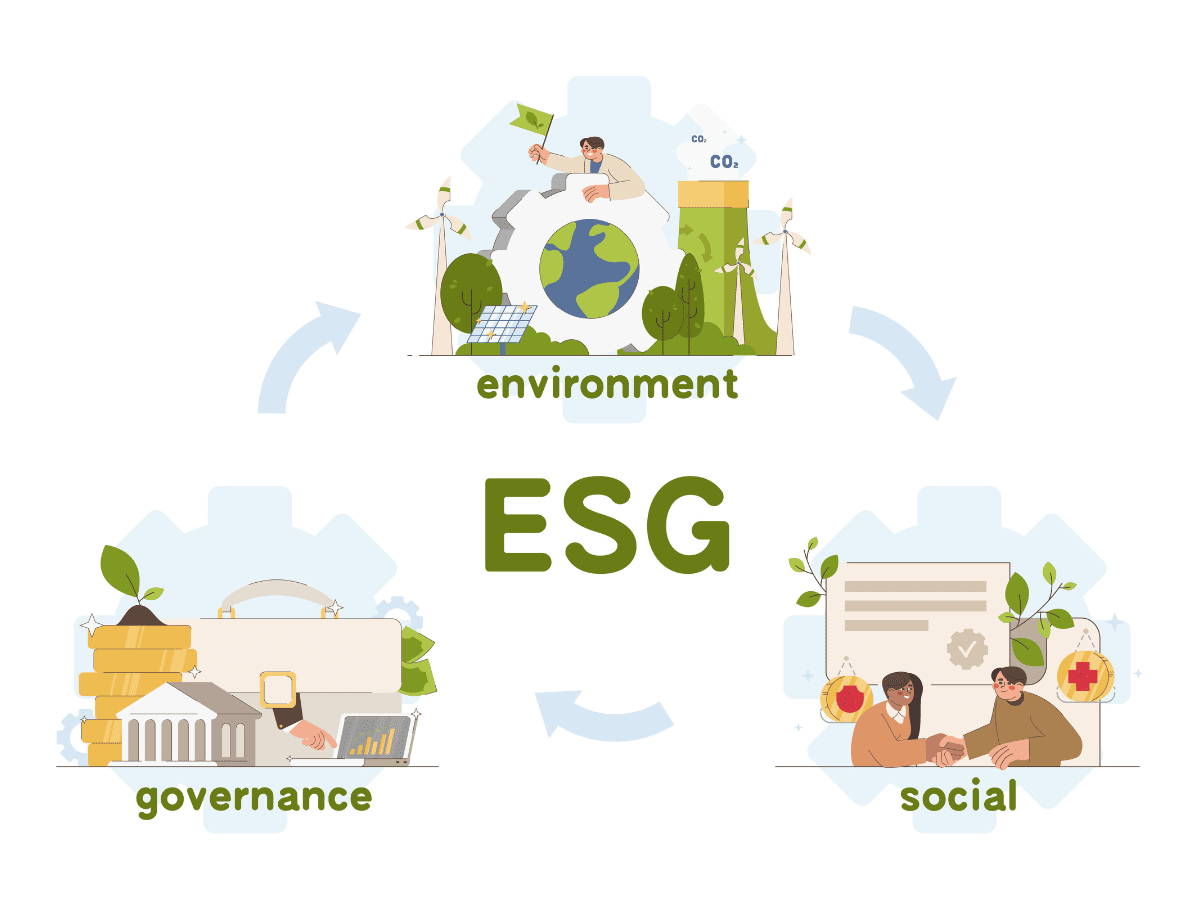
ESG stands for environmental, social, and governance. It is basically a framework that helps measure how responsibly a company operates. Including how it treats the environment, how it supports people, and how well it managed. While it is often talked about in investing, ESG also matters to customers, employees, suppliers, and the community as a whole.
Three Main Pillars of ESG:
Environmental: This involves how a company takes care of the planet. It covers things like climate change, greenhouse gas emissions, deforestation, biodiversity, carbon footprint, waste management, and pollution.
Social: This focuses on the company’s impact on people and communities. It considers diversity and inclusion, human rights, company’s relationships with employees, suppliers, and society at large.
Governance: This is about how a company is run. It includes things like executive pay, succession planning, board management, and protecting shareholder rights.
Benefits of ESG:
Enhanced Reputation: When businesses set clear ESG goals and actually track their progress, it boosts their credibility. Customers and regulators tend to trust them more. This can translate into stronger loyalty and better investor confidence along with smoother relationships with authorities.
Better Risk Management: Keeping an eye on ESG factors helps companies spot potential risks early whether financial, legal, or reputational. This makes it easier to address issues before they grow into bigger problems.
Improved Operational Efficiency: Good ESG practices often optimize operations. Cutting waste and using energy more efficiently can lower costs. For example, reducing energy use shrinks a company’s carbon footprint along with cutting down utility bills and boosts profitability.
Cost Savings: Many ESG-focused changes pay off over time. Sourcing materials more sustainably and improving transportation can make supply chains cheaper and more efficient. Prioritizing worker health and safety also reduces the costs linked to injuries or illnesses.
Stronger Employee Engagement: People want to work for companies that align with their values. When a business actively tracks and improves its ESG performance, it becomes more attractive to employees. This helps keep top talent and build a more motivated team.
Greater Competitiveness: Companies that take ESG seriously often stand out in the market. As consumers and investors look for sustainable choices, strong ESG performance can become a real competitive edge.
Improved Access to Capital: Investors are paying close attention to ESG performance. Companies that prioritize sustainability often find it easier to raise funds, sometimes at lower costs. It can result in long-term growth and profitability.
Sustainability and ESG:
ESG and sustainability are closely connected, but they are not the same thing. Both deal with environmental, social, and governance issues, however they differ in scope and purpose. ESG is more about measuring how well a company performs in these areas, while sustainability is a broader philosophy focused on running a business responsibly and ethically.
ESG is a set of standardized criteria used to assess a company’s impact on the environment, society and its own governance practices. Investors and stakeholders rely on ESG metrics to understand how a company manages issues like carbon emissions and diversity. Meanwhile sustainability, is a wider guiding principle. It is about making decisions that balance environmental health and economic stability. It focuses on long-term responsibility across areas like supply chain management and overall ethical practices.
The main difference is that ESG is a measurement tool, while sustainability is a holistic approach to doing business responsibly. ESG tells you how a company is performing in specific categories, whereas sustainability looks at the bigger picture of how the company operates and the impact it has on the world.