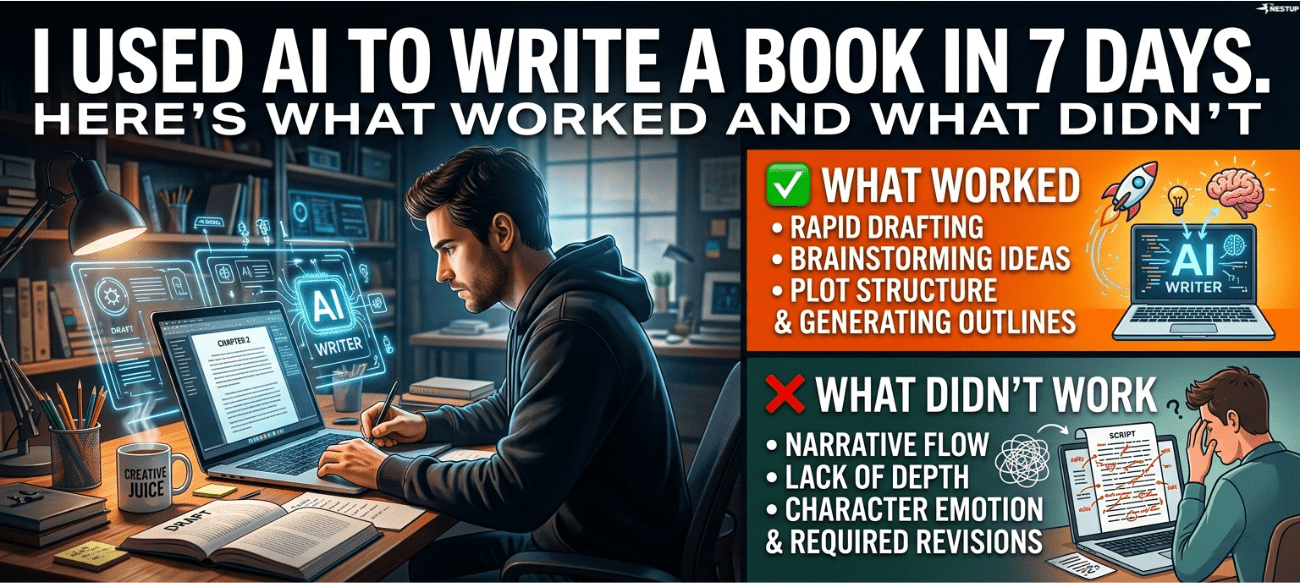
The Hook: An Impossible Deadline
Could AI actually help someone write a full book fast enough to matter? To answer this, I conducted a high-velocity stress test: a seven-day sprint to produce a professional-grade nonfiction book. This wasn’t an exercise in “blind publishing” or letting an LLM run wild. It was a strategic investigation into workflow architecture—specifically, how to integrate AI into research, structuring, drafting, and revision without compromising the “human-in-the-loop” quality standard.
The finding was clear: AI can compress weeks of production into days, but not through autonomous generation. Success requires a shift from being a “writer” to acting as a strategic director. The AI manages the low-level linguistic synthesis, allowing the human to focus on high-level conceptual architecture.
Takeaway 1: AI is an Accelerator, Not an Author
The most significant strategic error a creator can make is viewing AI as a replacement for the author. In this experiment, I leveraged the technology as a research assistant, an outline generator, and a drafting partner—never as the sole decision-maker.
The reality of high-output production is that while the AI handles the mechanical task of expansion, human judgment remains the only non-negotiable component. We are moving toward a model of “Human-directed AI collaboration,” where the human provides the intent and the AI provides the momentum.
AI made the process dramatically faster. Human editing made the result worth reading.
Takeaway 2: The Outline Speed Trap
On Day 1, the AI provided an immediate advantage by building a full chapter hierarchy in hours. Its pattern recognition and framework generation capabilities are unmatched. However, this speed hides a strategic risk: the “Outline Speed Trap.”
Left to its own devices, AI produces outlines that are overly symmetrical, formulaic, and predictable. To avoid a book that felt like a generic Wikipedia entry, I had to intervene with “intentional asymmetry.” I aggressively edited the hierarchy to inject narrative tension and a unique point of view—elements that AI’s “safe” structural tendencies naturally strip away.
Takeaway 3: The Secret Weapon for Writer’s Block
The greatest value of AI in the drafting phase is its ability to radically reduce the “activation energy” required to start. By eliminating blank-page syndrome, the AI provides a psychological acceleration that keeps the project moving.
The workflow was simple: I fed the AI a rough argument or a cognitive map of ideas, and it expanded those bullet points into readable explanations. Because mediocre draft text is significantly easier to edit than empty space, the AI’s primary role was to maintain momentum. It converted raw ideas into a “clay” that I could then mold into a final form.
Takeaway 4: The Fact-Checking Time Sink
The most dangerous discovery of the seven-day sprint was that AI-generated mistakes are rarely outrageous; they are subtle. This creates immense friction in the production cycle. Throughout the manuscript, the AI confidently presented:
- Inaccurate dates that looked plausible.
- Misattributed quotes that sounded like the speaker.
- Synthetic statistics that lacked any basis in reality.
Because these hallucinations were subtle rather than obvious, I could not simply skim the text. Every statistic, citation, and study reference required a deep audit and manual verification. This verification process quickly became the most time-consuming part of the experiment, proving that the time saved in drafting is often paid back in rigorous fact-checking.
Takeaway 5: The High Cost of “Emotionally Flat” Content
AI produces writing that is polished and competent, but it consistently lacks lived experience and genuine tension. This results in a “Genericness Risk”—a strategic market danger where your content sounds like every other AI-generated book on the shelf due to “internet-style sameness.”
In an era of automated abundance, the competitive edge shifts toward human synthesis. Without original insights and memorable storytelling, AI content becomes bloated and repetitive. If a writer doesn’t inject their own “soul” into the machine-generated base, they risk producing a work that is technically correct but entirely forgettable.
Takeaway 6: The Evolution of the Writer’s Role
This experiment confirmed a fundamental shift in our craft: the writer’s role is evolving from “the person who types the sentence” to “the person who shapes the meaning.” As the cost of generating text drops to zero, curation and high-level judgment become the real creative bottlenecks. The central question is no longer “How do I write this?” but “What deserves to stay?”
To manage this, I utilized a four-stage editing stack designed for a “Director” persona:
- Structural Edits: Breaking the AI’s symmetry to improve pacing and flow.
- Voice Refinement: Injecting sharp opinions, humor, and personal perspective.
- Fact Verification: Executing a deep audit of all data points to remove hallucinations.
- Human Polish: Adding the rhythm and storytelling that create emotional resonance.
Conclusion: The Future is Collaborative
The productivity reality of the modern era is that AI helps create content, but only humans can create coherence. By reducing friction and organizing ideas, AI can compress months of labor into a single week. However, the value of the final product is entirely dependent on the quality of the human’s direction and their ability to provide the “connective tissue” that machines currently lack.
The competitive edge in publishing is no longer about the ability to produce words; it is about the strength of your ideas and the uniqueness of your voice. As we move into this collaborative future, we must define ourselves by our judgment rather than our word count.
As the cost of generating text drops to zero, what is the premium you place on the mind that directs it?