Introduction: The Broken Promise of the AI Era
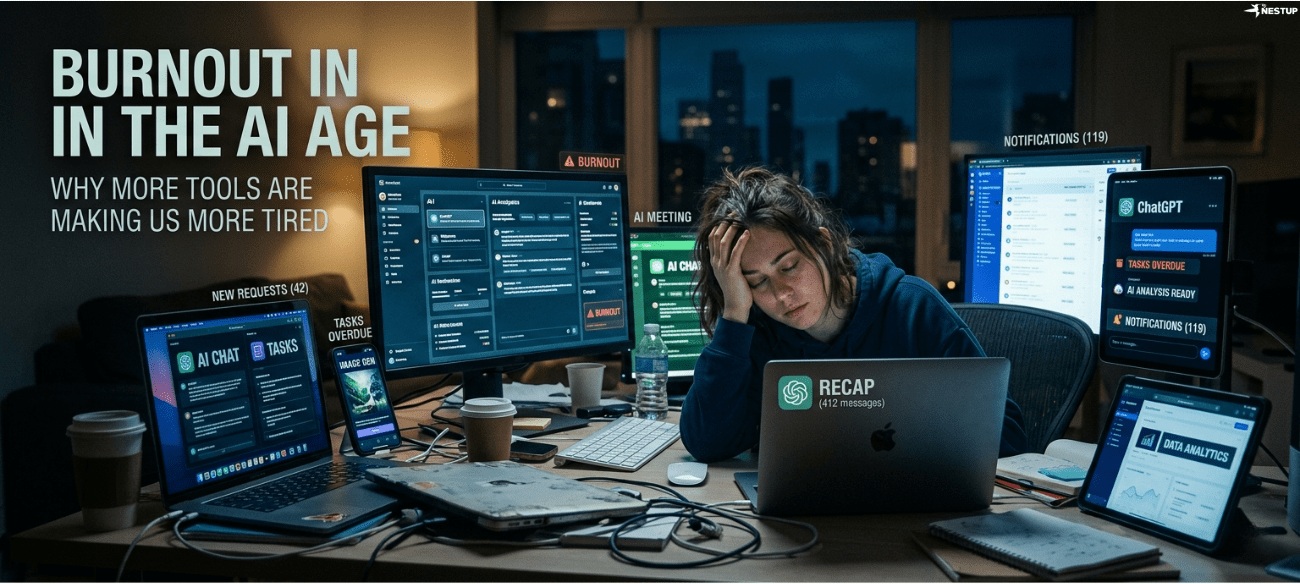
We were promised that artificial intelligence would be the ultimate engine of liberation, a tool to reclaim our most precious resource: time. On paper, the promise is seductive. An AI agent summarizes a missed hour-long meeting in seconds, or drafts a complex project proposal in the time it takes to pour a cup of coffee. But we must dissect the reality behind this “paper promise.” For the modern knowledge worker, that perfectly summarized transcript often represents a new form of debt—it instantly generates five more tasks that didn’t exist ten minutes ago.
As a digital productivity strategist, I observe a widening gap between what AI enables and what the human mind can sustain. We are witnessing a fundamental mismatch: technology is accelerating, but human capacity remains finite. The result is a growing contradiction where efficiency gains are paid for with mental exhaustion. We must move beyond the novelty of “faster” and address why AI is systematically amplifying our workload rather than reducing it.
The Expectation Trap: When Efficiency Expands the Workload
To understand our current exhaustion, we must first recognize the “Productivity Paradox.” In a corporate ecosystem, efficiency is rarely a gift returned to the worker; it is a resource reallocated by the organization. When AI shrinks a four-hour task into sixty minutes, the remaining three hours are seldom reserved for deep thinking or recovery. Instead, they are filled with more volume.
This creates an environment where expectations rise in lockstep with technological capability. We are no longer evaluated on the quality of our effort or the depth of our insights, but rather on our sheer output volume and response speed. In this high-velocity landscape, we find ourselves trapped in a cycle where:
“Efficiency gains don’t reduce workload—they expand it.”
Cognitive Overload: The Mental Cost of Tool Saturation
The average knowledge worker is now drowning in a “tool-saturated” environment. While each individual AI application claims to simplify our lives, the cumulative effect is a staggering increase in “mental friction.” This is best understood through Cognitive Load Theory: the human brain has a strictly limited processing capacity, and every digital interface we touch consumes a portion of that finite energy.
AI tools, despite their technical “ease,” often compromise our performance by:
- Fragmenting attention: The constant ping of AI-driven notifications and the need to monitor automated workflows disrupt the flow state required for high-value work.
- Increasing decision fatigue: Navigating multiple AI interfaces requires a continuous stream of micro-decisions—from prompting styles to output verification—that drain our cognitive reserves.
- Adding complexity: Every new layer of technology added to a workflow requires a new mental model, increasing the daily “entry fee” for simply beginning our work.
The End of the Natural Pause: Understanding Digital Exhaustion
We are entering an era of “techno-stress” and “digital fatigue,” a state of being that goes far beyond simple screen time. Historically, work was punctuated by natural pauses—the time it took to walk to a filing cabinet, wait for a render, or manually draft a memo. AI has effectively engineered these “human moments” out of the day.
When tasks become continuous, work becomes a relentless stream of engagement. As a result, we see the emergence of specific, debilitating symptoms:
- Difficulty focusing on a single, high-stakes task.
- Feeling mentally drained despite performing work that is technically “easy.”
- Reduced satisfaction from completing tasks, as the next one is already queued.
- A pervasive sense of being “always on,” even during traditional rest hours.
This acceleration leads to a haunting realization for many:
“You don’t stop because you’re done. You stop because you’re depleted.”
The Amplifier Effect: Why More Tools Aren’t the Answer
A common strategic error is the belief that more AI tools will eventually solve the burnout caused by current ones. In reality, AI functions as a force multiplier for existing patterns. If your underlying workflow is broken, AI only makes it “faster-but-still-chaotic.”
Speed without direction is just a faster path to burnout. The current crisis of exhaustion is not a lack of technological capability, but a systemic lack of design and boundaries. When we add powerful automation to an environment with unrealistic expectations, we don’t solve the pressure—we merely raise the bar. To reclaim our productivity, we must acknowledge that AI is an amplifier of our current dysfunction, not a cure for it.
The Path to Sustainability: A Strategic Framework for 2026
To remain competitive and healthy in the coming years, we must shift from a mindset of “unchecked acceleration” to one of “intentional design.” This is not just a wellness tip; it is a vital operational framework for the high-performance worker.
- Redefining Productivity: For 2026, we must shift our metrics from volume to impact. Productivity is about doing what matters consistently, not doing everything instantly.
- Building Friction Back In: We must reintroduce small pauses between tasks. These “recovery intervals” are essential for reducing errors and preventing long-term mental fatigue.
- Setting Clear Boundaries: Because AI never sleeps, you must define when you are “offline.” Without firm boundaries, the 24/7 availability of your tools will eventually mandate your 24/7 availability.
- Intentional AI Usage: Target AI specifically at high-friction, repetitive, or low-value tasks. Use it to filter the noise, not to automate your entire professional existence.
Tactical Move: Tool Consolidation One of the most effective ways to lower cognitive load is to centralize your workflow. Instead of scattering your energy across dozens of platforms, seek to reduce the number of interfaces you touch. By streamlining into fewer, more integrated systems, you eliminate the “context-switching tax” that erodes your focus and satisfaction.
Conclusion: From Speed to Sustainability
The fundamental question for the modern era is no longer “How fast can we work?” but rather “How long can we sustain this pace?” AI has effectively solved our technical speed problems, but it has not—and cannot—solve the biological reality of human limits.
The true root cause of our exhaustion is unchecked acceleration. As we move deeper into this AI-augmented age, the primary competitive advantage will not belong to those who can squeeze the most output from every minute. It will belong to those who have the wisdom to know what to ignore and the discipline to maintain their own boundaries against the machine.
Reflecting on your own workflow, where could you benefit from setting a firmer boundary with your digital tools today?