The memory of 2020 remains a jagged scar on the global psyche, a reminder of a "fog of war" era in public health. Back then, our defense was a desperate, reactive scramble: frontline doctors squinting at unusual lung scans, the scratching of pens on bureaucratic paperwork, and the agonizing wait for centralized lab results. By the time the world realized a novel pathogen had arrived, it was already tucked into the overhead bins of international flights, crossing borders at 500 miles per hour.
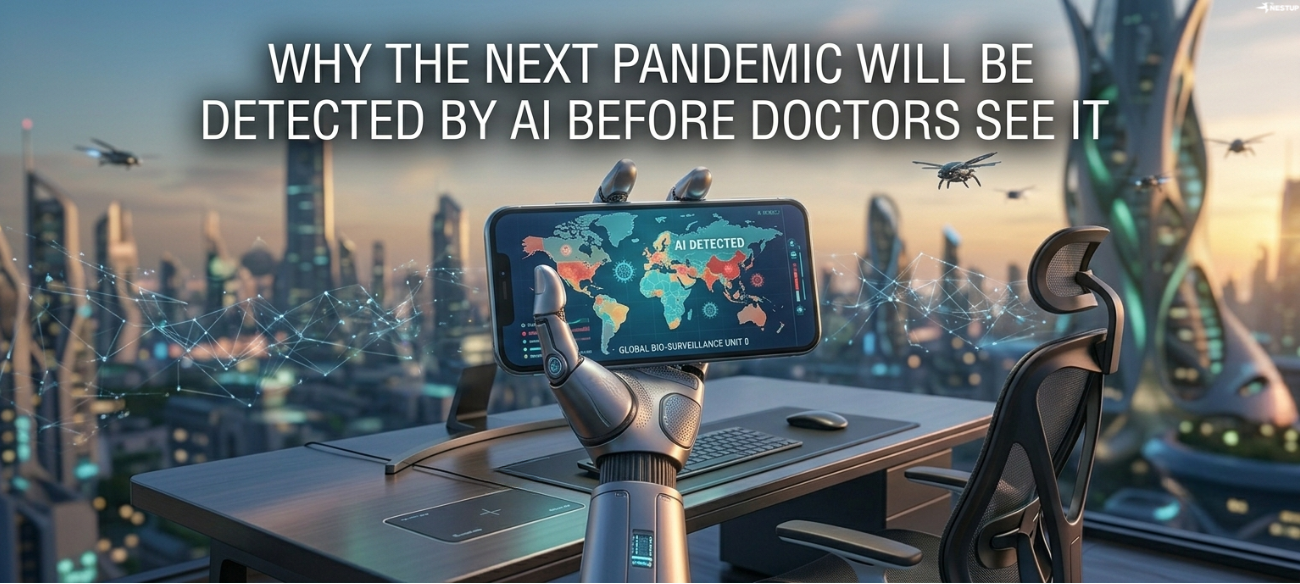
As we move through the late 2020s, that paradigm has been inverted. We have witnessed the birth of a planetary nervous system—a global immune system that operates not in the clinic, but in the "digital exhaust" of our daily lives. The next great plague won’t be announced by an exhausted physician in a crowded ER; it will be quietly flagged by a "Silent Sentinel" days or even weeks before a human patient realizes they are seriously ill.
We are transitioning from a world of reactive medicine to an era of predictive biosecurity, where the front line has moved from the hospital ward to the cloud.
The Early Pioneers: Beating the CDC at Its Own Game
The shift began with a few digital outliers that proved a radical thesis: behavioral data is faster than medical data. In December 2019, while official bodies like the WHO and the CDC were still operating through traditional reporting chains, a Toronto-based startup called BlueDot was already sounding the alarm. Their AI had identified a cluster of "unusual pneumonia" cases in Wuhan, China, successfully predicting the virus's trajectory before the first official warnings were ever drafted.
The breakthrough lay in the use of "unstructured data." While government agencies waited for structured medical charts—which are inherently lagging indicators—AI platforms like BlueDot and Metabiota were scraping thousands of organic data points: local news in dozens of languages, livestock health forums, and commercial flight ticketing data.
They understood that the first signs of a crisis aren't found in a laboratory; they are found in the frantic search for cough medicine, a sudden surge in school absenteeism, or "media chatter" in a regional hub. As the systems evolved, they became master cartographers of human behavior. According to the "Silent Sentinels" report, these early systems succeeded because they were:
"Connecting the dots between a localized spike in media chatter and international travel itineraries, allowing the AI to predict exactly which global cities the virus would land in next."
Beyond Social Media: Multi-Modal Surveillance
Early AI detection was impressive, but it was fragile—vulnerable to digital noise, government censorship, and the chaos of internet rumors. Modern surveillance has solved this by evolving into a "multi-modal" powerhouse that integrates hard biological data with real-time human behavior metrics.
Today’s systems bypass the noise of social media by plugging directly into the infrastructure of civilization through two high-speed channels:
- Sovereign and Private Guardrails: Modern AI models now securely interface with anonymous, regional Electronic Health Records (EHR) networks. Crucially, this is done through secure, sovereign guardrails that protect patient privacy while allowing the algorithm to spot statistical anomalies. If a specific postal code sees a 3% rise in respiratory distress markers, the AI registers a "biosecurity hit" long before any human doctor notices a pattern in their waiting room.
- Satellite and Supply Chain Imaging: We are no longer just watching humans; we are watching the "interface" where wildlife meets civilization. Machine learning tools monitor earth observation data for the precursors of zoonotic spillover. By tracking unexpected deforestation patterns, agricultural shifts, or even increased traffic in hospital parking lots via satellite, AI can map out risk zones where a virus is most likely to jump from animal to human.
The Sewer Sentinel: The Ultimate Genetic Filter
The most profound breakthrough in early detection doesn't happen on a screen or in a clinic—it happens in our urban lifelines. Humans shed genetic material in their waste days before they develop symptoms or feel sick enough to stay home. Wastewater monitoring, once a manual process, has been supercharged into the ultimate genetic tripwire.
The Biology Major transit hubs and municipal districts have deployed sampling robots directly into wastewater lines. These autonomous units continuously extract samples and perform high-throughput metagenomic sequencing on the spot, creating a constant stream of biological data from the entire population.
The AI Filter The challenge of wastewater is the sheer volume of "genetic noise"—billions of lines of DNA and RNA from harmless microbes and food waste. Humans cannot parse this "wall of data" in real time, but machine learning can. As the source context notes:
"Advanced machine learning models handle the heavy lifting, filtering out the baseline genetic noise to spot tiny, mutated anomalies... the moment a highly unusual genetic sequence starts duplicating across a city’s pipeline, the AI triggers an immediate localized alarm."
Invisible Biosecurity: A Silent Digital Cascade
The future of biosecurity is becoming a "silent digital cascade." We are moving away from a world that relies on the intuition of exhausted frontline doctors and toward a future where autonomous biological surveillance networks do the heavy lifting 24/7.
In this interconnected web, the process is seamless: an automated wastewater monitor spots a suspicious genetic signature; transport models immediately map out its probable flight trajectories; and regional clinical networks receive hyper-targeted alerts to start testing for a specific mutation—all before the "Index Case" even steps into an emergency room. The responsibility for global safety has shifted from human observation to algorithmic foresight.
The End of the Pandemic Era?
We are entering an age where the goal is no longer to survive a pandemic, but to ensure the word "pandemic" becomes a historical curiosity. By utilizing AI to monitor everything from our sewage to our satellite-mapped forests, we are building a world where the next outbreak is stopped before it ever has a chance to start.
However, this invisible shield comes with a unique psychological weight. As we hand over the keys of our biological defense to autonomous networks, we must ask ourselves: Are we ready to place our ultimate trust in a silent, algorithmic protector—a defense system that is most successful when we never even know it’s working?