
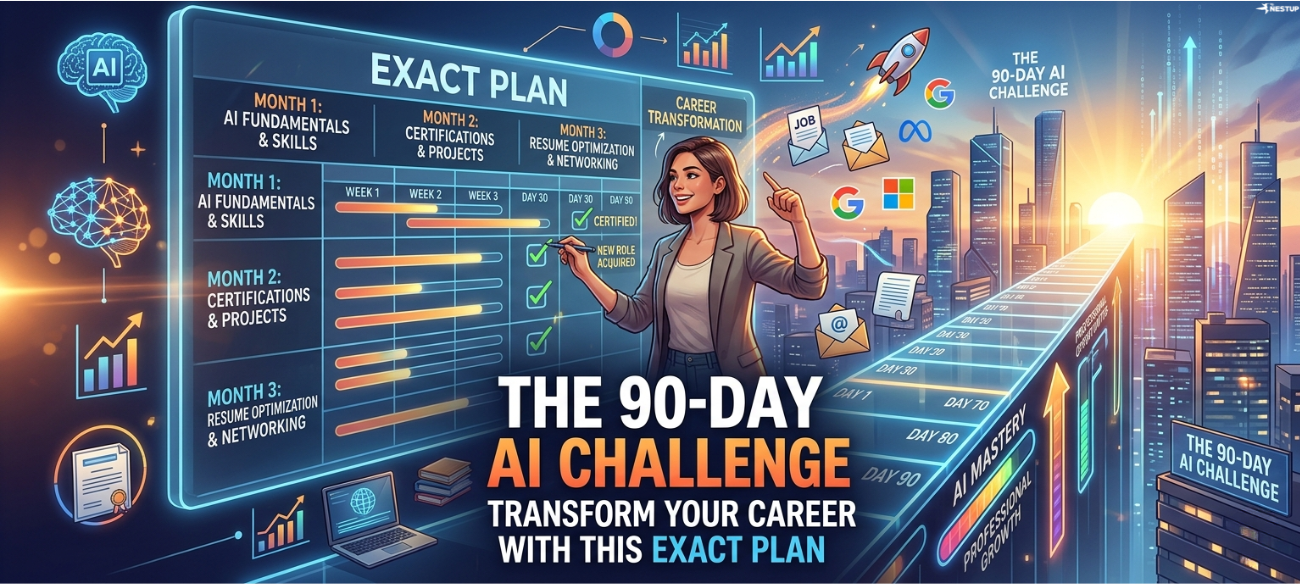
The AI Learning Trap: From Passive Consumer to Active Builder
The professional landscape of 2026 has no room for the "AI-curious"—it only rewards the "AI-native." Most professionals recognize the urgency of this shift but are currently drowning in the "AI Learning Trap." They binge-watch disconnected tutorials and test dozens of "flavor-of-the-week" tools without a clear objective. This isn't learning; it's a sophisticated form of procrastination.
While the "AI-curious" seek theoretical roadmaps that explain what AI might do, high-performers are executing a 90-day plan to secure their economic moat. In the next three years, AI literacy will transition from a niche advantage to a baseline requirement. If you aren't moving from a passive consumer of information to an active builder, you are choosing competitive obsolescence.
The Great Divide: Productivity Multipliers vs. Everyone Else
We are witnessing a brutal bifurcation of the workforce. This is no longer about "AI replacing jobs"—it is about individuals using AI to replace entire departments. AI has become the ultimate productivity multiplier, allowing one person to wield the output capacity previously reserved for full teams.
"The workforce is splitting into two groups: People who use AI effectively [and] people competing against people who use AI effectively."
This divide creates a massive economic leverage gap. Consider the shift:
- Designers now generate high-fidelity concepts in seconds, not hours.
- Lawyers leverage AI assistants to synthesize complex contracts instantly.
- Developers build software at 10x speed using coding copilots.
- Marketers automate entire multi-channel campaign workflows.
The new gold standard for hiring is "domain expertise + AI leverage." Your deep industry knowledge is the foundation, but your ability to amplify that knowledge with AI is what determines your market value.
Prompting is the New Coding (and It Requires a System)
Prompting is the highest-leverage skill of the decade, yet most treat it as a random conversation rather than a structured system. To achieve repeatable, professional-grade results, you must move beyond "chatting" and start building. Consistency in output matters more than intensity of effort.
A professional AI-native system requires mastering specific structures:
- Role Prompting: Defining the precise persona and expertise of the model.
- Chain-of-Thought: Forcing the AI to work through logic step-by-step.
- Context Injection: Feeding the model the exact data it needs for high-accuracy results.
- Iterative Refinement: Polishing outputs through systematic, successive interactions.
- Style Conditioning: Controlling the precise tone and format of the response.
- Structured Output Formatting: Ensuring the AI returns data in specific, usable formats (like JSON or tables) for immediate workflow integration.
The goal is to build reusable templates that turn one-off queries into scalable professional assets.
The Portfolio Paradox: Why Projects Beat Certificates
In the AI economy, knowledge only gains value when it is transformed into visible proof of skill. This is the "Portfolio Paradox": many stay stuck in "learning mode" to feel safe, but certificates are worth less than ever. Proof of execution is the only currency that matters.
By Month 2 of your transformation, you must shift entirely to building. Visible experimentation wins. Your portfolio should showcase:
- AI-powered dashboards for real-time data synthesis.
- Automated research workflows that aggregate market intelligence.
- AI-generated content systems for high-volume, high-quality media output.
- Chatbot prototypes designed to solve specific operational bottlenecks.
Crucially, you must abandon the "silent expert" mentality. Public documentation on platforms like LinkedIn, GitHub, and X (Twitter) is essential. Sharing your experiments, failures, and fixes attracts opportunities faster than any resume.
Technical Fluency Without the PhD
You do not need to be a machine learning engineer to be an AI-native professional. However, you do need "conceptual fluency" to lead AI-driven initiatives. You must understand the mechanics of the tools you use to build effective leverage.
This means mastering a concise set of terminology: APIs, embeddings, context windows, vector databases, fine-tuning, and agents. You don't need to write the underlying code for these, but you must understand how they interact. This fluency allows you to collaborate intelligently and architect workflows that solve real-world problems.
The Closing Window: Why Speed Matters in 2026
There is a high-reward window for those who reposition themselves today, but it is closing. As AI becomes the standard career operating system, the baseline for "standard" performance will skyrocket. The advantage belongs to the first movers.
"The people who benefit most from AI are not necessarily the smartest or most technical. They are usually the fastest adopters."
The transition from a "special skill" to an industry expectation is happening faster than most anticipate. Adopting these tools within a tight 90-day window isn't just a career upgrade—it is a survival strategy.
Conclusion: Beyond the 90 Days
Becoming an AI-native professional is about more than a new toolset; it is a fundamental shift in how you offer value to the world. AI does not replace human ambition; it amplifies it. The next decade belongs to the systems thinkers who view AI as an extension of their own human leverage.
The clock is ticking on your 90-day transformation. If you don't build your system today, you will be forced to work within someone else's tomorrow.
If your current workflow was automated tomorrow, what unique human leverage would you have left to offer?