
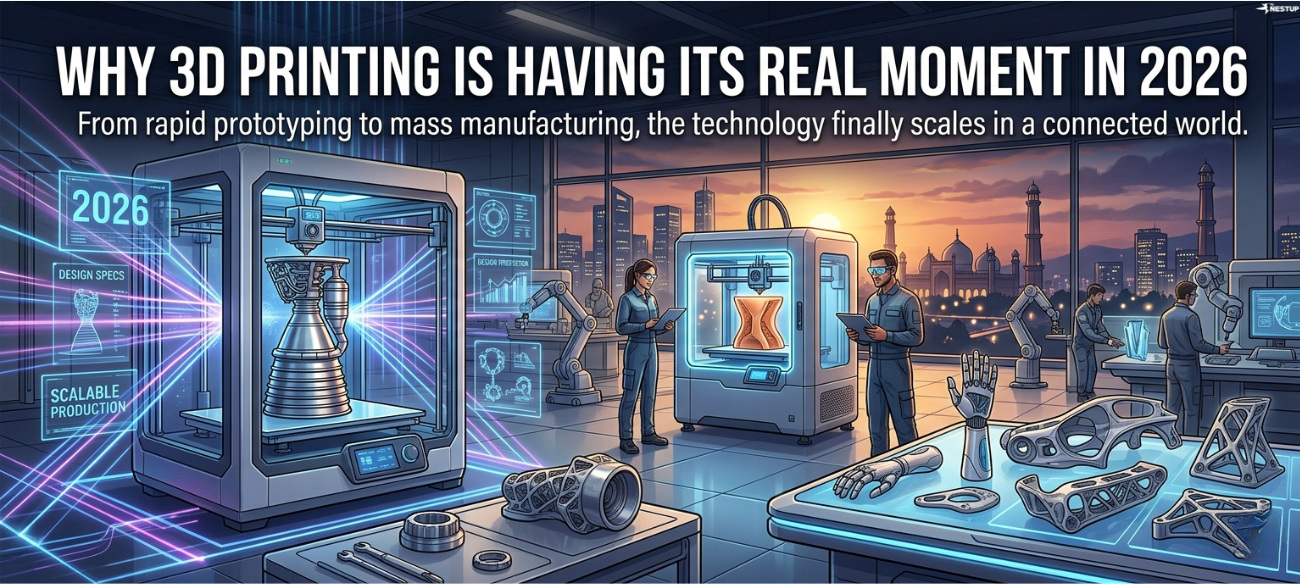
Beyond the Broken Promises
For nearly fifteen years, 3D printing was less an industrial tool and more a victim of its own venture-backed hyperbole. In the early 2010s, the hype cycle suggested a consumer-led utopia where we would download physical products as easily as MP3 files and print entire suburbs in a weekend. When these visions collided with the harsh realities of slow print speeds, limited material science, and punishing unit economics, the technology retreated into a "brutal reality phase."
In 2026, however, the narrative has fundamentally shifted. The momentum we are witnessing is not built on the populist dreams of the past, but on the quiet, industrial maturation of a technology that has finally found its niche. 3D printing has stopped trying to be everything to everyone; instead, it has become an essential infrastructure layer for an era defined by volatility and specialized performance.
The Great Pivot: From Consumers to Components
The most significant shift in the industry’s trajectory occurred when it abandoned the "printer in every home" fantasy to focus on high-value industrial components. By moving away from competing with the scale of traditional mass production, additive manufacturing (AM) found its footing where customization and speed outweigh the sheer volume of a factory line.
In many ways, failing to meet the initial hype was the most productive thing to happen to the technology. It forced companies to move beyond plastic trinkets and address the capital expenditure (CapEx) requirements and precision engineering needed for mission-critical sectors.
"Additive manufacturing is finally finding its real role in the global economy—not as a replacement for all manufacturing, but as a powerful tool for specific industries where customization, speed, supply-chain flexibility, and rapid iteration matter more than sheer scale."
The Supply Chain’s Strategic Necessity
The supply-chain chaos of the early 2020s acted as a catalyst, transforming 3D printing from a prototyping novelty into a strategic necessity. Global manufacturing proved to be remarkably efficient—right up until the moment it broke. This fragility prompted a massive shift from "efficient" centralized systems toward "resilient" localized ones.
By enabling on-demand production of replacement parts, 3D printing allows companies to drastically reduce physical inventory and the associated storage costs. For the defense and aerospace sectors, the ability to print a specialized component at the point of need rather than waiting months for a trans-Pacific shipment has redefined the concept of operational readiness.
Dentistry: The "One-Size-Fits-One" Success Story
While aerospace captures the imagination, the dental industry represents the gold standard for 3D printing’s commercial viability. Companies like Formlabs have led this charge by democratizing professional-grade resin printers for smaller labs, achieving a rare balance of precision and affordability.
Dentistry is the perfect environment for AM because it is inherently a "one-size-fits-one" market. Every patient requires a unique crown, aligner, or surgical guide. Because customization is a functional requirement rather than a premium add-on, the economics of 3D printing align perfectly with healthcare's needs. Here, the technology isn't a replacement for a human—it is an essential tool that allows a single lab to scale its output without losing individual precision.
Generative Design and the "Impossible" Lattice
Perhaps the most exciting development in 2026 is that we are no longer just printing parts; we are printing geometries that were previously "unmakeable." Through generative design—where software creates forms based on specific stress loads rather than traditional manufacturing constraints—companies like Carbon are producing intricate lattice structures that no lathe or mill could ever replicate.
These lattices aren't just aesthetic; they represent a leap in performance-driven engineering. In footwear, they create midsoles with variable energy return; in the automotive sector, they produce lightweight, high-strength brackets. The most profound impact, however, is in aerospace. By using advanced materials like aerospace-grade metals, carbon-fiber composites, and ceramics, engineers are printing complex fuel nozzles and heat exchangers as single units. These parts are significantly lighter and more efficient than their multi-part predecessors, translating into millions of dollars in fuel savings over the lifespan of an aircraft.
AI: The Silent Engine of the 3D Printing Boom
While the hardware—the "robot arms" and laser beds—receives the attention, software is the silent engine of this boom. AI has solved the technical hurdles that plagued the industry for a decade by shifting the "cost of failure" from the physical world to the digital one.
Modern AI systems now simulate structural performance and thermal stresses before a single layer is deposited. By detecting potential defects in real-time and automatically optimizing geometries to reduce material waste, AI has transformed 3D printing into a repeatable, high-yield industrial process. We have moved from a trial-and-error craft to a precision science.
A Reality Check on 3D-Printed Housing
ICON and its contemporaries have captured the public’s imagination by using massive robotic systems to extrude concrete-like materials for residential structures. This approach addresses the modern crises of labor shortages and housing scarcity by accelerating wall construction and reducing job-site waste.
However, a strategist’s perspective requires a reality check: 3D printing is a tool for the construction industry, not a replacement for it.
"The biggest misconception is that a robot prints an entire finished home automatically. In reality, plumbing still needs installation, electrical systems still require labor, and roofing and interiors remain conventional."
While the technology significantly lowers the barrier for affordable housing and disaster relief, it still faces a patchwork of regulatory hurdles and "on-the-ground" complexities that vary by region.
Conclusion: From Science Fiction to Infrastructure
In 2026, 3D printing has finally transitioned from a science-fiction trope to a fundamental layer of our industrial infrastructure. Its value is no longer measured by its ubiquity in our living rooms, but by its essential role in specialized manufacturing and supply-chain resilience.
Challenges remain. Traditional mass production still wins on sheer speed for high-volume commodities, and material science continues to play catch-up with the rigorous certification standards of the medical and aerospace worlds. However, by leaning into what it does best—handling complexity, customization, and localized production—the industry has finally matured.
Final Thought: As 3D printing completes its journey from hype-driven disappointment to an essential industrial tool, which other "failed" technologies of the last decade are currently undergoing their own quiet, pragmatic maturation?