
A Quiet Revolution Is Already Underway
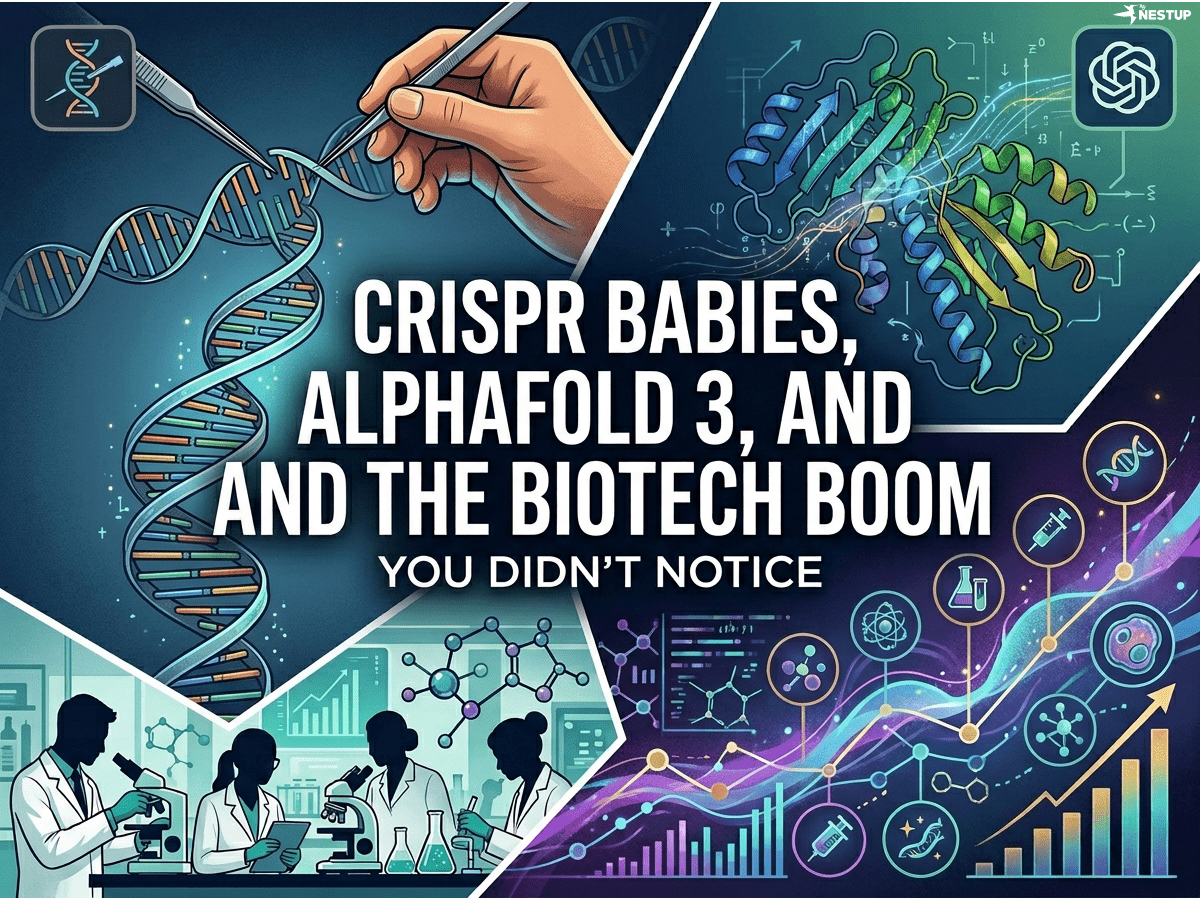
While AI headlines have focused on chatbots and automation, the most profound transformation may be happening quietly in biotech. In 2026, breakthroughs in gene editing, AI-driven drug discovery, and molecular biology are converging into something far bigger than any single technology. The combination of tools like CRISPR and AlphaFold 3 is not just accelerating research—it is redefining how medicine itself is created. The result is a biotech boom that most people haven’t fully noticed yet, even as it begins to reshape healthcare.
CRISPR Moves From Controversy to Clinical Reality
The idea of “CRISPR babies” once sparked global ethical outrage, particularly after early experiments pushed the boundaries of gene editing in humans. That controversy hasn’t disappeared, but the conversation has shifted. In 2026, the real story is not speculative embryo editing—it’s clinical success.
CRISPR-based therapies are now treating serious genetic diseases, including sickle cell anemia and beta-thalassemia. Early trials show patients experiencing long-term relief from conditions that once required lifelong care (crispr-medicine.com). A landmark therapy has already demonstrated the ability to effectively cure these diseases by editing a patient’s own cells and reinfusing them (Live Science). This marks a turning point: gene editing is no longer theoretical—it’s entering mainstream medicine.
The Rise of Real-World Gene Editing Therapies
What makes this moment significant is not just scientific success, but execution. Companies are moving from lab experiments to scalable treatments, building manufacturing pipelines and working through regulatory pathways. Analysts now expect multiple CRISPR-based therapies to receive approvals for inherited diseases in the near term (Innovation Hub Live).
However, challenges remain. These treatments are expensive, complex, and often limited to specialized centers. Long-term safety is still being studied, particularly in younger patients. The science is working—but the system around it is still catching up.
AlphaFold 3: Turning Biology Into Computation
If CRISPR is rewriting DNA, AlphaFold 3 is helping scientists understand it at an unprecedented level. Developed by Google DeepMind, AlphaFold 3 represents a leap from predicting protein structures to modeling entire molecular systems, including DNA, RNA, and drug interactions.
This matters because drug discovery has always been a slow, trial-and-error process. AlphaFold 3 changes that by allowing researchers to simulate how molecules interact before they ever enter a lab. Its predictions are significantly more accurate than previous tools, improving molecular binding predictions by over 50% in some cases (AI온다). What once took years of experimentation can now begin on a computer in minutes.
AI Drug Discovery Is Compressing Time Itself
The impact of AlphaFold 3 is most visible in drug development timelines. Traditional drug discovery can take 10 to 15 years and cost billions. AI-driven pipelines are beginning to compress that timeline dramatically. Companies like Isomorphic Labs are already advancing AI-designed drug candidates into clinical trials, signaling a shift from theory to practice (Singularity Moments).
In some cases, early-stage drug discovery has been reduced from years to weeks, with AI identifying viable compounds in a fraction of the time. This doesn’t eliminate the need for clinical trials, but it dramatically accelerates the most time-consuming early phases of research.
The Convergence: Biology Meets AI at Scale
What makes 2026 different is not just individual breakthroughs, but convergence. CRISPR enables precise editing of genes, while AlphaFold 3 provides a detailed map of molecular interactions. Together, they create a feedback loop: AI identifies targets, and gene editing modifies them.
This convergence is driving a new model of medicine—one that is more personalized, faster to develop, and increasingly data-driven. Biotech is no longer just about biology; it’s becoming a computational discipline, where code and chemistry intersect.
The Ethical Line: From Therapy to Enhancement
As capabilities grow, so do ethical questions. Treating genetic diseases is widely accepted, but editing embryos or enhancing human traits remains deeply controversial. The term “CRISPR babies” still carries weight because it represents a boundary society has not fully agreed to cross.
There are also concerns about access and inequality. Advanced therapies may initially be available only to wealthy patients or countries, creating a new form of medical disparity. At the same time, the power of these technologies raises questions about misuse, regulation, and long-term consequences.
Timeline: What to Expect Next
2024–2025: Foundation Phase
AlphaFold 3 is introduced and rapidly adopted across research labs. CRISPR therapies show strong clinical results, particularly in blood disorders, building confidence in gene editing as a viable treatment approach.
2026–2028: Early Approvals and Scale-Up
Multiple gene-editing therapies are expected to receive regulatory approvals for inherited diseases. AI-designed drugs begin entering early-stage clinical trials, marking the first wave of fully AI-driven medicine.
2028–2032: Mainstream Adoption
Costs begin to decline as manufacturing scales. Gene editing expands into more conditions, and AI-driven drug discovery becomes standard practice across pharmaceutical companies.
Beyond 2032: The Ethical Frontier
The debate shifts from “Can we do this?” to “Should we?” Questions around human enhancement, longevity, and genetic optimization become central to both science and policy.
What Most People Are Missing
The biotech revolution doesn’t feel as visible as AI chatbots or consumer apps, but its impact may be far greater. It operates on longer timelines and deeper systems—healthcare, biology, and human life itself.
The combination of CRISPR and AlphaFold 3 is not just improving medicine; it is changing how we understand and manipulate biology. This is not an incremental shift—it’s a foundational one.
Final Takeaway: A Decade That Redefines Medicine
In 2026, biotech is entering a new phase. Gene editing is moving into clinics. AI is accelerating drug discovery. And the line between biology and computation is disappearing.
The biggest changes are not making headlines every day, but they are happening steadily, building toward a future where diseases are treated at their source—and where the definition of medicine itself is rewritten.